Dream interpretation is the practice of making sense of a dream by translating its images, characters, settings, and emotions into real-life insight. The goal is not to force a single “correct” meaning onto every symbol, and it is not to treat dreams as prophecies. A useful interpretation does something simpler and more practical: it helps you name what you are processing, what you are avoiding, what you are longing for, and what your nervous system is trying to resolve. When you approach dreams this way, the question shifts from “What does this symbol mean for everyone?” to “What does this dream likely mean for me, right now, in the context of my life?”
People search for dream interpretation because dreams feel personal. Even when a dream is strange, the feeling often lingers: anxiety after a chase, sadness after a goodbye, embarrassment after teeth fall out, relief after escaping danger, warmth after seeing a loved one, or dread after a nightmare. Those emotional signatures are rarely random. They are data. In skilled dream work, emotion is not an afterthought; it is the central clue. Your mind can invent any story at night, but it is surprisingly consistent about the feelings it is trying to process.
This guide is written for readers who want a clear method they can use immediately. You will learn how to interpret dreams without superstition and without flattening everything into vague statements. You will also learn why common dreams repeat, why nightmares spike during stressful periods, and how to turn a dream into a small waking-life action that improves clarity and calm.
What dream interpretation actually is
What a good interpretation does
In everyday language, “dream interpretation” means finding the meaning of a dream. In practice, interpretation is closer to translation than decoding. Dreams speak in a symbolic language made of memory fragments, body sensations, emotional themes, and social roles. A good interpretation does not chase a dramatic answer; it gives you an insight that fits your life context and helps you move forward. The most reliable interpretations usually produce a quiet recognition: “That explains why this dream showed up now.”
What dream interpretation is not
Dream work is often misunderstood because people expect a universal dictionary. In reality, the same symbol can point to different themes depending on the emotion in the dream, the situation around the symbol, and your personal history. A dream can also have more than one meaning at the same time. A dream about an ex can reflect attachment patterns, current insecurity, comparison, closure, or an older version of you asking for attention. A dream about death can reflect fear of loss, but it can also symbolize transition, identity change, or the end of an old chapter. A dream about water can represent emotion, cleansing, risk, or surrender depending on tone.
Why dreams feel intense and vivid
Emotion-first dreaming
Many dreams are emotion-first. The plot may be confusing, but the feeling is sharp. That is why you can wake up unsettled even if you cannot explain what happened. Dreams compress life into emotional scenes the way a trailer compresses a movie. The dream mind is not trying to be logical; it is trying to process and simulate.
When vivid dreams increase
Dream intensity often increases when the nervous system is activated. Anxiety, sleep disruption, irregular schedules, late-night scrolling, and conflict before bed can all raise the likelihood of vivid dreams. This does not mean the dream is a warning from outside reality; it often means your system is running “hot” and your mind is trying to process more than it processed during the day. During transitions such as changing jobs, starting or ending a relationship, grieving, or facing uncertainty, the dreaming mind may repeatedly simulate similar challenges until your waking mind catches up.
How to interpret a dream step by step
Capture the dream quickly
Start by capturing the dream while it is fresh. Even fragments are useful. Note the setting, the main characters, the main event, and the ending. Write it in plain language without polishing. The goal is to preserve the emotional shape, not to write a perfect story.
Start with emotion
Name the strongest emotion you felt, not the emotion you think you should have felt. Fear, shame, relief, urgency, longing, anger, and confusion are all valuable. Emotion is the most stable clue because it connects most directly to waking-life experience.
Identify the symbol–action–relationship core
Next, identify the core triad. Choose one primary symbol, one primary action, and one primary relationship role. The symbol is the standout image that carries energy. The action is what the dream is doing, such as running, hiding, falling, searching, arguing, losing, being late, or arriving. The relationship role is who matters emotionally, such as a partner, ex, parent, child, boss, stranger, or crowd. Most dreams become interpretable once the triad is clear.
Connect the dream to waking life
Use three grounding questions. Where does this emotion show up in your life right now? What situation feels out of control, unresolved, or delayed? What change is occurring or needs to occur? These questions pull you away from superstition and toward the living pattern the dream is pointing to.
Choose one to three plausible meanings
Now choose one to three plausible meanings rather than forcing a single meaning. Dreams are rarely single-issue. A chase dream can be about avoidance and also about chronic pressure. A teeth dream can be about self-image and also about communication. A water dream can be about emotion and also about change. Keep meanings specific enough to be useful and flexible enough to respect uncertainty.
Turn insight into one real-world step
Finally, translate the dream into a small waking-life step. Interpretation without action becomes entertainment. Interpretation with action becomes growth. The step can be small: set a boundary, plan one task, have one honest conversation, ask for help, reduce an avoidable stressor, or simplify your schedule for a day. The value of dream work is not in the label you place on a symbol; it is in the clarity you create in waking life.
How to interpret dream symbols without guessing
Use function
Dream symbols are not universal dictionary entries. To interpret symbols with precision, begin with function: what does the symbol do in real life? Teeth chew, bite, and support clear speech; they also affect appearance. A house protects and contains private life. Water flows, cleanses, overwhelms, carries you, and hides what is beneath. A phone connects you, stores memory, provides direction, and offers reassurance. Function gives you a grounded meaning range.
Use feeling
Next, note how the symbol felt in the dream. A dog can feel comforting or threatening. A crowd can feel supportive or judgmental. Water can feel peaceful or suffocating. A snake can feel like danger or like transformation. The emotional tone narrows interpretation quickly.
Use context
Then consider context: what is happening around the symbol? Teeth falling out in a mirror often links to self-image. Teeth falling out while speaking often links to fear of embarrassment or fear of saying the wrong thing. A house that is bright and safe suggests something different than a house with locked rooms, broken walls, or intruders. Context turns a broad symbol into a specific message.
Use personal association
Finally, include personal association. Your brain uses emotional tags attached to memory. If you grew up with strict authority, a teacher figure may carry a different charge than it does for someone who had nurturing mentors. If you were bitten by a dog as a child, a dog may symbolize vigilance. When function, feeling, context, and association point in the same direction, you have a strong interpretation. When they disagree, hold the meaning lightly and return to the waking-life questions.
The dream themes that matter most
Most dream interpretation becomes dramatically easier when you stop chasing one-off symbols and start organizing dreams by “pillar themes.” Pillars are broad topic clusters that match how people actually search, and they also help Google understand your site structure. Use the pillars below to route yourself to the right type of meaning, then refine with emotion, context, and your current life chapter.
Animals
Animal dreams tend to reflect instinct, survival responses, threat detection, and primal needs like safety, territory, and belonging. A calm animal often points to a regulated nervous system or a helpful instinct; an attacking animal often points to boundary pressure, fear, or conflict you feel you must manage. If you want to browse animals by type and scenario, start here: Dream About Animals.
Nature
Nature dreams often reflect change, cycles, and emotional weather. Storms, floods, droughts, forests, mountains, and oceans typically mirror the scale of what you feel you are facing. Nature is also a common way the dream mind signals transition: endings, new beginnings, or periods of uncertainty. Explore the full pillar here: Dream About Nature.
People
People dreams are usually about relationship roles and attachment needs, even when the person is not the “real” focus. A parent may symbolize authority, approval, or responsibility; an ex may symbolize comparison, closure, or vulnerability; a stranger may represent an unknown part of you or uncertainty. If your dreams repeatedly center on relationships, use this hub to choose the right pathway: Dream About People.
Emotions
Some dreams are less about symbols and more about feeling-states: fear, shame, grief, anger, relief, desire, or loneliness. In those cases, interpretation is fastest when you name the dominant emotion first and then ask what in your waking life carries the same charge. If you want to interpret dreams by feeling rather than by object, begin here: Dream About Emotions.
Symbols
Symbol-focused interpretation is useful when one image dominates the dream (teeth, snakes, mirrors, doors, fire, water) and keeps repeating across different plots. The key is to interpret symbols through function, feeling, and context rather than fixed definitions. For a structured library of major symbols and themes, see: Dream Symbols and Meanings.
Objects
Objects in dreams often represent tools, identity markers, communication, and control: phones, cars, keys, money, bags, documents, rings, clothing. When an object breaks, goes missing, or becomes unusable, the dream frequently reflects a real-life fear of losing access, stability, direction, or connection. Browse object-based meanings here: Dream About Objects.
Situations
Situation dreams are the most “story-like” dreams: being chased, being late, missing a flight, getting lost, failing an exam, being trapped, being exposed, arguments, accidents. These dreams usually mirror pressure patterns and coping styles, not literal predictions. If your dreams are mainly scenarios, this is the best starting point: Dream About Situations.
Common dreams and what they often reflect
Common dreams matter for two reasons. First, they represent patterns shared across human life: stress, uncertainty, social judgment, attachment, and transition. Second, they provide a practical shortcut. If you recognize your dream as a common dream theme, you can interpret it faster, then personalize it based on your life context. Internal guides are provided only here so you can go deeper when a theme fits.
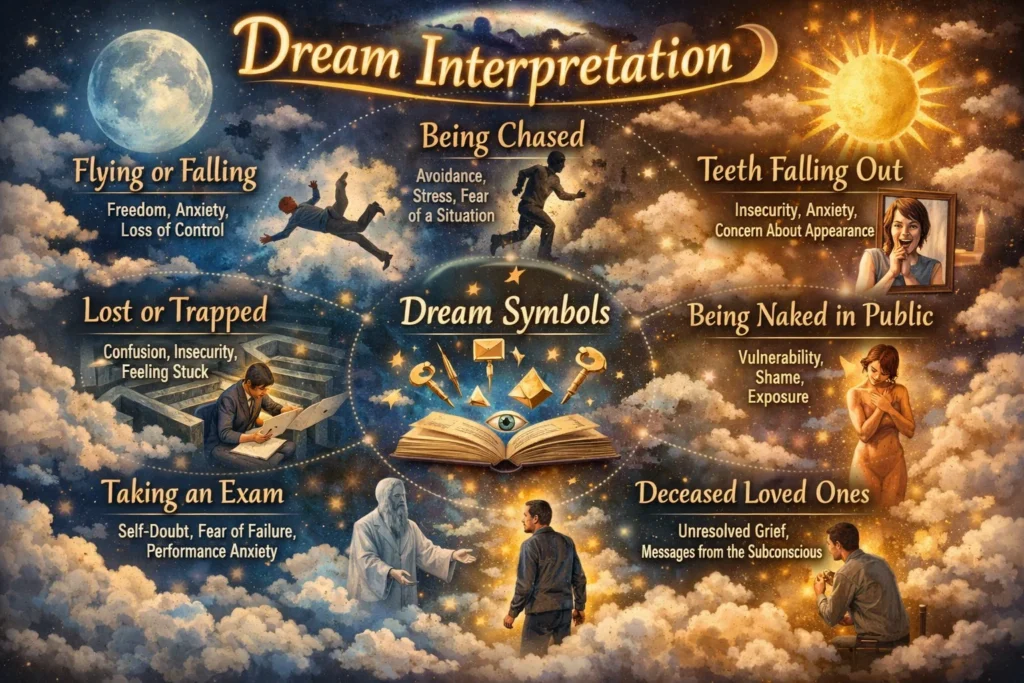
Teeth falling out
Teeth falling out is one of the most searched dream meanings because it often lands with embarrassment, panic, or helplessness. In many cases, this dream reflects anxiety about self-image, fear of being judged, fear of saying the wrong thing, or the feeling that something is slipping out of your control. It frequently appears during transitions where you are exposed to evaluation, such as interviews, presentations, relationship uncertainty, or social pressure. For scenario-specific meanings and practical next steps, see: Dream About Teeth Falling Out.
Being chased
Being chased is another high-volume dream because it captures a universal emotional pattern: avoidance under pressure. Chase dreams often reflect a situation you do not want to face, a conversation you keep delaying, a responsibility you feel unprepared for, or a consequence you fear. The question is rarely “Who is chasing me?” and more often “What am I trying not to feel or admit?” When the chaser is unknown, the theme is often generalized stress. When the chaser is a specific person, the theme may involve conflict, guilt, or power dynamics. For variations by chaser type and context, explore: Dream About Being Chased by Someone.
Snakes
Snake dreams can mean fear and warning, but they can also point to transformation, vigilance, boundaries, temptation, or healing. The interpretation depends heavily on emotion and context. A snake that is hidden can reflect an unspoken issue, a fear you do not want to name, or a situation where you do not fully trust what is beneath the surface. A snake that is calm can reflect the need to respect instinct and wisdom. A snake in water blends emotional overwhelm with boundary themes and can be a signal to slow down and pay attention to what your feelings are telling you. For a focused scenario, see: Dream About Snake in Water.
Pregnancy
Dreams about pregnancy often confuse people because they assume the meaning must be literal. In dream work, pregnancy frequently symbolizes a developing chapter, a new responsibility, a project that needs protection, or a self that is growing. The dream may show excitement, fear, timing anxiety, or worry about readiness. Even when a person is not trying to conceive, pregnancy dreams can appear during creative seasons, career changes, or new commitments. For scenario-based meanings and grounded steps, see: Dream About Pregnancy.
Baby
Baby dreams often revolve around vulnerability and care. A baby can symbolize a new part of you, a fragile opportunity, a need for nurturing, or a responsibility you fear you might mishandle. If you are holding the baby safely, the dream can reflect protective love or readiness. If you lose the baby, forget the baby, or cannot find the baby, the dream often reflects anxiety, overload, or fear of failing at something important. For a deeper breakdown, see: Dream About Baby.
Husband or spouse
Dreams about a spouse or husband often reflect partnership roles, emotional security, and expectations. Even if you are not married, the “husband” symbol can represent commitment, duty, protection, stability, or the fear that stability is changing. Dreams can surface hidden resentment, unmet needs, or a desire for reassurance. When you interpret these dreams, look at what the relationship role is doing in the dream, not just who the person is in waking life. For a focused guide, see: Dream About Husband.
Parents
Dreams about parents often trigger strong emotion because parents represent roots, authority, identity formation, and early attachment. A parent in a dream can reflect your need for approval, your fear of disappointing someone, your sense of responsibility, or an old rule you still live by. Sometimes the dream is about unfinished conversations, grief, or the desire to feel protected again. For context-rich interpretations, see: Dream About Parents.
Romantic partner roles
Dreams about a girlfriend or boyfriend often reflect reassurance needs, trust concerns, fear of losing connection, jealousy triggers, or the desire to feel chosen. These dreams are especially common during uncertain seasons or after emotionally charged conversations. If you want to compare scenario patterns, you may also read: Dream About Girlfriend and Dream About Boyfriend.
Falling
Falling dreams often reflect instability, loss of control, performance pressure, or a fear that something in life is slipping. If you wake with a jolt, the dream may also be influenced by sleep physiology; the interpretation still depends on what in your life currently feels unstable or fast-moving.
Cheating
Cheating dreams often feel like a direct message, but many are about insecurity, vulnerability, comparison, or fear of abandonment. Ask what you need more of right now: reassurance, clarity, boundaries, or honest communication. Also ask whether there is a wider theme of trust, not necessarily evidence of betrayal.
Drowning or being unable to breathe
Drowning dreams often reflect overwhelm, emotional overload, or the fear of being pulled under by responsibility. They can appear when you are taking on too much, delaying rest, or ignoring a body signal that you need to slow down.
Getting lost or missing a train
Dreams about being lost, missing a train, or arriving late often reflect fear of missing an opportunity, anxiety about timing, or pressure to perform. They can also appear when you feel uncertain about direction and need a clearer plan.
Recurring dreams: why they repeat and how to respond
Why recurring dreams repeat
Recurring dreams tend to repeat for one core reason: the underlying emotional pattern is still active. Your dreaming mind returns to the same theme because something remains unresolved or unintegrated. This is not punishment; it is persistence. The dream is saying, “This still matters.” Recurring dreams often appear during seasons of chronic stress, when you are stuck in an avoidance loop, when you carry responsibility without support, or when a decision is delayed. They can also repeat when your nervous system remains activated, such as during burnout, anxiety, or major instability.
How to work with a recurring dream
Start by identifying the repeating emotion and repeating action. Is it running, hiding, failing, losing, being late, being trapped, or being judged? Then identify the waking-life trigger. What is ongoing right now that makes you feel similar? A recurring exam dream is often linked to performance pressure and evaluation. A recurring chase dream is often linked to avoidance and pressure. A recurring “lost in a building” dream is often linked to uncertainty about direction. Next, change one input and one behavior. The input can be sleep hygiene, late-night stimulation, conflict before bed, caffeine, or overall stress load. The behavior can be a boundary, a conversation, a plan, a decision, or an ask for help. Recurring dreams often soften when your waking system feels safer.
Re-scripting the ending
One highly effective technique is to re-script the ending before sleep. Imagine a new ending that contains competence and safety. If you are chased, imagine turning to find help, locking a door, or confronting the chaser with calm. If you are failing an exam, imagine asking for instructions and completing one section successfully. If you are trapped, imagine finding an exit or calling someone. This is rehearsal. You are training the brain to practice a different response.
Nightmares and stress dreams
Why nightmares happen
Nightmares can be terrifying, but they are often understandable. Many nightmares are stress dreams: the mind’s way of signaling overload and rehearsing threat. Common nightmare themes include being chased, being attacked, losing a loved one, being trapped, falling, or public humiliation. The details vary, but the emotional logic is consistent: danger, helplessness, urgency, and loss of control.
How to reduce nightmares
When nightmares increase, treat them as a stress meter. Look at what changed in your life: sleep schedule, work pressure, relationship conflict, health anxiety, or a season of unpredictability. Also look at what changed at night: heavy meals late, alcohol, late caffeine, stimulating content, doomscrolling, or arguments before sleep. To reduce nightmares, focus on safety cues. Create a wind-down routine that includes lower light, less stimulation, and a consistent sleep window. Avoid intense emotional content close to bed. If your mind runs, write the main worry and one realistic plan step for tomorrow; it signals to the brain that you have a plan. If nightmares are frequent, highly distressing, or connected to traumatic memories, professional support can be valuable.
A simple dream journal practice that improves accuracy
A 60-second template
Dream interpretation improves rapidly when you track patterns instead of interpreting one dream in isolation. A short daily practice is enough. When you wake up, write a title for the dream, name the dominant emotion, and write the symbol-action-relationship triad. Then write one to three plausible meanings in plain language. Finally, write one small action you will take today, even if it is simply resting more, setting a boundary, or having a conversation.
What to track over time
Over time, you will notice your personal dream vocabulary. You may realize that water appears when you feel emotionally overloaded, that being late appears when you are afraid of disappointing someone, that exams appear when you feel evaluated, or that certain people appear when you are needing reassurance. This personal dictionary is more accurate than any universal list.
Mistakes that make dream interpretation less helpful
The most common mistakes
The most common mistake is treating symbols as fixed definitions. Dreams do not work like that. Another mistake is skipping emotion and interpreting the plot literally. The plot is often bizarre; emotion is often honest. A third mistake is relying on fear-based interpretations that insist something bad will happen. If an interpretation makes you feel doomed, it is usually low quality. A fourth mistake is ignoring your current life chapter. Without context, interpretation becomes guessing. A fifth mistake is over-literalizing relationship dreams. Dreams about cheating, abandonment, or rejection are often about vulnerability and the need for reassurance, not prediction.
What a helpful interpretation should feel like
A helpful interpretation should leave you with clarity, self-understanding, and a small step forward. If it only leaves you anxious, revisit the method: emotion, triad, context, and action.
FAQs about dream interpretation
What does dream interpretation mean
Dream interpretation means translating dream imagery into emotional and practical insight. You look at the symbols, actions, and relationships in the dream, then connect them to your current life context.
How do I interpret my dreams accurately
Start with the strongest emotion, identify the key symbol and action, connect the feeling to a waking-life trigger, then choose a few plausible meanings instead of forcing one definition. End with one practical step.
Do dreams predict the future
Most dreams reflect your inner world rather than literal future events. Dreams often forecast feelings and expectations more than external facts.
Why do I keep dreaming about the same person
Usually because the person represents an emotional theme: safety, rejection, guilt, longing, authority, or closure. Sometimes it also reflects increased contact or stress around that relationship.
What do recurring dreams mean
Recurring dreams often mean an emotional pattern is still active, such as chronic stress, boundary issues, delayed decisions, or nervous system activation.
Why do I have nightmares
Nightmares commonly increase with stress, sleep disruption, anxiety, or trauma triggers. They can be treated as a signal to reduce stimulation and increase safety cues.
How can I remember my dreams better
Improve recall by writing immediately upon waking, keeping a note nearby, and maintaining a consistent sleep schedule. Dream recall often worsens with sleep disruption.
Is dream interpretation psychological or spiritual
It can be either depending on your beliefs. A grounded approach starts with emotion, stress, relationships, and life context, and treats spiritual meaning as an additional layer rather than a substitute for real-life action.
Conclusion
Dream interpretation becomes reliable when you stop chasing fixed definitions and start working with what dreams consistently offer: emotion, symbols with function, and themes connected to your life context. Begin with the feeling, name the key symbol and action, ask what in your waking life carries a similar emotional charge, and choose one to three meanings that fit. Then take a small action. When you do this consistently, dreams shift from confusing movies into useful feedback. You may still have strange dreams, but you will meet them with clarity rather than fear.
Dream content is for informational and self-reflection purposes only and is not medical or mental health advice. If dreams cause ongoing distress or sleep disruption, consider professional support.