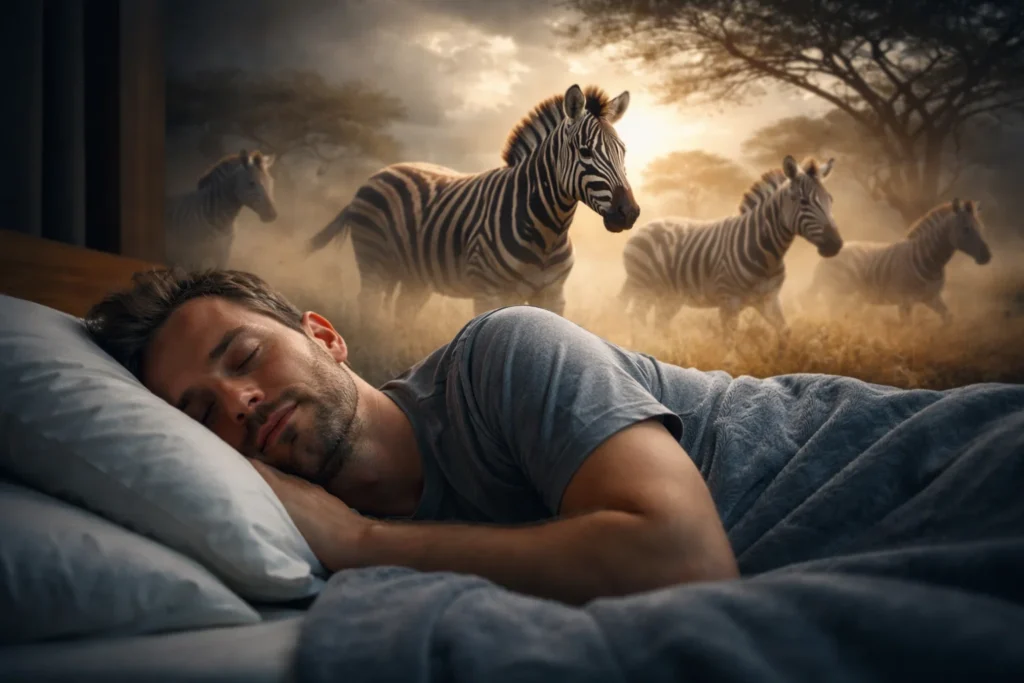
Dreaming about zebras can feel vivid even when the dream itself is quiet. Their black and white stripes make them instantly recognizable, but that strong visual contrast is also what gives them such rich symbolic meaning in dreams. A zebra is both familiar and unusual, beautiful yet wild, social yet difficult to fully tame. If a zebra appears in your dream, your inner world may be exploring themes like identity, balance, individuality, freedom, contrast, belonging, and the challenge of staying true to yourself while moving through a larger group or system.
Quick Answer
Dream About Zebras meaning usually relates to identity, balance, individuality, contrast, freedom, and the tension between fitting in and standing out. A zebra in a dream can symbolize the need to honor your unique nature while still finding your place among others. Depending on the dream’s mood and setting, it may reflect self-expression, emotional complexity, the search for inner harmony, the desire for independence, or uncertainty about how you are seen by the world.
Core Symbolism of Zebras in Dreams
Zebras are powerful dream symbols because they combine familiarity and uniqueness in one striking image. At first glance, a zebra resembles a horse, yet it is unmistakably its own creature. That makes it a strong symbol of individuality. In dreams, the zebra often appears when the subconscious is exploring how you define yourself, how you are perceived, and how comfortable you are with being distinct.
At a foundational level, the zebra represents contrast. Its black and white stripes naturally evoke opposites: logic and emotion, safety and risk, conformity and uniqueness, closeness and independence. Because of this, a zebra dream often emerges during times when life feels divided or emotionally layered. You may be trying to reconcile competing parts of yourself rather than choosing only one side. In this sense, the zebra can become a symbol of integration rather than conflict.
This visual duality also creates a strong connection with Dream About Stripes, where patterns, repetition, contrast, and the way identity is visually or symbolically marked can become important themes. In zebra dreams, the stripes are rarely just decorative. They often reflect what makes you recognizable, separate, protected, or difficult to categorize.
Because zebras are part of the equine family, they may share symbolic ground with Dream About Horses, especially around movement, vitality, instinct, and freedom. But the emotional tone is usually different. Horse dreams often emphasize power, speed, desire, and momentum. Zebra dreams tend to focus more on uniqueness, wild nature, social belonging, and the need to preserve an authentic identity.
Culturally, zebras are associated with the wild, with natural beauty, and with a form of order that is not forced but innate. No two zebras have exactly the same stripe pattern, which deepens their symbolism around individuality. In dreams, this can point to the truth that you may belong to a group, family, or community without being identical to those around you. The zebra does not erase itself to belong.
Emotionally, zebras may symbolize the part of you that is not easily simplified. You may be someone who carries contradictions: gentle but strong, private but expressive, sociable yet fiercely self-directed. The dream may be affirming that complexity rather than asking you to flatten yourself into something easier for others to understand.
Archetypally, the zebra can be seen as the balanced outsider. It belongs to a herd, yet it remains unmistakably individual. This makes it a meaningful dream image during periods of self-definition, social adjustment, creative development, or any stage of life where you are asking how to remain true to yourself without losing connection to others.
Spiritual Meaning of Dreaming About Zebras
Spiritually, dreaming about zebras often points to harmony within duality. The zebra suggests that your life may not need to become simpler in order to become more meaningful. Instead, it may be inviting you to hold opposites with greater grace. Light and shadow, movement and stillness, individuality and belonging can coexist. The spiritual message of the zebra is often not about choosing sides, but about learning how to live more whole.
This dream may arise when you are being called to honor your true nature more openly. Spiritually, the zebra can symbolize authenticity without aggression. It does not need to become something else in order to be accepted by life. In the same way, your dream may be inviting you to stop forcing yourself into roles, expectations, or identities that feel disconnected from your deeper self.
The zebra also carries a gentle lesson about natural design. Its pattern is not random, and it is not ashamed of being visibly different. In spiritual terms, this can reflect the idea that what makes you distinctive may also be part of your purpose. The dream may be encouraging you to stop treating your differences as problems and start seeing them as part of your deeper pattern.
Because zebras live in the wild and move within broader natural systems, the dream can also symbolize the soul’s desire for space, truth, and freedom from artificial pressure. If waking life feels overly controlled, performative, or rigid, a zebra may appear as a reminder to reconnect with what feels honest and alive. This is one reason the symbol can resonate with Dream About Freedom, where the deeper issue is often not escape for its own sake, but the recovery of authentic movement and inner permission.
If the zebra in the dream feels calm, the spiritual message may be about balance and self-acceptance. If it feels elusive or distant, you may be searching for a truer version of yourself that has been hidden under expectation, fear, or habit. Either way, the dream usually points to wholeness through honesty.
A Related Bible Verse
A fitting Bible verse for this symbol is Psalm 139:14: “I praise you because I am fearfully and wonderfully made.” This verse connects naturally to zebra symbolism because the zebra’s uniqueness is part of its very nature.
Applied to dream interpretation, this verse encourages a reflective view of identity. Dreaming about zebras may be a reminder that difference is not deficiency. What sets you apart may also be what makes your life meaningful and recognizable. The dream can gently invite you to respect your design rather than constantly measuring yourself against other people.
Psychological Interpretation
Psychologically, dreaming about zebras often reflects identity formation, self-perception, social belonging, and the management of contrast within the personality. This dream symbol tends to appear when the mind is processing how you relate to groups, how you express individuality, and how comfortable you are with complexity.
One common interpretation is that the zebra reflects the struggle between fitting in and standing out. Many people want connection but also fear losing themselves in relationships, institutions, workplaces, or social expectations. The zebra becomes a strong psychological symbol here because it moves with the herd while remaining visibly distinct. The dream may be exploring whether you are finding that balance or feeling pulled too far in one direction.
The black and white pattern can also reflect binary thinking or the tension between opposites. You may be seeing life too rigidly, dividing things into success or failure, acceptance or rejection, freedom or obligation. In that case, the zebra does not merely symbolize contrast. It may challenge simplistic thinking by showing that different elements can coexist within one living whole.
This is where the dream can connect meaningfully with Dream About Balance. The zebra’s symbolism is not only about difference. It is about patterned difference that still forms a coherent identity. Psychologically, that can point to emotional regulation, self-integration, and the acceptance of paradox within the self.
The emotional tone of the dream matters a great deal. A peaceful zebra may reflect growing self-acceptance and comfort with your individuality. A frightened zebra may suggest vulnerability around visibility, judgment, or social comparison. A trapped zebra may symbolize feeling constrained by roles that do not fit your nature. A running zebra may reflect instinctive movement toward freedom, self-expression, or escape from psychological pressure.
From a Jungian viewpoint, the zebra may represent an individuation symbol. Individuation involves becoming fully oneself rather than unconsciously conforming to collective norms. In this sense, the zebra may appear when the psyche is trying to help you differentiate from external expectations and live from a more authentic center.
At the same time, the dream may reveal social anxiety or fear of being misunderstood. People who feel “different” often carry a subtle tension between the desire to be seen and the wish to remain protected. A zebra dream can bring that tension into focus. It may ask whether you are hiding your real nature to maintain acceptance, or exaggerating your difference because belonging feels risky.
This dream can also reflect identity transitions. New jobs, new communities, changing relationships, creative reinvention, gender expression, spiritual growth, or simply moving into a more mature version of yourself can all trigger zebra symbolism. In such cases, the dream is not only about who you are. It is about how you are becoming recognizable to yourself.
The broader emotional field of the dream may also connect with Dream About Identity, especially if the zebra’s presence feels deeply personal rather than merely visual. In that context, the dream may be asking who you are beneath labels, expectations, and roles.
Common Dream Scenarios About Zebras
Dream of Seeing a Zebra
Seeing a zebra in a dream often symbolizes recognition. You may be noticing a part of yourself that stands out, or becoming more aware of contrasts in your life that need integration rather than denial. The dream may also reflect admiration for uniqueness, either in yourself or in someone around you.
Dream of Riding a Zebra
Riding a zebra can symbolize trying to direct or manage your unique nature. This may be a positive sign if the ride feels smooth, suggesting that you are becoming more comfortable guiding your individuality with confidence. If the ride feels unstable, the dream may show tension between control and authentic instinct.
Dream of a Zebra Running Free
A zebra running freely often symbolizes liberation, self-expression, and movement toward a more honest life. This dream may appear when you are longing to escape restrictions or when part of you is already moving toward greater authenticity. The image can be especially powerful during life transitions.
Dream of a Zebra in a Cage or Zoo
A zebra confined in a cage often represents a unique part of yourself that feels restricted, observed, or misunderstood. You may be living under expectations that do not fit your nature. The dream may ask whether you are being admired from the outside while feeling inwardly trapped.
Dream of Many Zebras
Many zebras can symbolize social identity, group belonging, or the experience of being part of a larger system while still maintaining your own pattern. This dream may reflect communities, family roles, workplace culture, or peer dynamics. It may also ask whether you feel connected without losing your individuality.
Dream of a Baby Zebra
A baby zebra often symbolizes a developing identity, a new stage of self-expression, or a vulnerable but promising part of yourself that is still growing into its full shape. This can be a meaningful dream during periods of reinvention, recovery, or personal discovery.
Dream of a Zebra Attacking or Acting Wild
An aggressive zebra may symbolize the frustration that arises when individuality is suppressed for too long. The dream can suggest that your need for autonomy has been ignored or that a part of you resists being controlled. Because zebras are wild by nature, this scenario may reflect a tension between outward adaptation and inner instinct.
Dream of Touching or Caring for a Zebra
Touching a zebra may symbolize intimacy with your own difference. Caring for one can suggest that you are learning to protect and nurture a unique side of yourself rather than treating it as inconvenient or strange. This can be a healing image during times of self-doubt.
Dream of a Zebra on Safari
A zebra seen during a safari often symbolizes perspective. You may be observing the wild, instinctive, and truthful parts of life from a slight distance. This scenario can suggest curiosity about your own deeper nature, especially when it connects with environments of exploration such as Dream About Safari.
How This Dream Connects to Your Real Life
Love and Relationships
In relationships, dreaming about zebras often reflects the challenge of staying authentic while building closeness. You may be asking whether a relationship allows you to be fully yourself or whether you are adjusting too much in order to keep the peace. The zebra reminds you that real connection should not require self-erasure.
If you are in a relationship, the dream may point to differences that need to be respected rather than fixed. Two people do not have to be identical to be compatible. In fact, the zebra often symbolizes the beauty of distinctiveness within partnership. If the dream feels tense, however, it may show that one person’s individuality is being overlooked or misunderstood.
If you are single, the dream may reflect your standards around authenticity. You may be less interested in being chosen by everyone and more interested in being known accurately by the right people. That is an emotionally mature shift, even if it sometimes feels lonely.
Career and Money
In work life, zebra dreams can relate strongly to questions of professional identity. You may be wondering how to stand out without being isolated, how to contribute to a team without losing originality, or how to build a career that fits your real nature rather than just your expected role.
This dream can also appear when you are in environments that reward conformity. A zebra in that context may symbolize your discomfort with being flattened into sameness. Financially, the dream may reflect choices between secure but restrictive paths and more independent, self-directed ones. The message is rarely reckless. It is more about alignment than rebellion.
Personal Growth
On the level of personal growth, dreaming about zebras often signals individuation. You may be entering a stage where external approval matters less than self-recognition. The dream can affirm that your differences are not obstacles to growth but part of its shape.
This may involve accepting contradictions within yourself. You can be both ambitious and gentle, social and private, disciplined and creative. The zebra does not force you to choose only one stripe. It symbolizes the possibility of a fuller identity that includes different dimensions without collapsing into confusion.
This is one reason the zebra can resonate with the broader symbolic field of Dream About Wild Animals, where instinct, truth, and untamed aspects of the self often come forward more clearly. In zebra dreams, those wild qualities are often less about danger and more about authenticity.
Health and Emotional State
From a health and emotional standpoint, zebra dreams may appear when you feel pulled in different directions or pressured to simplify yourself in ways that create inner strain. Emotional health often depends on being able to live in alignment with your own nature. If your outer life has become too rigid, false, or socially performative, the dream may be reminding you that internal balance matters.
If the zebra appears healthy and free, the dream may reflect increasing emotional coherence. If it seems stressed, trapped, or separated from others, you may be feeling disconnected from your true rhythm. The message is often not dramatic. It is simply a call to return to a life pattern that feels more honest.
Is Dreaming About Zebras a Positive or Warning Sign?
Dreaming about zebras can be very positive when the symbol reflects self-acceptance, freedom, uniqueness, integration, and healthy social belonging. A peaceful zebra may affirm that you are learning to live more honestly and more comfortably within your own nature. It can also suggest that you are finding balance between independence and connection.
At the same time, the dream can act as a warning sign when it reveals identity confusion, social pressure, emotional rigidity, or the feeling of being trapped inside a role that does not match who you are. A caged or distressed zebra may be showing that your individuality is being constrained or that you are experiencing too much tension between belonging and authenticity.
Still, the dream should be interpreted with balance. It is not usually a fixed prediction about the future. More often, it reflects your present emotional and psychological condition. It asks whether your current life allows enough freedom, truth, and inner coherence.
Sometimes the dream is simply descriptive. It may reflect a season in which questions of self-definition, visibility, or social identity are especially active. In that case, the zebra is less a warning and more a mirror.
Case Studies
A Creative Professional Feeling Pressured to Conform
A designer dreamed of seeing a zebra standing still among a group of horses. She felt drawn to it immediately. In waking life, she was succeeding professionally but felt pressured to make her work more conventional. The dream reflected her fear of losing her originality. The zebra symbolized the part of her identity that refused to disappear into sameness.
A Student Navigating Social Belonging
A university student dreamed of walking beside a herd of zebras without knowing whether he belonged with them. He had recently moved to a new city and was struggling to feel socially settled. The dream captured his inner question clearly: how do you find belonging without pretending to be someone else?
A Man Leaving a Restrictive Job
A man dreamed of a zebra pacing inside a fenced enclosure. The image stayed with him long after waking. At the time, he was considering leaving a stable but emotionally deadening job. The dream symbolized the tension between safety and authenticity. He recognized that his frustration came less from workload and more from living out of alignment with himself.
A Woman Healing After Years of Self-Suppression
A woman dreamed of gently touching a zebra and noticing how beautiful its stripes were. She had spent years minimizing her preferences and personality in order to avoid conflict. The dream felt affirming. It suggested that she was beginning to appreciate her own pattern instead of apologizing for it.
A Traveler Dreaming of Zebras in Open Land
A traveler dreamed of watching zebras move freely across a wide landscape. He felt peaceful and alert at the same time. In waking life, he had recently begun reassessing what freedom actually meant to him. The dream reflected a shift away from chasing excitement and toward a more grounded form of self-directed living. It also fit naturally into the wider emotional symbolism found in Dream About Animals, where different creatures often mirror instinctive truths, relational needs, and deeper aspects of identity.
Dream Numbers
In some dream and folklore traditions, zebras are loosely associated with numbers such as 2, 7, and 11 because of their link to duality, pattern, contrast, and individuality. These number associations vary widely and are best treated as symbolic rather than exact.
Lucky Lottery Meaning
Some people connect zebra dreams with luck because of their unusual appearance and strong visual symbolism. Still, any lottery meaning attached to this dream should be understood only as folk belief, not as certainty. The deeper value of the dream usually lies in what it reveals about authenticity, balance, freedom, and your relationship with being distinct.
FAQ
What does it mean spiritually to dream about zebras?
Spiritually, dreaming about zebras often points to harmony within contrast, authentic identity, and the wisdom of living according to your natural design rather than forced expectations.
Why do I keep dreaming about zebras?
Recurring zebra dreams often happen when questions of self-definition, belonging, or freedom are especially active in your life. The dream may reflect your effort to stay true to yourself while navigating outside pressure.
Is dreaming about zebras a good sign?
Often, yes. Zebra dreams can symbolize uniqueness, freedom, balance, and healthy individuality. The meaning becomes more cautionary when the zebra appears trapped, threatened, or disconnected.
What does a zebra running in a dream mean?
A running zebra usually symbolizes freedom, authentic momentum, or the urge to move away from pressure and toward a life that feels more natural and self-directed.
What does a baby zebra mean in a dream?
A baby zebra often represents a growing sense of identity, a new phase of self-expression, or a vulnerable but meaningful part of you that is still developing.
Conclusion
Dreaming about zebras usually speaks to the beauty of being fully yourself. This symbol often appears when life is asking you to balance individuality with belonging, contrast with harmony, and freedom with grounded self-awareness. Sometimes the dream affirms that your uniqueness is real and worth protecting. Sometimes it reveals where your true nature feels constrained. Either way, the zebra invites you to respect your own pattern. It reminds you that wholeness does not require sameness. It requires honesty, balance, and the courage to live as the person you already are.