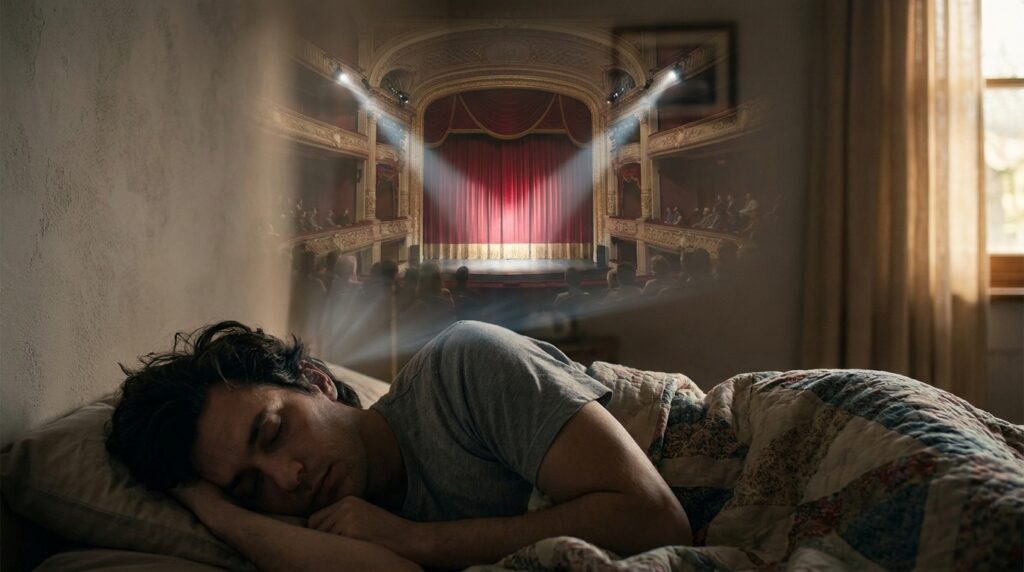
Dreaming about a theater can feel strangely powerful because a theater is never just a building. It is a place where emotion is displayed, roles are performed, stories unfold in front of others, and hidden things are revealed under light. You may dream of standing on a stage, sitting in the dark watching a play, getting lost backstage, forgetting your lines, or walking through an empty theater that feels full of memory and tension. Whatever form it takes, a theater dream often leaves the impression that something in your life is being presented, observed, or acted out. That is why this symbol often relates to self-image, social roles, emotional performance, and the question of what is real beneath the surface.
Quick Answer
Dream About Theater meaning usually points to social roles, performance, emotional exposure, self-presentation, hidden truth behind appearances, or the feeling that part of your life is being watched, judged, or acted out. Dreams about theaters often appear when your subconscious is processing the gap between what you show others and what you genuinely feel inside. Depending on the dream context, a theater may symbolize confidence, creativity, public pressure, emotional masking, the need for authenticity, or a life situation that feels dramatic, performative, or deeply revealing.
Core Symbolism of Theater in Dreams
A theater in dreams is a rich symbol because it brings together several psychological themes at once. It is a place of performance, but also of observation. It contains both the visible stage and the hidden backstage. It involves scripts, roles, costumes, timing, applause, silence, and expectation. All of these elements make theater a powerful dream image for the parts of life that feel structured, expressive, dramatic, or socially exposed.
At its core, a theater often symbolizes the roles you play in waking life. Many people act differently depending on where they are and who they are with. You may be one version of yourself at work, another with family, and another when alone. Dreaming of a theater can suggest that your subconscious is paying attention to this performance of identity. It may be asking whether your outer role still fits your inner truth.
From a Jungian perspective, theater connects closely to the concept of the persona, the social face a person presents to the world. Carl Jung did not use the idea of theater by accident when describing parts of human identity. In dream terms, a theater may symbolize the space where the persona becomes visible. The dream may be exploring how much of your current life is authentic and how much is shaped by expectation, adaptation, or emotional protection.
Freud might have viewed theater dreams through desire, tension, and hidden motives. A performance can conceal as much as it reveals. Modern psychology often interprets theater more practically as a symbol of visibility, self-consciousness, social anxiety, role conflict, emotional expression, and the tension between public identity and private feeling.
Culturally, theater represents storytelling, spectacle, creativity, exaggeration, entertainment, ritual, imitation, and catharsis. A stage performance can reveal emotional truth through fiction. This is one reason the theater dream can feel so meaningful. It suggests that something important in your life may not be showing itself directly. Instead, it may be appearing through drama, symbolism, and role-play.
The emotional tone of the dream matters a great deal. A beautiful theater filled with light may symbolize creativity, readiness, and confidence. A dark or abandoned theater may reflect loneliness, old identity patterns, or emotions that once mattered deeply but now feel distant. A chaotic theater may suggest stress, confusion, or the feeling that too many roles are competing inside you.
Because the theater centers on presentation and exposure, this dream naturally overlaps with the symbolic world of Dream About Stage, where the dreamer is confronted with the question of how comfortable they are being seen, judged, and emotionally present in front of others.
A theater can also symbolize emotional distance. In some dreams, you are not the performer but the observer. This can suggest that you are watching your own life from the outside, analyzing events rather than fully living them, or struggling to connect directly to your feelings. Watching a play in a dream may reflect self-reflection, but it can also reflect detachment.
Another key symbolic layer involves illusion versus truth. Theater is built on artifice, but it can still reveal something very real. This is why theater dreams often arise when a person suspects that appearances in life are misleading. Someone may be hiding feelings. A relationship may feel performative. A work environment may reward image more than sincerity. The dream uses theater to show that not everything visible is the whole story.
Spiritual Meaning of Dreaming About Theater
Spiritually, dreaming about a theater often relates to awareness, self-examination, and the difference between external role and inner truth. A theater dream may arise when you are becoming more conscious of the masks you wear, the parts you perform, and the ways your life may have become shaped by expectation more than deeper authenticity.
This does not mean the dream is condemning social roles entirely. Everyone plays roles in life. The spiritual question is whether those roles still allow your true self to breathe. If the theater dream feels heavy or uneasy, it may suggest that you are tired of performing, tired of pleasing, or tired of living under emotional scripts that no longer fit who you are becoming.
If the theater feels beautiful or inspiring, the spiritual meaning may be more affirmative. The dream may symbolize creative calling, meaningful expression, or the recognition that your life itself is a form of unfolding story. In that case, theater represents not falseness but conscious participation. You are no longer sleepwalking through your roles. You are becoming more aware of how you show up and what kind of story you are helping shape.
A backstage setting can carry especially strong spiritual symbolism. It often points to the hidden preparation behind outer life. Much of spiritual growth happens away from public view. If you dream of being backstage, the dream may suggest that you are in a quiet season of inner formation rather than outward display.
If the dream emphasizes lights, music, movement, or dramatic performance, it may also reflect the soul’s desire to express what words alone cannot fully carry. That expressive quality can resonate with Dream About Singing and Dream About Dancing, where inner feeling seeks a fuller, more embodied form of expression.
In a balanced spiritual reading, the theater dream may ask a simple but important question: where in your life are you performing instead of fully living, and where are you finally ready to bring more truth into view?
A Related Bible Verse
A fitting Bible verse for this dream theme is Psalm 139:23–24: “Search me, God, and know my heart; test me and know my anxious thoughts. See if there is any offensive way in me, and lead me in the way everlasting.”
This verse connects well with dreams about theater because the symbol often points to inner examination beneath outward appearances. In a reflective sense, the verse supports the idea that real understanding begins when a person looks honestly beneath performance, role, and image. It does not need to be read in a rigid or preachy way. Instead, it gently reinforces the dream’s invitation to seek sincerity, emotional truth, and a life less controlled by appearances alone.
Psychological Interpretation
Psychologically, dreams about theaters often reflect social awareness and the emotional pressure of being seen. A theater is a structured environment where behavior is observed, judged, and interpreted. Because of this, theater dreams frequently appear when a person feels evaluated, exposed, or uncertain about how they are coming across to others.
One common interpretation involves role strain. You may feel that you are performing too much in daily life. Perhaps you are trying to seem calm when you are overwhelmed, confident when you are insecure, agreeable when you are resentful, or strong when you are exhausted. The theater becomes the perfect symbol for this because it reveals the labor of presentation. It suggests that part of your identity is currently working very hard.
Another major interpretation involves self-consciousness. If the dream places you on stage, under lights, in costume, or in front of a crowd, it may reflect fear of judgment, fear of mistakes, or concern about how others perceive you. This is especially likely during times of transition, leadership, career change, family pressure, or emotional vulnerability.
If you are only watching from the audience, the dream may indicate observation rather than participation. You may be standing back from your own life, assessing a situation without fully engaging it, or feeling like an outsider to events that affect you deeply. Watching can sometimes be healthy reflection, but it can also suggest emotional distance.
Forgetting lines, losing props, missing cues, or arriving late to a performance often reflects anxiety. These dream details commonly show up when a person feels unprepared, overloaded, or afraid of failing visible expectations. The dream dramatizes that pressure by turning life into performance.
A theater dream may also reveal inner division. There is often a split between public and private self, between front stage and backstage. You may be wondering which version of you is real, or you may feel exhausted from shifting between roles that demand different behaviors. This makes theater dreams especially common during periods of identity change.
Because performance is closely linked with judgment and public visibility, these dreams can share strong emotional territory with Dream About Performance, especially when the dream centers on getting things right under pressure.
Emotion inside the dream gives important clues. Excitement may suggest readiness, creative energy, or the desire to step forward. Fear may indicate vulnerability, insecurity, or social anxiety. Shame may reflect concern about exposure or being misunderstood. Calmness may suggest growing confidence in how you present yourself. Sadness may point to loneliness behind public roles. Confusion may reveal identity conflict or uncertainty about what is expected of you.
The theater can also symbolize emotional drama in relationships or family systems. Some people dream of theater when they feel trapped in recurring emotional patterns that seem predictable, exaggerated, or performative. In that sense, the subconscious may be saying that a situation has become more about role repetition than genuine connection.
Psychologically, theater dreams often invite one central question: are you living from your deeper self, or are you exhausting yourself trying to perform a part that no longer feels true?
Common Dream Scenarios About Theater
Dream of Performing on a Theater Stage
If you dream that you are performing in a theater, the dream often reflects visibility, emotional exposure, and the desire to be recognized or understood. It may point to a real-life situation where you feel watched, evaluated, or responsible for how others perceive you.
If the performance feels smooth and confident, the dream may symbolize readiness and self-trust. If it feels stressful, it may reveal fear of judgment, perfectionism, or emotional pressure connected to being seen.
Dream of Sitting in the Audience Watching a Play
Watching a play from the audience often symbolizes observation, reflection, or emotional distance. You may be examining your own life from the outside, noticing patterns that have become obvious but still feel difficult to change.
In some cases, this dream suggests that you are more passive than you want to be. You are watching events unfold but not fully stepping into your own role within them. The audience position can also connect naturally with Dream About Audience, where the emotional tension comes from being seen, watching others, or feeling part of a collective emotional experience.
Dream of Forgetting Lines in a Theater Performance
Forgetting your lines is a classic anxiety image. It usually reflects self-doubt, pressure, or the fear of failing in a visible situation. You may be worried about saying the wrong thing, not meeting expectations, or losing control at an important moment.
This scenario often appears during major responsibilities, career stress, family tension, or moments when you feel you must perform correctly to maintain stability or approval.
Dream of Getting Lost Backstage
Backstage dreams often symbolize the hidden side of identity, preparation, and private emotional life. If you are lost backstage, the dream may suggest confusion about your role, uncertainty about what comes next, or difficulty connecting your inner self to your outward responsibilities.
This dream can be especially meaningful during transitions. You may no longer fit your old role, but you are not yet clear on the new one. The backstage area becomes a symbolic place of in-between identity.
Dream of an Empty Theater
An empty theater often carries a haunting or reflective feeling. It may symbolize loneliness, lost opportunity, nostalgia, or the sense that a role or chapter in life has ended. It can also suggest that you are questioning whether the performance you have been giving is still meaningful.
If the empty theater feels peaceful, the dream may represent rest from social pressure. If it feels sad, it may reflect emotional absence, disappointment, or the fading of something that once mattered deeply.
Dream of Acting in a Play
If the dream emphasizes acting itself, the meaning often revolves around identity, adaptation, and emotional masking. You may be adjusting your behavior to fit expectations or navigating a situation where sincerity feels risky.
This scenario can connect strongly with Dream About Acting, especially when the dream draws attention to costume, pretense, role-play, or the difference between what is felt and what is displayed.
Dream of Standing Under a Theater Spotlight
A spotlight in a theater dream often symbolizes attention, exposure, pressure, and the feeling that something about you is being highlighted. This may be positive if you crave recognition or feel ready to step forward. It may be stressful if you fear criticism or feel unprepared.
The spotlight often asks whether you are comfortable with visibility. It can also suggest that an important truth, talent, or vulnerability is becoming harder to hide.
Dream of Theater Music, Dance, or Dramatic Movement
If the dream includes theatrical music, singing, or dance, it often suggests that your emotional life is becoming more expressive and embodied. You may be processing feelings that need more than words. The theater becomes a full symbolic environment for emotion, art, and identity to merge.
In some cases, this can also reflect dramatic social dynamics or the feeling that life around you has become exaggerated, stylized, or emotionally theatrical.
How This Dream Connects to Your Real Life
Love and Relationships
In relationships, dreaming about a theater often points to emotional roles, hidden feelings, and the difference between genuine intimacy and performative harmony. You may be acting fine when you are hurt, playing the peacemaker when you are exhausted, or staying inside a role that no longer reflects how you truly feel.
If the dream involves performing for someone, it may suggest a desire to be recognized or loved more deeply. If it involves watching someone else perform, it may reflect suspicion, distance, or the feeling that the relationship contains emotional scripts rather than full honesty.
Career and Money
Career is one of the strongest real-life connections for a theater dream. Work often requires performance in the broad psychological sense. You may need to present confidence, manage impressions, speak in public, meet expectations, or adapt to workplace culture. A theater dream can highlight how visible or exhausting that performance feels.
If the dream feels pressured, it may point to burnout, evaluation anxiety, or the sense that your professional role is becoming emotionally draining. If it feels energizing, it may reflect creative ambition or growing readiness to step into a more public or expressive role.
The same symbolic pressure can sometimes overlap with Dream About Spotlight, where the emotional issue is not only work itself but what it feels like to be visible under scrutiny.
Personal Growth
For personal growth, a theater dream often marks a moment of self-awareness. You may be recognizing which parts of your life are authentic and which parts are overperformed. This can be uncomfortable, but it is often meaningful. Growth begins when you stop confusing adaptation with identity.
Theater dreams can appear during healing, reinvention, creative change, or any period when you are trying to live more honestly. The dream may not be telling you to abandon every role. It may simply be showing that some roles need to be updated so your life reflects who you really are now.
Health and Emotional State
Emotionally, theater dreams can reflect stress, social exhaustion, identity tension, or the fatigue of always being composed for others. If you are constantly managing impressions, suppressing feelings, or shifting between incompatible expectations, the dream may reveal how draining that has become.
A chaotic or overwhelming theater can suggest overstimulation. A silent or empty one can suggest withdrawal, sadness, or burnout. A joyful theater can suggest healthy expression and creative recovery. In every case, the dream often mirrors the emotional cost of how you are currently showing up in the world.
Is Dreaming About Theater a Positive or Warning Sign?
Dreaming about a theater can be positive when it reflects creativity, confidence, meaningful self-expression, readiness to be seen, or the healthy recognition that life includes chosen roles you can inhabit consciously. In this form, the dream suggests that you are learning how to express yourself with more skill, depth, and awareness.
It can act as a warning sign when the dream reveals emotional masking, social pressure, identity exhaustion, fear of judgment, or the sense that too much of life has become performance and not enough feels real. If the theater dream is tense, repetitive, or emotionally heavy, it may be asking you to look more honestly at what you are pretending, protecting, or avoiding.
Sometimes the dream is not strongly positive or negative. It may simply reflect how the mind organizes social life through symbols of performance and observation. The most useful question is not whether the dream predicts something dramatic, but whether it reveals a gap between outward role and inward truth.
That question becomes especially relevant when the theater dream blends into entertainment imagery, scripted scenes, or cinematic emotion, which can place it near the symbolic territory of Dream About Movie, where story, projection, and identity become emotionally significant.
Case Studies
A Corporate Manager Dreamed of Performing in a Play Without Rehearsal
A manager under heavy workplace pressure dreamed he was suddenly pushed onto a theater stage and expected to perform a complex role without any rehearsal. In waking life, he had recently taken on leadership duties he did not feel prepared for. The dream reflected visibility anxiety, performance pressure, and the fear of failing publicly rather than a literal interest in theater.
A Young Woman Dreamed of Sitting Alone in an Empty Theater
A woman recovering from the end of a long relationship dreamed she walked into a large empty theater and sat silently in the dark. She woke feeling sad but thoughtful. The dream seemed to symbolize emotional aftermath, the ending of a shared role, and the quiet realization that a chapter of life had closed.
A Student Dreamed of Forgetting Every Line While the Audience Watched
A university student dreamed she stood center stage in front of a full audience but suddenly could not remember a single line. She had been struggling with exams and feeling judged by family expectations. The dream clearly mirrored fear of visible failure and the belief that she had to perform perfectly to be valued.
A Creative Artist Dreamed of Exploring a Theater Backstage
An artist in a period of reinvention dreamed she wandered backstage through costumes, props, and half-lit corridors before stepping toward the stage. She felt curious rather than afraid. In waking life, she was rethinking her identity and creative direction. The dream appeared to symbolize inner preparation and the quiet work that happens before a new version of the self becomes visible.
A Father Dreamed of Watching His Family Perform Different Roles in a Theater
A father dreamed he sat in the audience while members of his family each acted out different roles on stage. He felt unsettled because the scenes felt familiar but exaggerated. In waking life, ongoing family conflict had made him feel that everyone was trapped in predictable emotional patterns. The dream reflected his growing awareness that the family system had become more about role repetition than genuine listening.
Dream Numbers
In some symbolic traditions, theater dreams are loosely linked to numbers such as 2, 5, and 8. The number 2 can relate to duality, role, and the tension between inner and outer self. The number 5 may suggest change, unpredictability, or dynamic movement. The number 8 is sometimes associated with structure, repetition, and long-term cycles. These connections are best treated lightly as folklore rather than fixed meaning.
Lucky Lottery Meaning
Some folk beliefs treat dreams involving theaters, stages, or dramatic scenes as signs that luck may come through public events or visible opportunities. Still, this should be understood only as cultural tradition and not as a reliable prediction. In most cases, the deeper value of a theater dream lies in what it reveals about identity, visibility, pressure, and authenticity rather than anything related to chance.
FAQ
What does it mean spiritually to dream about a theater?
Spiritually, a theater dream often points to awareness of the roles you play, the masks you wear, and the difference between outward performance and inner truth. It may invite greater authenticity and self-examination.
Why do I dream about being on stage in a theater?
This usually reflects visibility, pressure, and self-expression. You may feel watched, evaluated, or called to step more fully into a role that feels emotionally important.
Is dreaming about a theater a bad sign?
Not necessarily. It can be positive if it reflects creativity, confidence, or healthy self-awareness. It becomes more cautionary when it reveals emotional masking, social exhaustion, or fear of judgment.
What does an empty theater mean in a dream?
An empty theater often symbolizes loneliness, reflection, the ending of a chapter, or relief from social pressure. The emotional tone of the dream helps clarify whether it feels peaceful or sad.
What does it mean if I am acting in a play in my dream?
It often suggests role adaptation, emotional masking, or awareness that part of your life feels scripted. The dream may be asking whether the role you are playing still reflects your deeper self.
Conclusion
Dreams about theaters often appear when life feels visible, dramatic, emotionally layered, or shaped by roles that deserve closer examination. Whether you are on the stage, hiding backstage, watching from the audience, or standing alone in an empty theater, the dream usually points toward the relationship between appearance and truth. Rather than treating the symbol as a prediction, it is more useful to ask what part of your life feels performed, what part feels authentic, and where you may be ready to step out of old roles and into a more honest way of being.