Dreaming about sloths can feel strangely memorable because the image is so specific. A sloth does not rush, chase, or demand attention in the way many dream symbols do. Instead, it lingers. If you saw a sloth in your dream, your mind may be drawing your attention to pace, energy, rest, patience, or the quiet parts of life that are easy to overlook. Sometimes this dream appears when you are exhausted and need to slow down. Other times, it comes when you are moving too slowly in an area of life that needs courage and action. The meaning often depends on whether the sloth in the dream felt peaceful, vulnerable, strange, comforting, or frustrating.
Quick Answer
Dream About Sloths meaning often relates to patience, slow progress, emotional stillness, rest, and the need to move through life at a pace that feels more natural to you. A sloth in a dream may symbolize calm endurance, gentleness, and inner peace, but it can also point to delay, avoidance, low energy, or fear of change if the dream feels heavy or uncomfortable. In many cases, this dream appears when your subconscious is asking you to look at how you use your energy, whether you are rushing too much, or whether you have become stuck in passivity and hesitation.
Core Symbolism of Sloths in Dreams
At a symbolic level, sloths represent deliberate movement. They do not survive by force, speed, or aggression. Their energy is conserved, measured, and quiet. In dreams, this often reflects a part of the dreamer that wants to withdraw from pressure, noise, and urgency. A sloth may symbolize the wish to live more gently, to stop performing constantly, or to trust that not every meaningful step has to be fast.
Sloths also carry an image of vulnerability. They are not dream symbols of domination or control. They can reflect softness, sensitivity, and a nervous system that is tired of overstimulation. If your waking life has been crowded with demands, deadlines, or emotional pressure, a sloth may appear as the symbol of a slower internal rhythm trying to protect itself.
From a Jungian perspective, the sloth can be understood as an image from the unconscious that corrects imbalance. If your conscious life is driven by productivity, comparison, and constant movement, the dream may bring in the opposite force: rest, waiting, receptivity, and patience. The psyche often creates balance through contrast. In that sense, the sloth is not just about being slow. It is about restoring proportion.
Culturally, many people associate sloths with calmness, gentleness, and harmlessness. That makes the symbol somewhat similar to the emotional tone found in Dream About Koalas, where softness and emotional safety can play a central role. Still, sloths carry a distinct meaning of suspended motion. They do not just rest. They remain in-between action and stillness, which can symbolize a life season where you are not fully moving forward yet, but you are not lost either.
There is also an archetypal layer here. The sloth may represent patience with the natural timing of growth. In a world that celebrates speed, a sloth dream can challenge the assumption that faster is always better. It may be asking whether your soul is trying to move at a wiser pace than your ego prefers. In some dreams, the sloth becomes a symbol of acceptance, surrender, and trust in gradual processes. That can overlap with themes found in Dream About Pandas, where gentleness and emotional balance often matter more than force.
At the same time, not every sloth dream is positive. The symbol can also point to procrastination, emotional numbness, passivity, or avoidance. If the sloth in the dream seems stuck, weak, falling, or unable to move, your subconscious may be reflecting a situation in which you are not honoring your own power. The dream then becomes less about healthy rest and more about fear disguised as stillness.
Spiritual Meaning of Dreaming About Sloths
Spiritually, sloths can symbolize the value of slowing down enough to hear yourself clearly. Many people move through life at a pace that disconnects them from intuition. A sloth dream may appear when your inner life wants more silence, more contemplation, and more honest reflection. It can be a symbolic invitation to stop reacting automatically and start listening more deeply.
In this sense, the sloth can represent alignment rather than inactivity. There are times in life when the most spiritual thing you can do is pause before making the next move. If you have been pushing too hard, pleasing too many people, or forcing outcomes, a sloth dream may suggest that wisdom is found in restraint. Not every door needs to be opened immediately. Not every answer comes through effort.
A repeating sloth dream can sometimes show up during periods of inner transition. You may be shedding an old identity, healing from emotional exhaustion, or learning how to live with less urgency. The image of the sloth suggests spiritual maturation through patience. Transformation is not always dramatic. Sometimes it looks like becoming less reactive, less frantic, and more grounded.
The dream may also be asking you to reflect on your relationship with time. Do you trust the unfolding of your life, or do you live in a state of permanent hurry? A sloth dream can challenge the spiritual habit of mistaking motion for meaning. You may be active but misaligned. You may be slower than others but closer to your truth.
When the dream feels peaceful, the sloth often symbolizes energetic conservation and emotional wisdom. When the dream feels frustrating, it may reveal resistance to a lesson you cannot rush. Either way, the image encourages awareness of your natural rhythm, not the rhythm imposed by fear, social comparison, or outside pressure.
A Related Bible Verse
A verse that fits this symbol well is Psalm 46:10: “Be still, and know that I am God.”
This verse connects naturally to dreams about sloths because the symbol often carries a message about stillness, trust, and stepping back from mental noise. In a reflective sense, the dream may be reminding you that clarity does not always come from doing more. Sometimes it comes from becoming quiet enough to notice what is already true inside you. This does not mean the dream is predicting anything spiritual in a literal way. It simply suggests that stillness, patience, and trust may be important themes in the emotional or spiritual lesson behind the dream.
Psychological Interpretation
Psychologically, dreaming about sloths often relates to energy management. Your mind may be processing fatigue, overwhelm, burnout, or the desire to protect yourself from overstimulation. A sloth can be a symbolic mirror of the nervous system when it wants rest more than stimulation. If you have been emotionally overloaded, your subconscious may choose a sloth because it represents safe slowness.
The dream can also reveal ambivalence. Part of you may want to move forward, while another part resists. This is common during life transitions. You may want change but fear the pressure that comes with it. You may want intimacy but feel emotionally cautious. You may want success but feel exhausted by the pace required. The sloth then becomes the image of hesitation, not because you are lazy, but because your inner world is negotiating safety.
Freud might view the sloth as part of wish fulfillment, especially if the dreamer feels burdened by responsibility. In that sense, the dream could be expressing a wish to escape demands, deadlines, and expectations. Modern psychology would expand that view by considering stress, coping patterns, emotional depletion, and avoidance behaviors.
Emotion inside the dream matters a great deal. If you felt comfort while watching the sloth, the dream may represent your need for rest, patience, and gentle living. If you felt irritated, trapped, or anxious, the dream may reflect frustration with slow progress in waking life. If you felt protective toward the sloth, you may be recognizing a softer or more vulnerable part of yourself that needs care. If the sloth seemed strange or unsettling, the dream may be showing discomfort with slowing down or with being seen as less productive.
Sloths can also appear when you compare yourself too harshly to others. In a social environment that rewards speed and visible achievement, dreaming of a slow-moving creature may reflect insecurity about your pace. This is especially likely if the dream includes other animals moving faster or more chaotically, which creates a useful contrast with themes explored in Dream About Monkeys, where restless mental activity and impulsive behavior are often more central.
On a deeper level, the sloth may represent a self-state that is withdrawn but observant. You may not be actively engaging with everyone around you, yet part of you is still noticing, feeling, and processing. The dream suggests that what looks passive on the surface may actually be an important stage of emotional digestion.
Common Dream Scenarios About Sloths
Dream of a Sloth Hanging in a Tree
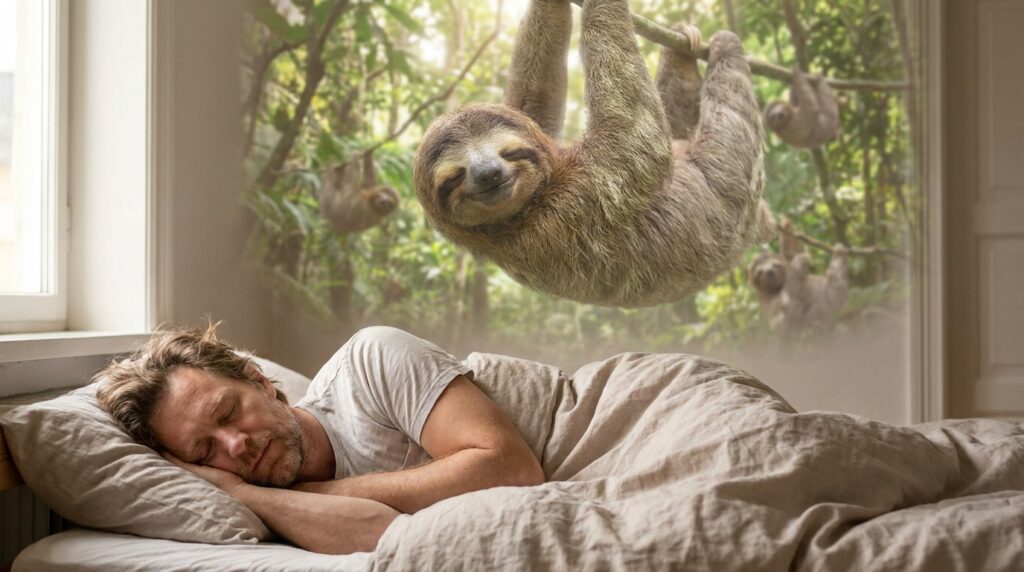
This is one of the most natural and meaningful sloth dream scenarios. A sloth hanging peacefully in a tree often symbolizes suspension, patience, and trust in timing. You may be in a waiting period where not much is visibly happening, yet something important is still developing beneath the surface. The tree adds meaning because it often represents life structure, growth, roots, and stability. The emotional tone can overlap with the grounded symbolism often seen in Dream About Trees. If the dream feels calm, it may be affirming your current pace. If it feels tense, you may fear that waiting is becoming stagnation.
Dream of Holding or Touching a Sloth
Holding a sloth in a dream often reflects tenderness toward your own softer side. You may be learning to treat yourself more gently instead of demanding nonstop performance. This scenario can also suggest that you are carrying something delicate in waking life, such as healing, grief, a new identity, or emotional recovery. If the sloth feels warm and safe, the dream may be encouraging compassion. If it feels heavy or awkward, you may be feeling burdened by a responsibility that requires more patience than you expected.
Dream of a Sloth Moving Very Slowly While You Wait
This scenario often reflects frustration with timing. Perhaps something in your life is taking longer than you want: a relationship decision, a job opportunity, emotional healing, or personal growth. The sloth becomes the image of delay. However, the dream is not always criticizing the delay itself. Sometimes it is exposing your relationship to control. Are you struggling because life is truly stuck, or because you cannot tolerate uncertainty?
Dream of a Baby Sloth
A baby sloth in a dream often symbolizes developing patience, fragile healing, or a new emotional pattern that needs protection. This dream can appear when you are beginning to live more slowly and intentionally after a difficult period. It may also reflect innocence, softness, and a wish to feel safe. If the baby sloth appears vulnerable, the dream may be asking you to care for a part of yourself that is not strong yet but is still valuable.
Dream of Many Sloths
Dreaming of many sloths may suggest that your life has entered a slower season overall. It can symbolize a broad shift in priorities, a quieter social phase, or a desire to retreat from chaos. Sometimes this dream reflects emotional withdrawal, especially if everything in the dream feels unusually silent. In other cases, it is a healthy correction to overstimulation. Context matters. If the dream feels peaceful, the message may be about calm. If it feels stagnant, the message may be about inertia.
Dream of an Injured or Dying Sloth
An injured or dying sloth can symbolize the loss of patience, inner peace, or emotional gentleness. Perhaps you are living in a way that crushes your natural rhythm. This dream may appear when you are burned out, emotionally hardened, or disconnected from your need for rest. It can also reflect guilt about not protecting your energy. Because sloths are associated with quiet vulnerability, harm to a sloth in a dream often feels emotionally significant.
Dream of Being a Sloth
If you dream that you are the sloth, the message becomes especially personal. Your mind may be exploring how you feel about your own pace, motivation, or energy level. This can be healing if the dream feels peaceful, as it may signal self-acceptance and a new relationship with rest. But if you feel ashamed in the dream, it may point to fear of being judged as lazy, weak, or unproductive. The dream is then asking you to separate healthy rest from self-condemnation.
How This Dream Connects to Your Real Life
Love and Relationships
In relationships, a sloth dream can point to emotional pacing. You may want closeness, but only at a speed that feels safe. This is not necessarily a problem. In fact, the dream may be encouraging you to respect your emotional rhythm rather than forcing intimacy before trust is built. On the other hand, if a relationship has become inactive, overly passive, or emotionally distant, the sloth may symbolize what is not being addressed. The dream asks whether patience is supporting the relationship or silently replacing honest communication.
Career and Money
In work and financial life, sloths often symbolize pace, pressure, and sustainability. You may be tired of environments that reward urgency over depth. The dream could be telling you that your current workload is not aligned with your mental or physical energy. It may also reflect fear that slow progress means failure. But slow progress is not the same as no progress. In some cases, the dream invites you to trust steady development instead of panic. This is especially relevant if you are building something long term, like a new skill, business idea, or gradual career shift.
Personal Growth
For personal growth, the sloth is often a symbol of maturity through patience. Not every transformation is visible right away. You may be changing in subtle ways that only become obvious later. The dream encourages you not to abandon a meaningful path simply because it is slow. Growth often happens in the hidden spaces of life, much like the stillness and natural rootedness associated with Dream About Forest. A sloth dream may mean your inner life is asking for depth over speed.
Health and Emotional State
This dream is strongly connected to stress, fatigue, nervous system overload, and emotional recovery. If you have been drained, a sloth may appear as a direct symbol of the body asking for restoration. It can also reflect depression-like emotional heaviness, lack of motivation, or avoidance if the dream feels bleak. The difference lies in tone. Peaceful sloth dreams usually suggest needed rest. Disturbing sloth dreams may suggest that exhaustion has turned into disconnection. Either way, the dream is calling attention to how you carry energy through daily life.
Is Dreaming About Sloths a Positive or Warning Sign?
Dreaming about sloths can be positive when the dream feels calm, safe, or quietly reassuring. In that form, the dream often symbolizes patience, emotional wisdom, gentle self-protection, and the ability to move through life without constant panic. It may be reminding you that peace is not laziness and that your healing does not need to look dramatic to be real. In this sense, the message is close to the emotional atmosphere found in Dream About Peace, where stillness itself can become meaningful.
The dream can act as a warning sign when the sloth appears weak, trapped, injured, or frustratingly immobile. Then it may reflect avoidance, procrastination, emotional shutdown, or a life pattern in which you keep postponing necessary decisions. A warning sign does not mean the dream is predicting a bad event. It simply means your subconscious may be highlighting an imbalance. You may be resting when action is needed, staying safe when honesty is needed, or hiding in slowness because movement feels risky.
In many cases, the dream is neither entirely positive nor negative. It is diagnostic. It shows you your current relationship with pace. Are you overdriven and in need of rest? Or have you become so passive that life is moving around you while you remain suspended? The sloth becomes meaningful because it reveals where patience ends and avoidance begins.
Case Studies
A College Student After Burnout
A university student dreams of seeing a sloth sleeping peacefully on a branch while everyone else runs below it. In waking life, the student has been exhausted from academic pressure and constant comparison with classmates. In this case, the dream reflects a wish for emotional permission to slow down. The sloth is not failure. It represents recovery from over-identification with productivity.
A Woman Waiting on a Relationship Decision
A woman dreams that she is following a sloth through a forest path, frustrated by how slowly it moves. She is currently waiting for her partner to decide whether they want a deeper commitment. The dream reflects the emotional pain of delayed clarity. The sloth symbolizes slow relational timing and her growing impatience with uncertainty.
A Man Healing After Job Loss
A man dreams of holding a baby sloth and feeling unusually protective of it. He recently lost his job and has been struggling with self-worth. In his case, the dream suggests that a fragile but important part of his identity is healing. The baby sloth represents slow rebuilding, self-kindness, and the need to protect his confidence while it grows back.
A Mother Feeling Emotionally Drained
A mother dreams that a sloth is clinging to her shoulder all day long. She wakes up feeling tired but calm. Her waking life is full of caregiving responsibilities, and she has neglected her own rest. The dream symbolizes the weight of exhaustion, but also a need to carry herself more gently. Rather than warning of danger, it invites a softer routine and more realistic expectations.
A Business Owner Avoiding a Necessary Change
A business owner dreams that they themselves have turned into a sloth and cannot finish simple tasks. They feel embarrassed in the dream because others are watching. In waking life, they have been avoiding a difficult but necessary business decision. Here, the sloth reflects fear-based hesitation rather than healthy patience. The dream suggests that what once felt like thoughtful waiting is becoming paralysis. This interpretation naturally connects with the deeper lesson behind Dream About Patience, where patience is useful only when it still allows honest movement.
Dream Numbers
Some dream traditions and folk systems loosely associate sloths with numbers connected to calm, waiting, and gradual progress, such as 2, 7, 12, or 22. These numbers are not fixed meanings, and there is no universal rule behind them. If they stand out to you, they are best treated as symbolic details for reflection rather than literal signs.
Lucky Lottery Meaning
In some cultural dream traditions, gentle animals are sometimes linked with lucky numbers or fortunate timing. If someone gives a lottery interpretation to a sloth dream, it is best understood as folklore rather than fact. The dream may feel meaningful, but it should not be treated as a promise of luck or a reliable basis for gambling decisions.
FAQ
What does it mean spiritually to dream about sloths?
Spiritually, dreaming about sloths often points to stillness, patience, and the need to reconnect with your natural rhythm. The dream may suggest that insight will come more easily when you stop forcing answers and give yourself space to listen inwardly.
Why do I keep dreaming about sloths?
Repeating dreams about sloths often happen when a lesson about timing, energy, rest, or hesitation has not been fully understood yet. Your subconscious may be asking you to reflect on whether you need more restoration or more courage to move forward.
Is dreaming about sloths a bad omen?
Usually, no. A sloth dream is more often symbolic than predictive. It may reflect slow healing, emotional caution, or frustration with delay, but it does not automatically signal something bad. The emotional tone of the dream matters more than superstition.
What does it mean if the sloth in my dream feels peaceful?
A peaceful sloth usually suggests acceptance, calm, softness, and the wisdom of moving more gently. It can be a strong sign that your mind is seeking rest, emotional regulation, or a quieter relationship with time.
What if the sloth in my dream is injured or dying?
This often suggests that your patience, emotional balance, or need for rest is being neglected. The dream may be showing that something gentle inside you has been overburdened. In some cases, it can also reflect sadness about losing a slower, more grounded way of living.
You may also notice that sloth dreams fit within a broader symbolic family of gentle, instinctive, or emotionally revealing creatures, which is why some readers find related meaning in Dream About Animals.
Conclusion
Dreaming about sloths usually brings your attention to pace, patience, energy, and the emotional meaning of slowing down. Sometimes the dream is encouraging rest, softness, and trust in gradual growth. Other times, it is warning that delay has become avoidance or that exhaustion is quietly shaping your choices. The most helpful question is not whether the sloth is good or bad, but what your relationship with time looks like right now. When you reflect honestly on that, the dream often becomes clearer. A sloth dream invites you to notice whether your soul needs more calm, more healing, or simply the courage to move when the moment is right.