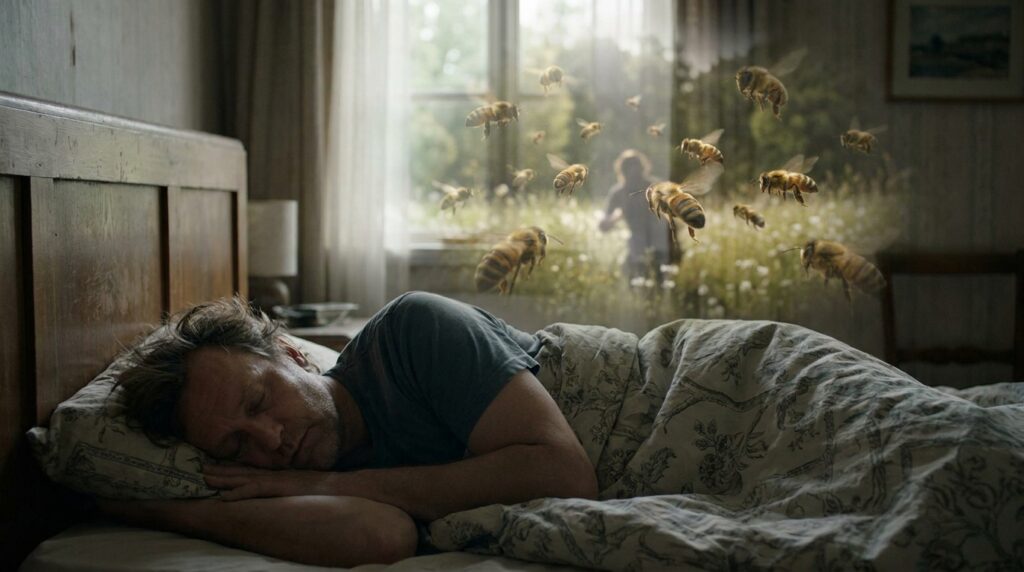
Dreams about bees chasing you can feel intense in a very specific way. Unlike some frightening dreams that center on one large threat, this kind of dream often carries the feeling of many small dangers closing in at once. You may wake up with your heart racing, your body tense, and your mind still holding onto the urgency of needing to get away. Because bees are not always seen as purely negative symbols, the dream can feel confusing too. Bees are often linked with productivity, teamwork, order, and nature, yet in a chasing dream they become a source of pressure, fear, and emotional overwhelm. That is why this symbol can be so revealing. It often points to something in your waking life that feels persistent, stressful, demanding, or emotionally hard to escape.
Quick Answer
Dream About Bees Chasing Me meaning often relates to stress, pressure, fear of being overwhelmed, unresolved anxiety, or the feeling that many small problems are piling up and closing in on you at once. When bees chase you in a dream, your subconscious may be expressing emotional overload, social tension, fear of conflict, or a situation in which you feel pursued by responsibilities, expectations, criticism, or inner worry. In some cases, the dream reflects avoidance of a problem that needs attention. In other cases, it shows that your mind and body are reacting to an environment that feels too demanding, too crowded, or too emotionally sharp.
Core Symbolism of Bees Chasing You in Dreams
Bees are complex dream symbols because they carry both positive and difficult meanings. On one hand, bees represent cooperation, community, structure, effort, and productivity. They are often associated with purpose, discipline, and the larger systems that hold life together. On the other hand, bees can sting, swarm, and create fear when they feel threatening or too close. In a dream where bees are chasing you, the meaning usually shifts away from harmony and toward pressure.
At the symbolic level, being chased by bees often represents the feeling of being pursued by something persistent and hard to ignore. This may not be one dramatic issue. More often, it is many smaller pressures that accumulate until they feel impossible to calmly manage. Work demands, social obligations, emotional tension, unresolved tasks, financial worries, or ongoing stress can all take this form in the subconscious. The bees become symbols of repeated stimulation that your nervous system no longer experiences as manageable.
There is also a strong connection here to collective pressure. Unlike a lone predator, bees usually appear as part of a group, swarm, or hive structure. That makes this dream especially relevant when the stress in your life comes from social environments, teamwork, family expectations, public judgment, or feeling surrounded by too many demands at once. The symbolism can connect naturally with broader meanings found in Dream About Bees, but the chasing element changes the tone from productive energy to emotional pursuit.
From a Jungian perspective, bees chasing you may symbolize instinctive energies from the unconscious that have become agitated. These could include anxiety, irritability, anger, perfectionism, or even ambition. If your conscious self is trying to stay composed while deeper emotional tensions keep building, the dream may dramatize that imbalance. What is chasing you may be partly external, but it may also be internal pressure you have absorbed so fully that it now feels like an attack.
The image of chasing matters just as much as the image of bees. A chase dream usually suggests avoidance, urgency, or the sense that something unresolved is gaining force. If the bees are close behind you, the dream may reflect the belief that relief is not far away enough to feel real. If the bees never quite catch you, the dream may be showing an ongoing state of hypervigilance rather than a single direct crisis.
At the same time, this dream is not always negative in the simplistic sense. Sometimes it is a wake-up symbol. It can reveal where you are overcommitted, where your boundaries are too weak, where your stress has become chronic, or where you keep running from a problem that would be less frightening if addressed directly. The dream feels intense because it is trying to get your attention.
Spiritual Meaning of Dreaming About Bees Chasing Me
Spiritually, dreams about bees chasing you often point to energetic overload, emotional restlessness, and the need to restore inner balance. This does not require an extreme or mystical interpretation. In a grounded spiritual sense, the dream may be showing that your inner peace is being disturbed by constant external input, unresolved inner tension, or a lifestyle that leaves little room for stillness.
Bees are creatures of order, rhythm, and collective movement. When they chase you in a dream, one possible spiritual meaning is that you have become misaligned with your natural pace. You may be living under too much urgency, reacting too often, or saying yes to too many things that do not truly support your deeper well-being. The dream then becomes a symbolic signal that your spirit is tired of being rushed.
There is also a lesson here about avoidance. Sometimes spiritual growth requires stillness, but sometimes it requires honest confrontation. If you keep running from conversations, decisions, or emotional truths, the bees may symbolize the consequences of what you continue postponing. The chase suggests that whatever you are avoiding is not fading on its own.
In another sense, bees can symbolize messages from the collective world around you. They belong to systems larger than the individual. A chasing dream may arise when you feel burdened by group dynamics, social comparison, family roles, or the pressure to constantly contribute. Spiritually, the dream may be asking whether your life is overly shaped by outside demands and not enough by inner clarity.
If the dream repeats, the message may be growing stronger. Repetition often suggests that stress, fear, or avoidance has become a pattern rather than a passing moment. The dream is not necessarily predicting harm. More often, it is calling for awareness, boundaries, rest, and more truthful engagement with what feels emotionally urgent.
A Related Bible Verse
A fitting verse for this dream is Psalm 118:12: “They compassed me about like bees; they are quenched as the fire of thorns: for in the name of the Lord I will destroy them.”
This verse connects especially well because it directly uses the image of bees to express the feeling of being surrounded and pressured. In a reflective dream context, it can symbolize moments when fear, stress, or outside pressure feels as though it is closing in from every side. The deeper lesson is not about panic, but about remembering that even when life feels overwhelming, inner steadiness and trust can help you face what seems larger than you at first.
Psychological Interpretation
Psychologically, dreaming about bees chasing you often reflects anxiety, overstimulation, accumulated stress, or the feeling that too many demands are competing for your attention at once. The dreaming mind often converts emotional strain into physical pursuit. Instead of saying, “I feel overwhelmed,” the dream shows you being chased by something small, fast, numerous, and difficult to control.
This dream is strongly connected to the nervous system. Bees create a particular kind of fear because they are unpredictable in a group. That makes them a useful symbol for diffuse anxiety, the kind that does not come from one obvious cause but from many smaller pressures building over time. Deadlines, unfinished tasks, family demands, messages you have not answered, fears you have not faced, and inner self-criticism can all gather into a swarm-like image.
In many cases, this dream reflects avoidance. If you are running from the bees, your subconscious may be showing that you feel unable or unwilling to stop and deal with the real issue. This does not mean you are weak. Avoidance is often a natural response when something feels emotionally loaded or when your system already feels stretched too thin. The dream becomes less about judgment and more about visibility: it shows what your coping pattern looks like from the inside.
The symbolism also overlaps naturally with the emotional states explored in Dream About Anxiety, especially when the dream leaves you waking with a pounding heart, shallow breathing, or a lingering sense that danger is still nearby. Anxiety often behaves like a swarm. It comes from many directions, moves quickly, and becomes harder to think through once it has fully activated.
Emotion inside the dream matters. If you feel pure terror, the dream may reflect acute stress or panic. If you feel frustrated, the dream may point to pressure you are tired of carrying. If you feel embarrassed while running, social judgment may be central. If you feel angry, you may be reacting not only to fear but to resentment about how much is being demanded from you.
Freud might interpret the dream through repressed tension or fear of consequences. Jung would likely view the bees as instinctive psychic energy linked to collective order, duty, and emotional agitation. Modern psychology might describe the dream in terms of overload, hyperarousal, avoidance, burnout, or social stress. Different frameworks use different language, but they often point in the same direction: this dream usually reflects a system under strain.
Common Dream Scenarios About Bees Chasing Me
Dream of a Swarm of Bees Chasing You
This is one of the most direct and common versions of the dream. A swarm often symbolizes overwhelm. Instead of one clear problem, you may be dealing with many pressures all at once. The emotional truth of the dream is not just fear, but too muchness. You may feel that everything wants your attention at the same time and that none of it is waiting for you to recover first.
Dream of Running From Bees But Not Escaping
If you keep running but never feel safe, the dream often reflects chronic stress. The problem may not be one crisis but a continuous state of pressure. You may be functioning, working, and responding, yet internally you never feel truly off-duty. This scenario carries an obvious symbolic connection to Dream About Running, where motion itself often represents urgency, avoidance, or the struggle to keep ahead of emotional pressure.
Dream of Bees Chasing You After You Disturb Their Hive
When the chase begins because you accidentally or intentionally disturb the hive, the dream may suggest that something in waking life has consequences you are now trying to outrun. Perhaps you spoke up, made a difficult choice, triggered conflict, or disrupted a system that was already tense. The dream does not automatically say you were wrong. It may simply show that change has activated reactions around you.
Dream of Bees Chasing You in Public
A public setting often adds social anxiety, embarrassment, or fear of judgment. You may feel that your stress is visible, that others are watching you struggle, or that you are under social pressure you cannot gracefully manage. This can happen during periods of performance anxiety, workplace tension, or public responsibility.
Dream of Bees Chasing You at Home
When the bees chase you inside your home, the symbol often becomes more personal. Home usually reflects the inner self, family life, private relationships, or emotional safety. A bee chase in the home may suggest that stress has entered a place where you normally expect rest. It can point to family conflict, emotional overload, or the feeling that even your private life no longer feels calm.
Dream of Being Stung While Running From Bees
A sting makes the symbolism more immediate. It may represent criticism, emotional injury, guilt, or the painful consequence of something you were hoping to avoid. The dream can suggest that running is no longer keeping you fully protected. In some cases, the sting is not only about harm but about awareness. Something has reached you, and now it demands your attention.
Dream of Freezing While Bees Chase You
If you cannot move, the dream may reflect helplessness, shutdown, or the feeling that you do not know how to respond to pressure anymore. This is especially important when waking life has been emotionally exhausting. Not everyone responds to stress by running harder. Sometimes the system freezes. The dream then becomes an image of overload rather than weakness.
Dream of Escaping the Bees
If you eventually get away, the dream can be reassuring. It may symbolize resilience, the possibility of recovery, or the growing belief that stress is survivable. The emotional tone here may align with Dream About Escape, especially when the dream ends with relief rather than panic. Escaping does not always mean the problem is solved, but it can show that your psyche is beginning to imagine safety again.
Dream of Bees Chasing Someone Else While You Watch
If the bees chase another person, the dream may reflect projection, concern, or emotional distance. You may see in someone else what you are struggling to admit in yourself. Alternatively, the dream may express genuine worry that someone around you is under too much pressure. Your role in the dream matters. Are you helping, hiding, or simply observing? Each version changes the interpretation.
How This Dream Connects to Your Real Life
Love and Relationships
In relationships, a dream about bees chasing you can reflect tension that builds through many small moments rather than one big event. Repeated misunderstandings, emotional pressure, criticism, demands for attention, or fear of conflict can all accumulate until love feels more stressful than safe. Sometimes the dream shows that you are avoiding a difficult conversation. Other times, it reflects the feeling of being emotionally crowded or unable to relax around someone close to you.
Career and Money
In work life, this dream often points to deadlines, pressure, multitasking, interruptions, and the feeling that responsibilities are multiplying faster than you can handle them. Bees are especially fitting here because they already symbolize industriousness and group systems. The chase begins when productivity turns into emotional pursuit. You may feel trapped in constant response mode, always moving but never fully caught up. When that happens, the dream can start to reflect the same emotional atmosphere seen in Dream About Fear, especially if work pressure begins to affect your sleep and baseline sense of safety.
Personal Growth
For personal growth, this dream may signal that you are reaching a limit with old coping styles. Running from stress, postponing important conversations, or trying to stay functional without processing your emotions may no longer be enough. The dream may be asking you to develop a more honest relationship with pressure. Growth here does not necessarily mean doing more. It may mean setting better boundaries, acknowledging your anxiety sooner, and refusing to let overwhelm become your normal state.
Health and Emotional State
This dream has a strong link to anxiety, burnout, overstimulation, nervous system fatigue, and mental overloading. If you have been sleeping poorly, living under constant responsibility, or carrying emotional tension without enough recovery, the dream may be a direct reflection of that state. Your mind is telling you that your inner world does not feel spacious enough right now. It may need quiet, rest, and less incoming pressure.
Is Dreaming About Bees Chasing Me a Positive or Warning Sign?
Most often, this dream acts as a warning sign, but not in a supernatural sense. It usually warns that your emotional system feels overloaded, threatened, or unable to keep up with everything pressing in on it. That could involve work pressure, relationship stress, social anxiety, unresolved fear, or too many responsibilities happening at once.
Still, a warning sign is not the same as a bad omen. In many cases, the dream is actually helpful because it makes invisible stress visible. It shows you what pressure feels like inside your body and mind. Instead of dismissing your strain as normal, the dream amplifies it into a vivid scene so you can no longer ignore it.
The dream may be more positive when it leads to awareness. If you realize that you need firmer boundaries, more rest, more emotional honesty, or a new way of managing pressure, then the dream has served a protective function. It may also be positive if you escape, find shelter, or stop running and the bees calm down. Those outcomes can suggest that a healthier response is becoming possible.
Sometimes the clearest way to understand the dream is through the symbolic theme of pursuit itself, which is why some readers also find related insight in Dream About Being Chased. The deeper issue is not just bees. It is what in your life feels like it will not stop coming after your attention.
Case Studies
A Student Under Academic Pressure
A university student dreams that bees chase her across campus while she carries books she cannot hold onto. She has several exams, poor sleep, and growing fear of failure. In this case, the bees reflect layered stress rather than one single problem. The dream shows what academic pressure feels like internally: fast, swarming, relentless, and hard to outrun.
An Employee Drowning in Small Tasks
A man dreams that bees follow him from room to room in his office, and every time he thinks he is safe, more appear. In waking life, he is not facing one major crisis, but dozens of small tasks, emails, deadlines, and interruptions. The dream captures the reality of cumulative overload. Each bee is manageable alone, but together they become emotionally threatening.
A Woman Avoiding a Difficult Conversation
A woman dreams that bees chase her after she sees a damaged hive in her backyard. She has been avoiding a serious conversation with her partner because she does not want conflict. The dream suggests that the more she postpones the issue, the more emotionally charged it becomes. The damaged hive symbolizes a disturbed emotional system that now wants a response.
A Business Owner Experiencing Social Pressure
A business owner dreams of running through a crowded street while bees chase them and strangers stare. They have been dealing with public expectations, customer complaints, and the pressure to appear calm while feeling deeply tired. The dream reflects both stress and visibility. The bees represent pressure; the crowd represents judgment.
A Person Recovering From Burnout
Someone dreams that bees chase them at first, but then they find a quiet place, stop running, and the bees gradually disperse. They have recently started reducing commitments and resting more seriously after months of burnout. This dream suggests that the nervous system is beginning to believe that escape from constant pressure is possible. It carries a different tone from direct harm and can even overlap with the more confrontational themes found in Dream About Attack, except here the lesson is not only about threat but about learning how to respond differently.
Dream Numbers
Some dream traditions loosely associate bees with numbers linked to work, repetition, and collective energy, such as 3, 6, 9, or 12. In a chasing dream, these numbers may also reflect urgency or accumulated pressure. These associations are not universal, so they are best treated as symbolic details rather than fixed signs.
Lucky Lottery Meaning
In some folk traditions, dreams involving bees are connected to luck, numbers, or messages about timing. If a dream about bees chasing you is given a lottery interpretation, it should be understood as cultural belief rather than certainty. The stronger meaning of the dream is usually emotional and psychological, not financial.
FAQ
What does it mean spiritually to dream about bees chasing me?
Spiritually, this dream often points to energetic overload, misalignment, or the feeling that your inner peace is being disturbed by too many demands. It may be asking you to restore balance and listen more honestly to what is exhausting you.
Why do I keep dreaming about bees chasing me?
Recurring dreams about bees chasing you often happen when stress, anxiety, responsibility, or avoidance remains unresolved. Your subconscious may repeat the image because the deeper issue still feels active and emotionally urgent.
Does dreaming about bees chasing me mean something bad will happen?
Usually, no. The dream is generally symbolic rather than predictive. It more often reflects pressure, fear, emotional overload, or a sense of being pursued by demands in waking life.
What does it mean if the bees sting me in the dream?
A sting often symbolizes emotional injury, criticism, consequence, or a problem that has finally reached you directly. It may suggest that avoiding the issue is no longer preventing pain.
What if I escape from the bees in my dream?
Escaping often suggests resilience, recovery, and the possibility that your mind is beginning to imagine safety again. It can be a hopeful sign that pressure is being recognized and managed more consciously.
You may also notice that this dream fits into a broader symbolic family of small but emotionally intense creatures, which is why some readers also connect with the wider themes found in Dream About Insects.
Conclusion
Dreaming about bees chasing you usually reflects stress, pressure, anxiety, or the feeling that too many demands are closing in at once. The dream may point to unresolved fear, emotional overload, social tension, or a problem you have been trying to outrun instead of face directly. Even though the image can feel frightening, it does not have to be understood as a bad omen. More often, it is your subconscious translating invisible pressure into a scene you cannot ignore. The deeper question is not simply why the bees were chasing you, but what in your waking life feels relentless, crowded, or too emotionally close. When you answer that honestly, the dream often becomes much easier to understand.