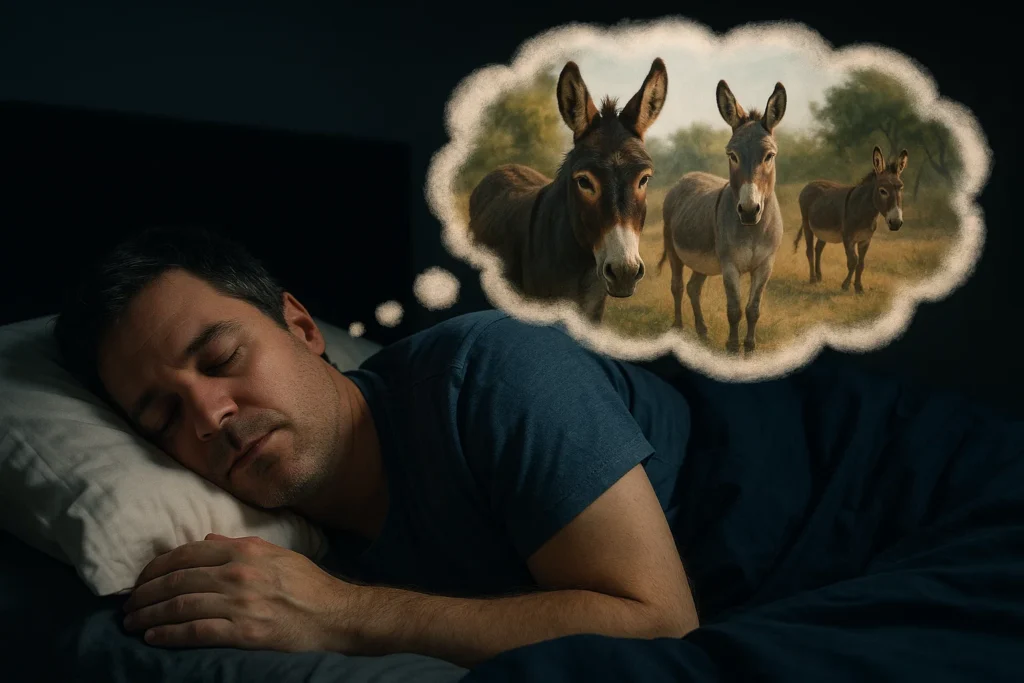
Donkeys appear in American life more than you think—on small farms, at county fairs, in therapy animal programs, and as cultural icons of work ethic, patience, and stubborn wisdom. In dreams, they often arrive during seasons when you’re carrying a heavy load: finals week, back-to-back shifts, caregiving, immigration paperwork, a cross-country move, or the quiet grind of building savings. Unlike horses (speed, prestige), the donkey symbolizes reliable strength, humility, and good sense—the kind of power that shows up daily and doesn’t perform for applause.
This comprehensive guide unpacks donkey dreams across psychological, spiritual, cultural, and biblical lenses. You’ll get highly specific scenarios by color, species/type, number, behavior, and setting; three practical frameworks to apply immediately; short U.S.–centric case studies; a rapid Symbol → Action map; an expanded FAQ; and a dedicated Dream Number & Lucky Lottery Meaning section. Expect nuance—plus actionable steps you can do in 10–20 minutes.
Psychological Meanings of Donkey Dreams
Core Themes
- Steady Work & Endurance: Consistent effort beats flashy sprints; the dream validates sustainable pacing.
- Boundaries & Stubbornness: “Digging in” can be resilience—or avoidance. The psyche asks: Where is “no” wisdom, not defiance?
- Carrying Loads: Emotional labor, invisible tasks, debt, family obligations. Donkeys point to weight distribution.
- Service Without Spectacle: Pride in honest craft; recognition may be late but durable.
Behavior & Cognition
REM sleep rehearses how you allocate energy and sequence tasks. A donkey dream often runs a loop: assess the load → test footing → take the next sure step. Emotional tone guides interpretation:
- Calm, sure-footed donkey: Your plan is realistic; keep pacing and hydration/rest.
- Overburdened, staggering donkey: Scope creep; redistribute or drop weight.
- Kicking or braying: A boundary has been crossed; your “no” needs to be audible and enforceable.
- Refusing to move: The plan is unsafe or misaligned; revise route, tools, or expectations.
Archetypes / Jungian Layer
Donkey embodies the Humble Servant and Truth-Teller by Refusal. Its message lands in:
- Head (planning): pick the safe path, not the scenic one.
- Heart (dignity): honor your worth even in unglamorous roles.
- Hand (craft): competence is ritual—tools, checklists, maintenance.
Spiritual Meanings of Donkey Dreams
Uplift & Guidance
Spiritually, donkeys mark quiet guidance, everyday miracles, and sacred usefulness. They highlight right-sized ambition and the holiness of small, faithful tasks. Expect synchronicities around paths, gates, loads, and timing—doors that open only when you carry what actually belongs to you.
Protection / Renewal
Donkeys protect by refusing unsafe terrain. A spiritual read: slow down, lighten the pack, and respect limits. Renewal looks like sabbath practices—structured rest, simple meals, silence from attention-draining apps, and gratitude for what works.
Cultural Perspectives on Donkey Dreams
Snapshots; respect your own tradition.
U.S./Western Everyday Symbolism
Rural pragmatism, blue-collar reliability, therapy/companion animals, and the cautionary tale against overworking for under-thanks. Politically, donkeys can also cue party identity—interpret with care: is the dream about you or about discourse?
Mediterranean & Near Eastern
Donkeys are lifeline logistics—market runs, water, family transport. Symbolically: provision, patience, and rightful burden-sharing.
Latin American (broad)
The burro often signifies familial duty, mutual aid, and humor under pressure. A stubborn burro can be a loving nudge to reorganize chores and avoid martyrdom.
Biblical and Christian Readings
Scriptural Parallels
From Balaam’s speaking donkey (truth confronting folly) to the humble animal that carries Jesus, donkeys point to discernment, humility, and fulfilled purpose without fanfare. They signal peaceful service rather than warlike display, wise refusal when danger looms, and provision on ordinary roads.
Calling, Humility & Integrity
A Christian lens emphasizes servant leadership: keep covenants, carry only rightful loads, and speak truth kindly but firmly. If the donkey appears in a sanctuary or near a Bible, treat the dream as a call to honest work rhythms and clean motives.
Detailed Dream Scenarios and What They Might Mean
By Color
- Gray (common): Everyday steadiness. Action: commit to a realistic weekly cadence (work/study/rest blocks).
- White: Purity of motive, service with grace. Action: do one unseen kind act—no posting, no credit.
- Black/Dark: Hidden burdens, financial or emotional. Action: list debts/obligations; choose one to address this week.
- Brown/Russet: Home logistics and caregiving. Action: redistribute chores; post a simple rota.
- Spotted/Painted: Mixed roles causing friction. Action: clarify your job scope in writing.
By Species/Type (U.S. context)
- Standard Donkey/Burro: Reliable day-in day-out effort; local errands of life.
- Miniature Donkey (therapy): Comfort, gentleness, trauma-aware pacing.
- Mule (donkey × horse): Hybrid power + caution—strong but won’t be pushed into unsafe moves. Action: insist on safety checks.
- Wild ass/onager (symbolic): Untamed autonomy. Action: protect creative time; avoid micromanagement.
- Pack Donkey (saddled): Documentation and logistics. Action: inventory load, remove 20%.
By Number
- One donkey: Personal duty; your lane. Action: pick one priority and finish.
- Two (pair): Shared yoke; partnership balance. Action: renegotiate who carries what.
- Three: Triaging loads—keep, delegate, drop.
- Herd: Community logistics; policy-level fixes (schedules, budgets, staffing).
By Behavior
- Walking steadily: Sustainable plan. Action: protect routine from interruptions.
- Refusing to move: Misaligned task/safety concern. Action: revise route, tools, or timeline; say “no” clearly.
- Braying loudly: Message/boundary needs airtime. Action: send a firm, kind email about scope.
- Kicking: Resentment or unsafe handling. Action: stop silent compliance; require consent-based workload.
- Carrying an overloaded pack: Martyr pattern. Action: drop one obligation today; decline future repeats.
- You’re grooming/feeding it: Rest and maintenance. Action: schedule recovery—sleep, water, mobility.
- Crossing a narrow bridge: Transitional stress. Action: lighten load + one spotter/mentor.
By Setting
- Farm or trail: Practical diligence; daily cycles. Action: install a simple morning setup ritual.
- Market/urban alley: Errands, side gigs, paperwork. Action: batch tasks; keep receipts.
- Desert road: Endurance under scarcity. Action: plan water (money/time) stops; cut nonessentials.
- School/campus: Study stamina; group work fairness. Action: set clear deliverables and credit.
- Hospital/clinic: Caregiving boundaries. Action: rotate respite; ask for help formally.
Edge Cases
- Talking donkey: Direct truth you’ve ignored. Action: transcribe exact words; test within 72 hours.
- Giant donkey: Overgrown responsibility. Action: escalate resources or re-scope project.
- Mechanical/CGI donkey: Bureaucracy or branding. Action: align optics with real capacity.
- Donkey turns into mule/horse: Role upgrade + risk; keep caution intact. Action: negotiate authority and safety.
Applying the Message: Real-Life Integration
Framework 1: BRAY
Boundaries (what you won’t carry) • Route (safest, shortest path) • Allocation (who carries what) • Yield time (built-in rest).
Steps: Write one sentence for each; post it where you decide work.
Framework 2: LOAD
List every burden • Omit 20% (drop/defer) • Assign owners & deadlines • Document proof (emails, receipts).
Tip: If everything feels “critical,” nothing is. Cut visibly.
Framework 3: PATH
Pace (cadence you can sustain) • Assets (tools, allies) • Terrain (risks, access) • Handoff (delegate or escalate).
Micro-actions (10–20 minutes):
- Cancel one commitment; send a clean, grateful “no.”
- Repack your week: one deep-work block/day + true lunch.
- Create a “Pack List” template (docs/tools/contacts).
- Move money: minimum to debt + cushion to emergency fund.
- Book a recovery slot (stretching, walk, or power nap).
Boundary scripts:
- “That’s beyond my capacity this week. Here’s what I can deliver by Friday.”
- “For safety/quality, we need two people or more time. Which would you prefer?”

Case Studies (Short, Realistic Vignettes)
Evan, 20, commuter student — Dream: an overloaded donkey stalls at a campus bridge. Meaning: unsafe scope. Action: drops one elective; asks lab partner to split duties; grades rebound.
Rosa, 35, CNA & mom of two — Dream: a calm donkey lets her brush it after a double shift. Meaning: maintenance = love. Action: schedules 20-minute nightly wind-down; sleep and mood stabilize.
Malik, 42, warehouse lead — Dream: two pack donkeys carry uneven loads; one kicks. Meaning: unfair distribution. Action: reassigns tasks and adds pallet jacks; injury risk falls.
Ava, 31, nonprofit program manager — Dream: a donkey brays at a locked office door. Meaning: speak up. Action: sends a scope email; board approves phased rollout.
Quick Reference: Symbol → Action
- Overloaded pack → Remove 20%; renegotiate scope.
- Refusal to move → Safety check; change route/tools/timeline.
- Braying → State boundary in writing.
- Steady walk → Protect routine; keep cadence.
- Grooming/feeding → Schedule recovery and tool care.
Gentle Cautions
- Don’t romanticize overwork—martyrdom isn’t virtue.
- “Stubborn” can be wisdom; verify risk before forcing movement.
- Share loads transparently; invisible labor breeds resentment.
- If the dream triggers panic, burnout signs, or despair, consult a professional.
- Keep records—boundaries stick better when documented.
Expanded FAQ
Are donkey dreams good or bad?
Mostly instructional—they tune your pace, boundaries, and load management.
Why was the donkey stubborn?
Likely a safety or alignment issue. Revise plan; don’t bulldoze.
Donkey vs. horse in dreams?
Horse = speed/status; donkey = safety/endurance/service. Choose the symbol’s wisdom that fits your season.
What if the donkey talked?
Treat it as direct counsel. Write down the line and test it in a small way within 72 hours.
Is a mule different symbolically?
Yes—hybrid strength plus caution. Demand proper tools/training before heavy lifts.
White donkey meaning?
Service with pure motive; humility that elevates others. Do one unseen good deed.
Donkey in church/Bible setting?
Integrity and servant leadership. Carry rightful loads; refuse what violates conscience.
The donkey kicked me—bad omen?
It’s a boundary alarm. Something is unfair or unsafe. Address the handler, not the animal—fix system issues.
Recurring donkey dreams?
Run LOAD weekly for a month. Recurrence usually fades when behavior matches the message.
Does this predict money or promotion?
Not directly. It predicts that sustainable pacing + clear scope increases odds of durable success.
Dream Number & Lucky Lottery Meaning
Symbol-derived numbers:
- 4 (sure footing; stable cadence)
- 6 (workdays/service rhythm)
- 8 (loops of effort → rest)
- 12 (shared yoke; months of steady progress)
- 22 (double boundaries; firm “no”)
- 40 (testing seasons; endurance)
Lucky sets (entertainment only):
- Pick-2/3: 0-4, 4-6-8, 1-2-2
- Pick-4/5: 0-4-1-2, 0-8-2-2, 0-4-6-8-1
- Power/Jackpot style: 4, 6, 8, 12, 22, 40
Disclaimer: For fun and cultural interest—this is not financial advice. Play responsibly.
Conclusion
Donkey dreams champion dignified work, honest limits, and safe progress. Drop one burden, state one boundary, and schedule one recovery ritual today. The humble animal in your dream isn’t asking for applause—it’s showing you the dependable road to results.