A musician in your dream turns your inner life into sound—melodies for desires you’ve muted, rhythms for work you’ve avoided, and harmonies for parts of you that want to collaborate. The figure may be dazzling on stage, shy in a corner, or painfully off‑key. Read the performance as a live dialogue about creativity, practice, audience, and permission to take up space. Begin by naming the dominant emotion (inspired, blocked, jealous, exposed, proud), then link it to one live arena: a project you’re postponing, a stage you’re craving, a boundary you need, or a value you don’t want to betray.
Quick Summary
Dreams about musicians rarely predict fame; they highlight your relationship with creativity, courage, and audience. A generous, skillful performer signals readiness to practice and share; a harsh critic or botched set mirrors comparison wounds, perfectionism, or fatigue; becoming the musician yourself is a future‑self rehearsal—showing that small, steady reps beat waiting for inspiration. Decode by matching the dream’s tone to one real situation, then take a concrete step: protect a focus window, ship a draft, ask for clean feedback, or set a humane limit so your art—and life—can breathe.
Core Meanings at a Glance
- Voice & identity: Instruments, timbre, and lyrics symbolize the self you’re willing to reveal and the story you dare to tell.
- Practice & craft: Rehearsals, scales, metronomes, and studios represent process over myth—hours that build mastery.
- Audience & visibility: Stages, spotlights, applause, and silence mirror your relationship with being seen, evaluated, or ignored.
- Collaboration & boundaries: Bands, conductors, producers, and contracts highlight teamwork, roles, and consent.
- Value & livelihood: Tips, patrons, gigs, and merch surface pricing, scope, and fair exchange for your energy.
When creative roles blur with everyday relationships, you’ll notice the same dynamics of belonging, feedback, and limits explored in Dream About People.
Symbolism by Instrument & Setting
- Voice (singing): Truth, vulnerability, and breath. Losing your voice points to over‑arousal or self‑silencing; vocal ease signals congruence.
- Piano/keyboard: Structure + emotion; left/right hand balance = logic and feeling in dialogue.
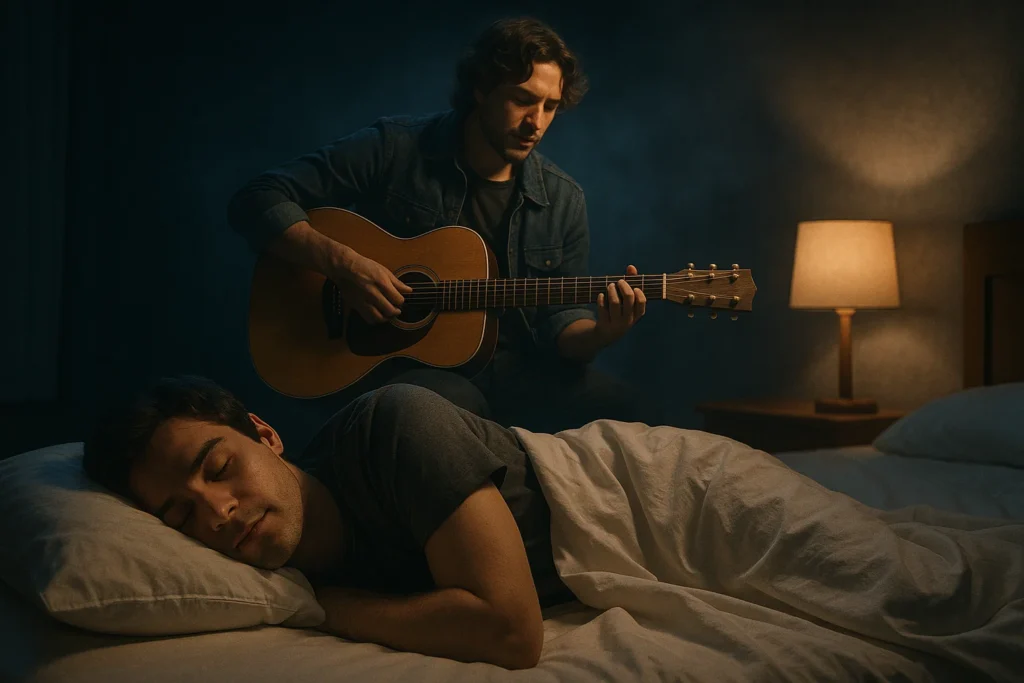
- Guitar/bass: Storytelling and groove; broken strings reflect thin margins or over‑stretching.
- Drums/percussion: Grounding and pace; rushing/dragging mirrors time management and nervous‑system load.
- Violin/strings: Sensitivity and attunement; intonation issues = boundary haze or high standards without rest.
- DJ/electronic: Curation and systems; loops symbolize habits, both helpful and compulsive.
- Choir/orchestra: Collective coordination; your chair/section speaks to role clarity.
- Studio vs. stage: Craft in private versus risk in public; many dreams toggle between the two as a pacing cue.
Common Scenarios and What They Suggest
Playing flawlessly to a receptive crowd
Meaning: Readiness to move from hesitation to practice and share.
Do next: Book a small public deadline (class share, 90‑second clip, open‑mic slot) and prepare one focused rep per day.
Stage fright, broken strings, or a missed cue
Meaning: Over‑arousal, fatigue, or perfectionism.
Do next: Lower inputs, sleep, and restart with constraints (one song, one take, one hour); adopt a pre‑show ritual.
Being criticized by a famous musician
Meaning: Internalized standards or fear of judgment.
Do next: Ask for criteria; keep one actionable note and release the rest.
Band conflict, tuning wars, or no one listening
Meaning: Role confusion and boundary leaks.
Do next: Clarify who plays what, for whom, by when; write it down and share.
Writing a new song or improvising freely
Meaning: Voice is emerging; you’re ready to explore.
Do next: Capture ideas fast (voice memos, notebook) and schedule short, regular jams.
Cancelled gig, power outage, or broken PA
Meaning: External constraints or inner sabotage.
Do next: Build redundancy (spare cable, offline plan) and a “plan B” venue/time for creative work.
When the dream leans toward visual craft, you may resonate with the patterns in Dream About Artist.
Psychological, Spiritual & Cultural Lenses
- Jungian view (Creator archetype): Imagination, pattern‑making, and shadow integration. Shadow shows up as performance addiction or avoidance dressed as “waiting for inspiration.”
- Attachment & audience: Anxious systems over‑perform for applause; avoidant systems hide to dodge critique; secure creativity shares in stages with boundaries and recovery time.
- Threat simulation: Night rehearses visibility, risk, and collaboration so daytime choices get cleaner: draft → feedback → revise.
- States vs. traits: Peak moments are states; method and environment become traits that you can design.
- Spiritual meaning: Calling as service—beauty and truth offered without self‑erasure; excellence as stewardship, not perfection.
- Cultural context: Gatekeeping, algorithms, and class access shape exposure; pace yourself and diversify venues to stay sane.
If creative friction lives inside workplace authority—deadlines, reviews, scope—you’ll hear echoes of approval dynamics in Dream About Boss.
Working With Stage Anxiety
- Physiology first: 6 slow breaths; plant feet; soft gaze. Label: “Nerves → readiness.”
- Micro‑exposures: Speak/sing one line to a safe friend; graduate to a 60–90‑second public share.
- Anchor rituals: Same warm‑up, same water bottle, same mantra. Ritual beats mood.
- Audience of one: Visualize the one listener who benefits; let generosity steady you.
- Debrief cleanly: After sharing, log one win, one tweak. No global self‑attacks.
Practice Systems That Stick
- Time box: 15–30 minutes/day beats occasional marathons.
- Constraint sets: One key, one tempo, one color. Constraints create flow.
- Feedback loop: “One thing to keep, one to improve” from a trusted peer.
- Cadence: Weekly or biweekly share; pause newsfeeds before/after.
- Energy budget: Protect sleep; set a polite “no” for scope creep and unpaid asks.
Collaboration & Boundaries
- Roles on paper: Who leads, who arranges, who handles bookings.
- Conflict hygiene: Facts → impact → request; three strikes before exit.
- Rights & money: Scope, price, rights, and credit in writing; timestamp drafts.
- Exit ramps: Define “done,” revision limits, and kill‑fees to prevent resentment.
If creative blocks feel tangled with emotional overwhelm, a skilled reflector can help—threads that overlap with Dream About Therapist.
Advanced Symbol Maps
- Key changes/modulations: Adaptability; learning to pivot without losing theme.
- Tempo: Nervous‑system pacing—allegro weeks vs. adagio rest; both belong.
- Dissonance/resolution: Tolerating tension long enough to find novel harmony.
- Silence/rests: Space for integration; empty bars are musical on purpose.
- Improvisation vs. score: Trusting intuition within clear frames.
Real‑World Integration Plan (7 Days)
- Day 1 – Inventory: List 3 pieces/themes you care about. Pick one.
- Day 2 – Window: Carve a 20‑minute daily slot. Phone in another room.
- Day 3 – Constraint: Choose one constraint (key/tempo/tool). Start.
- Day 4 – Capture: Record a rough take; name one thing to keep.
- Day 5 – Feedback: Ask one trusted person for “keep + improve.”
- Day 6 – Revise: Apply one note; cut 10% of fluff.
- Day 7 – Share: Post or perform a 60–90‑second snippet; log one win and one tweak.
Case Studies
The Open‑Mic Promise
N., 22, dreamed of nailing a small gig but kept postponing. Action: booked a 3‑minute slot and rehearsed daily for 10 days. Outcome: calmer nerves, a satisfying performance, and momentum to write two new songs.
The Ruthless Critic
K., 30, heard a legend tear him down on stage. Action: asked a mentor for clear criteria and kept one actionable note per draft. Outcome: steady progress without shame spirals; a demo shared with joy.
The Silent Band
L., 27, fought tuning wars. Action: clarified roles, tempo, and setlist in a shared doc; set revision limits. Outcome: fewer conflicts, better shows, and a sense of fairness.
The Broken String
P., 24, repeatedly dreamed of a snapped string mid‑solo. Action: built redundancy (spare strings/cables) and practiced “rescue transitions.” Outcome: confidence rose; the nightmare faded.
FAQs
Does dreaming of a musician mean I’m destined for fame?
No. It highlights a live relationship with creativity, practice, and audience.
Why am I always judged or compared?
Your mind is rehearsing visibility. Ask for specific criteria and share in stages.
What if I’m jealous of another musician?
Treat envy as a compass—extract three behaviors to learn and schedule one rep this week.
How do I handle stage fright?
Lower inputs, breathe, rehearse small; constrain the set and invite one friendly face in the room.
Is monetizing my art “selling out”?
It’s about consent and scope. Write terms, protect your voice, and price your energy.
What if my dream shows broken gear or power outages?
Plan redundancy and a “plan B” venue/time; sometimes your system is asking for backup.
Can these dreams be about career or relationships instead of art?
Yes—feedback, roles, and value show up everywhere; translate symbols into those arenas.
Should I share more of my work?
Likely yes—in small, regular releases with rest before and after to protect your nervous system.
How do I restart after burnout?
Sleep first; then constraints + short windows + a gentle witness.
Why do I dream of losing my voice?
Over‑arousal or self‑silencing. Practice breath + a 30‑second script to reclaim voice.
Dream Number & Lucky Lottery Meaning
- Core number: 3 (expression, communication); supporting numbers 5 (experimentation), 6 (harmony), 9 (completion), 11 (inspiration).
- Suggested picks: Two‑digit 33, 36, 59, 69, 11 · Three‑digit 336, 569, 311, 963 · Four‑digit 3359, 3611, 6963 · Six‑number set 3, 5, 6, 9, 11, 33. Use for fun and reflection, not financial advice.
Conclusion
A dream about musician imagery isn’t a verdict on talent—it’s an invitation to practice, share, and protect the conditions where your voice grows. Choose one tiny daily window, one humane deadline, and one boundary that guards your energy. When you convert inspiration into routine, your life—not just your music—starts to sound like you.
Dream Dictionary A–Z
Build your personal symbol map and explore how creativity intersects with mentorship, audience, and collaboration in our index: Dream Dictionary A–Z.
Written and reviewed by the Dreamhaha Research Team, where dream psychology meets modern interpretation — helping readers find meaning in every dream.