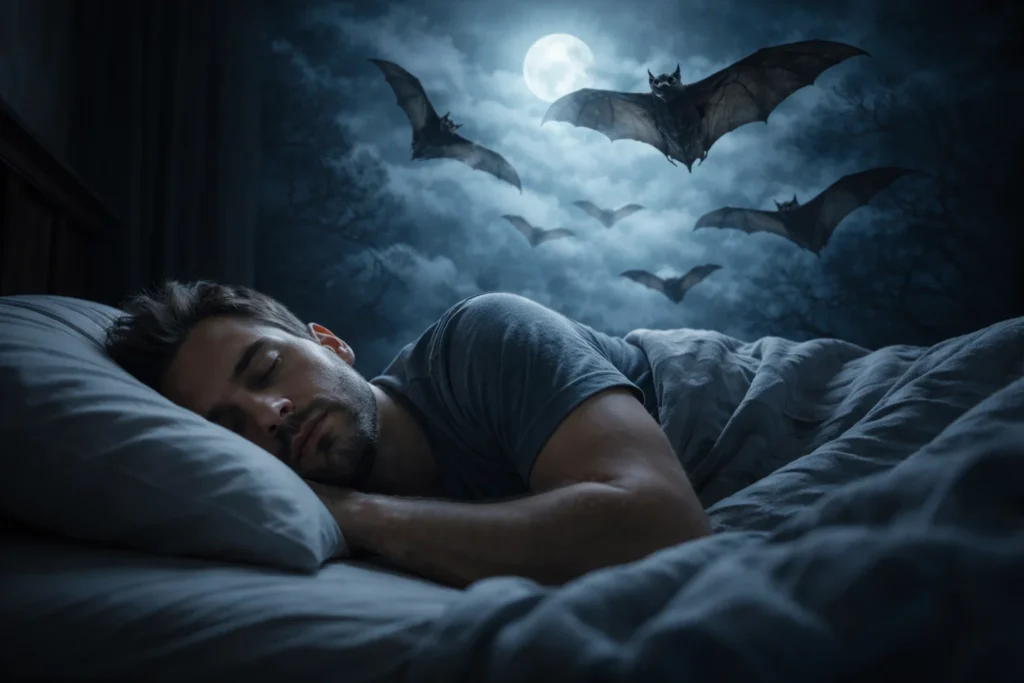
Dreaming about bats can feel eerie in a way that stays with you long after waking. Even when nothing dramatic happens in the dream, the atmosphere often feels strange, dark, hidden, or emotionally charged. You may see bats flying overhead, hanging silently in the shadows, entering your home, circling you at night, or emerging from a cave in a way that feels both unsettling and fascinating. That reaction makes sense. Bats are one of those dream symbols that naturally stir strong feelings because they belong to darkness, hidden movement, unusual perception, and the parts of life we do not fully see. Yet bat dreams are not always negative. Very often, they appear when your inner world is dealing with fear, uncertainty, instinct, transformation, or the need to navigate a situation without full clarity.
Quick Answer
Dream About Bats meaning often points to fear, hidden emotions, intuition, uncertainty, transition, or the need to face something that has been living in the shadows of your mind. In many cases, this dream does not predict danger. Instead, it reflects your relationship with the unknown, especially when you feel vulnerable, emotionally alert, or aware that something important is happening beneath the surface. Depending on the dream context, bats can also symbolize heightened instinct, emotional sensitivity in dark situations, avoidance, discomfort with change, or the beginning of inner transformation that feels unsettling before it feels clear.
Core Symbolism of Bats in Dreams
Bats are powerful dream symbols because they live at the edge of what is visible. They move through darkness, rest upside down, hide in enclosed places, and navigate in ways that seem mysterious from a human perspective. In dreams, this often makes them symbols of what is hidden, unconscious, feared, avoided, or not yet fully understood.
At a subconscious level, bats often represent shadow material. Something may be active in your emotional life that you have not fully named. This could be fear, grief, guilt, suspicion, intuition, or a change that has already begun internally even if your conscious mind has not caught up. The dream uses bats because they fit that feeling exactly: movement in the dark, sensed more than clearly seen.
Bats can also symbolize adaptation. They are creatures of darkness, yet they are not helpless in it. They move with precision through what others might find disorienting. In that sense, a bat dream may not only show fear. It may also show your ability to function in uncertain conditions. You may be learning how to trust instinct when ordinary vision is limited.
Archetypally, bats often carry themes of death and rebirth, hidden knowledge, withdrawal, transformation, and reversal. Because they hang upside down and emerge from darkness, they can symbolize a period in which your usual perspective is being disrupted. Something may look unfamiliar because you are in between one phase of life and another. The image feels strange because the inner transition is real.
Since bats are often associated with wings, movement, and creatures of the air, their symbolism naturally touches the broader dream field of Dream About Birds, though bats usually carry a darker, more shadow-oriented emotional tone than most bird dreams.
Spiritual Meaning of Dreaming About Bats
Spiritually, dreaming about bats often points to navigating a season of inner darkness without yet having full answers. This is not necessarily a bad sign. In a balanced reading, darkness in dreams can symbolize mystery, transition, gestation, spiritual listening, or the need to trust what is sensed before it is fully seen.
A bat dream may appear when your usual way of understanding life is no longer enough. You may be in a period where certainty has thinned out, but intuition is growing stronger. The dream can suggest that you are being asked to develop a more subtle kind of awareness. Instead of relying only on what is obvious, you may need to listen to instinct, emotional truth, and quieter signals.
Bats can also symbolize release from false comfort. They emerge when the light changes, which makes them fitting symbols for parts of the self that come forward only when surface distractions fall away. Spiritually, this can mean that something hidden is asking to be acknowledged. That hidden thing may be fear, but it may also be wisdom.
At the same time, the dream can ask whether you are avoiding light in some area of life. Are you staying too long in confusion, secrecy, emotional avoidance, or patterns that feel safer because they remain hidden? The lesson is not to fear the dark, but to move through it with honesty.
When the dream’s emotional atmosphere leans more toward watchfulness, intelligence, and nighttime awareness than raw fear alone, some of its symbolism may overlap with Dream About Owls, where nocturnal wisdom, silence, and hidden perception often become central themes.
A Related Bible Verse
A fitting verse for this dream is Psalm 139:11–12: “If I say, ‘Surely the darkness will hide me and the light become night around me,’ even the darkness will not be dark to you.”
This verse fits the symbolism of bats because bat dreams often unfold in darkness, uncertainty, and emotional hiddenness. In dream interpretation, the value of the verse is not to turn the dream into a rigid warning. It is to offer reassurance that darkness does not automatically mean abandonment or doom. A dream about bats may reflect confusion, fear, or hidden change, but the deeper message can still be one of guidance: what feels obscure to you is not beyond understanding, and what is hidden can still be brought into clarity over time.
Psychological Interpretation
Psychologically, dreams about bats often reflect fear, uncertainty, suppressed emotion, hypervigilance, and the mind’s attempt to process what feels present but not fully visible. These dreams are especially common when you sense that something is wrong, changing, or emotionally active, but you do not yet have clear language for it.
One major theme is anxiety about the unknown. Bats move quickly, appear unexpectedly, and are associated with spaces people often find uncomfortable. In dreams, this can symbolize vague fear rather than specific danger. You may be carrying low-level dread, suspicion, or emotional tension without knowing exactly what it is attached to.
Another important psychological layer is repressed or avoided material. The bat may represent a thought, truth, or feeling you have pushed into the background because it feels too uncomfortable, confusing, or disruptive. The dream brings it back into awareness, not always by explaining it directly, but by making you feel its presence.
Bat dreams can also arise during life transitions. If you are leaving one role behind and have not yet settled into the next, the psyche may use bats to symbolize the discomfort of moving through an in-between state. Everything is less visible than usual, but instinct is active.
The emotional tone matters greatly. Fear may point to avoidance, vulnerability, or emotional overload. Curiosity can suggest emerging self-awareness. Calm observation may mean you are ready to understand what once frightened you. If the bats seem chaotic, the dream may reflect overstimulation or intrusive thoughts. If they are quiet and distant, the dream may point to shadow material that is present but not yet overwhelming.
When the dream atmosphere feels especially ominous, watchful, or associated with dark intelligence, some of its meaning may also brush against Dream About Crows, where mystery, sharp perception, warning, and psychological depth often become more pronounced.
Common Dream Scenarios About Bats
Dream About Bats Flying Around You
This is one of the most common bat dream scenarios. Bats flying around you often symbolize emotional agitation, uncertainty, intrusive fear, or the feeling that something unsettling is active in your environment. If they fly fast and chaotically, the dream may reflect an overstimulated mind. If they move calmly, the dream may suggest that hidden issues are present but not necessarily harmful. Your reaction in the dream is the key.
Dream About Bats in Your House
When bats appear inside your home, the symbolism becomes more personal. Home in dreams usually represents your inner life, emotional boundaries, or private environment. Bats in the house can symbolize hidden fears, unresolved tension, secrets, or emotional discomfort entering a space that should feel safe. The dream may be pointing to something you have not fully addressed in your close relationships or within yourself.
Dream About Being Chased by Bats
Being chased by bats often reflects avoidance. Something in waking life may feel hard to face, and the dream dramatizes that through pursuit. The fear may be emotional rather than literal. You may be running from truth, change, grief, conflict, or an anxiety that follows you because it has not been acknowledged directly.
Dream About a Bat Biting You
A bat bite in a dream can symbolize feeling psychologically invaded, emotionally triggered, or affected by something you tried to keep at a distance. It may point to a fear that is no longer abstract. It has made contact. The dream may also reflect betrayal, shock, or a sudden awareness that a hidden issue has become personally relevant.
Dream About Many Bats or a Bat Swarm
A swarm of bats often symbolizes overwhelm through hidden or unclear stress. You may be dealing with many anxieties, too much internal noise, or an emotional situation that feels larger and darker than you can easily organize. These dreams often occur when your mind is struggling to sort multiple fears at once.
Dream About a Dead Bat
A dead bat can symbolize the ending of fear, the exposure of something once hidden, or the loss of a shadow pattern that no longer controls you. It may also reflect emotional exhaustion if the dream feels empty rather than freeing. The full meaning depends on whether the dream leaves you relieved, sad, disturbed, or calm.
Dream About Bats in a Cave
This is one of the clearest shadow-symbol scenarios. A cave often represents the unconscious, the unknown, retreat, or what has been kept hidden for a long time. When bats emerge from or live inside a cave, the symbolism becomes especially strong. Something buried in the psyche may be active and ready to be faced. In these dreams, the wider emotional setting may also connect naturally with Dream About Cave, where inner depth, hidden fear, withdrawal, and psychological descent become central.
How This Dream Connects to Your Real Life
Love and Relationships
In relationships, bats often symbolize fear of what is hidden. This can include distrust, emotional distance, unspoken resentment, anxiety about betrayal, or the feeling that something important is happening beneath the surface. A bat dream may appear when you sense emotional change in a bond but do not yet understand it clearly.
It can also reflect your own withdrawal. You may be protecting yourself by becoming less visible, less emotionally open, or more avoidant. In that case, the dream is not only about what you fear in others. It may be showing how you respond when closeness starts to feel uncertain or unsafe.
Career and Money
At work, bat dreams often point to unseen tension, unclear motives, or background stress that is affecting you even if no one is naming it openly. You may be picking up on politics, instability, secrecy, or the emotional cost of working in uncertainty. The dream may also symbolize transition in your role, especially if you no longer feel oriented by the old structure but have not yet found your next direction.
Financially, bats can symbolize fear of instability or worry about what you cannot fully predict. This is especially true if the dream happens during a time of hidden costs, unclear plans, or vague stress around security.
Personal Growth
From a growth perspective, bat dreams often appear when you are confronting your shadow. This does not mean something evil or dramatic. It usually means you are becoming more aware of uncomfortable truths, hidden habits, buried emotions, or parts of yourself you once avoided. Growth at this stage often feels less like confidence and more like honesty.
Bats can also symbolize transformation through discomfort. You may be learning how to move without certainty, how to trust intuition, and how to stay present in emotional darkness without rushing to false clarity. When the dream emphasizes wings, motion, or movement through uncertainty, some of its meaning may also touch Dream About Flying, though the emotional tone in bat dreams is usually more shadowed and introspective.
Health and Emotional State
Emotionally, these dreams often reflect hypervigilance, stress, sleep disturbance, and the sense that your nervous system is staying alert even when you want rest. Because bats belong to the night, they can symbolize mental activity that becomes louder when external distractions fade away.
If you have been dealing with anxiety, exhaustion, nighttime rumination, or fear that grows stronger in solitude, the dream may be translating that inner state into imagery. In that sense, the emotional atmosphere can connect strongly with Dream About Darkness, Dream About Fear, and Dream About Night, where uncertainty, vulnerability, and what emerges after the world quiets down become more central.
Is Dreaming About Bats a Positive or Warning Sign?
Dreaming about bats can feel like a warning sign when the dream highlights avoidance, hidden stress, fear, secrecy, emotional invasion, or a growing sense that something important is being ignored. In those cases, the warning is usually not about supernatural danger or fixed prediction. It is about psychological truth. The dream may be asking you to stop pretending that what feels unsettled is not affecting you.
At the same time, bat dreams can also be positive in a deeper sense. They may signal that you are becoming more aware of what used to stay buried. That awareness can be uncomfortable, but it is often the beginning of real transformation. If the bats do not harm you, or if you observe them with growing calm, the dream may be showing that you are ready to face what once frightened you.
The key question is whether the dream leaves you feeling powerless or more conscious. If it increases clarity, even through discomfort, it is already doing healing work.
Case Studies
A woman sensing hidden tension in a relationship
A woman dreamed that bats were flying silently through her living room while her partner acted as if nothing was wrong. In waking life, she felt that emotional distance had been growing, but no direct conversation had happened. The dream reflected hidden discomfort inside a private space. It was less about danger than about what had been quietly avoided.
A man going through a major identity shift
A man dreamed that he was standing in a cave while bats flew past him into the open night sky. He had recently left a long-term career and felt disoriented. The dream seemed to reflect transition through darkness. What looked frightening at first also carried movement, release, and the beginning of a new direction.
A student dealing with nighttime anxiety
A university student dreamed that bats kept circling her whenever she tried to fall asleep. In waking life, she was struggling with anxious thoughts that became strongest at night. The dream did not introduce a new problem. It visualized the one she was already living with: fear becoming louder when everything else went quiet.
A man confronting buried grief
A man dreamed that he found a single bat hanging in an old building from his childhood. He felt afraid at first, then sad. He had recently started thinking about the death of a family member he never fully grieved. The bat seemed to symbolize something long hidden in emotional darkness that was finally ready to be felt.
A woman becoming less afraid of her inner world
A woman dreamed that she watched bats fly at dusk from a distance, but instead of panicking, she felt calm and curious. In waking life, she had been doing therapy and becoming more honest about parts of herself she used to avoid. The dream suggested progress. The shadow was still present, but it was no longer entirely threatening.
Dream Numbers
In some symbolic traditions, bats may be loosely associated with numbers like 4, 7, and 13 because they are often linked with mystery, reversal, hidden movement, and transformation. These associations vary across systems and should be treated lightly. In real dream interpretation, the emotional structure of the dream matters far more than any number symbolism.
Lucky Lottery Meaning
Some folk beliefs connect dark or unusual dream animals with lucky numbers or hidden signs. If bats are interpreted in that folkloric way, they are usually associated with secrecy, reversal, or change rather than simple good luck. This should remain only a matter of cultural belief, not a certainty or encouragement to gamble.
FAQ
What does it mean spiritually to dream about bats?
Spiritually, dreaming about bats often symbolizes navigating inner darkness, trusting instinct, becoming aware of what is hidden, and moving through uncertain emotional territory with deeper perception.
Are bats a bad sign in dreams?
Not always. They can feel ominous, but in most cases they symbolize fear, hidden emotions, uncertainty, or transformation rather than literal danger. The tone of the dream matters a great deal.
What does it mean if bats are inside my house in a dream?
Bats in your house often suggest that hidden fear, tension, secrecy, or emotional discomfort has entered your private life or inner world and needs more honest attention.
Why do I keep dreaming about bats?
Recurring bat dreams often happen when you are dealing with unresolved fear, shadow material, nighttime anxiety, emotional avoidance, or a major transition that feels unclear and psychologically intense.
What does a bat bite mean in a dream?
A bat bite often symbolizes that something hidden or feared has become personal and immediate. It may reflect emotional intrusion, shock, betrayal, or a fear that has moved from the background into direct impact.
Conclusion
Dreaming about bats often reveals what moves in the shadows of your emotional life. This symbol points to fear, hidden truth, uncertainty, instinct, and the strange but meaningful process of learning to navigate what is not yet fully visible. A bat dream can be unsettling, but it is often less about doom than about awareness. It may be asking you to face what has been avoided, trust what your deeper instincts already sense, and move through darkness with more honesty than panic. When you do, the dream becomes less of a threat and more of a guide through a difficult but transformative inner passage.