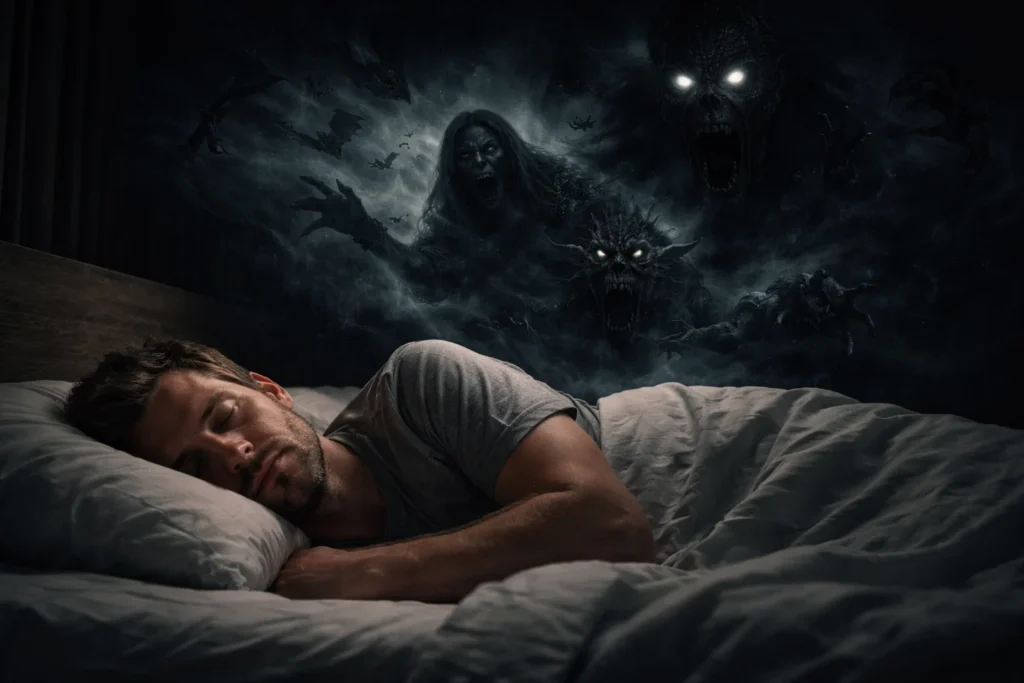
Dreaming about fear can stay with you long after waking because the emotion often feels immediate, physical, and deeply personal. Your heart may race in the dream. You may be running, hiding, freezing, or simply sensing that something is wrong without knowing exactly what it is. Sometimes the dream includes a threat you can clearly see. Other times, the fear itself is the main event, as if your body knows danger even when your mind cannot name it. That is what makes fear dreams so important. They are rarely just about being scared. They often reveal what your inner world is trying to protect, what your subconscious still finds unresolved, and where your emotional system may be carrying more pressure than you realize.
Quick Answer
Dream About Fear meaning often relates to vulnerability, unresolved stress, inner insecurity, avoidance, emotional overwhelm, or a situation in waking life that feels uncertain or difficult to face directly. Dreaming about fear does not usually predict the future. Instead, it often shows that your mind and body are processing threat, pressure, instability, or emotional tension, whether the source is external, internal, or partly hidden from conscious awareness. Depending on the context, fear in dreams can also be a signal that you need stronger boundaries, more rest, greater honesty about what is affecting you, or a healthier way to face what you have been avoiding.
Core Symbolism of Fear in Dreams
Fear is one of the most universal dream emotions because it is tied so closely to survival. At the most basic level, fear in dreams symbolizes the perception of threat. But in dream language, a threat is not always literal. It may be emotional, relational, social, spiritual, or psychological. You may fear rejection, loss of control, failure, shame, abandonment, conflict, illness, change, or something unknown that you cannot yet put into words.
That is why fear dreams are so rich in symbolic meaning. Fear often appears when something important feels unstable. The dream may be dramatizing a real life uncertainty, but it may also be drawing attention to an inner state. Sometimes the fear points to something external that truly needs caution. Other times, it reflects the nervous system carrying too much tension, anticipation, or unresolved emotional material.
Fear also symbolizes vulnerability. A dream about fear often reveals the places where you do not feel strong, safe, prepared, or protected. Many people dislike fear dreams because they feel powerless inside them. Yet that very powerlessness can be the message. The dream may be showing you where you need support, clarity, healing, or stronger emotional grounding.
Another major symbolic layer is avoidance. Fear dreams often arise when there is something in waking life that you do not fully want to face. This does not mean you are weak. It means your psyche knows that a certain issue carries emotional charge. The dream brings that charge into awareness. You may not be ready to deal with the issue directly during the day, but the subconscious continues working on it at night.
Fear can also act as a doorway emotion. In dream interpretation, fear is often not the final truth but the first signal. Underneath fear there may be grief, anger, shame, hurt, helplessness, or exhaustion. The dream shows fear because fear organizes the body quickly. It gets your attention. It activates the whole system. But once you look closer, you may discover deeper emotional layers beneath it.
This is why fear dreams naturally overlap with the emotional intensity found in Dream About Anxiety, where anticipation, worry, and internal tension often shape the dream atmosphere even before a visible threat appears.
From a Jungian perspective, fear in dreams may reflect confrontation with the shadow, with the unknown, or with parts of the self that the conscious personality is not yet ready to integrate. Freud might look at fear dreams through the lens of repression, unresolved wish conflict, or disguised emotional content. Modern psychology often sees fear dreams as emotional processing, threat simulation, stress discharge, and symbolic rehearsal of danger.
Culturally, fear is also shaped by personal history. A person raised in chaos may dream fear differently than someone raised in emotional stability. For one dreamer, fear may signal remembered danger. For another, it may reflect social pressure or perfectionism. This personal context matters. Fear in dreams is universal, but what triggers it is deeply individual.
Spiritual Meaning of Dreaming About Fear
Spiritually, dreaming about fear often points to inner imbalance, loss of trust, or a soul that feels overburdened by uncertainty. This does not mean the dream is a supernatural warning in a dramatic sense. More often, it reflects a struggle between fear and faith, fear and surrender, fear and emotional truth.
A fear dream may appear when you are trying to hold everything together through control alone. Spiritually, fear often grows where trust has become weak, where the heart feels unsupported, or where life seems too uncertain to rest in. The dream may be asking you to notice where you are living from constant defense rather than grounded presence.
At the same time, fear can be spiritually informative. It can reveal what still rules your decisions. What do you obey without realizing it? What possibility do you avoid because fear keeps whispering worst case outcomes? What truth do you delay because you are afraid of what it might change? In this sense, the dream is not punishing you. It is showing you where fear still has power.
Some fear dreams also emerge during spiritual transition. When your identity, beliefs, or direction in life are changing, the unknown can feel threatening even when growth is actually happening. The old self does not disappear quietly. Sometimes it reacts with fear because it cannot yet see what comes next.
There are also cases where fear in dreams serves as discernment. Not every fear should be dismissed. Sometimes the dream reflects a real intuition that something in your environment feels wrong, manipulative, unsafe, or emotionally costly. The challenge is learning to distinguish grounded discernment from fear fed by exhaustion or old wounds.
This deeper spiritual tension often connects with the emotional overwhelm described in Dream About Panic, where fear becomes so intense that it feels immediate, bodily, and hard to reason with.
If you keep having fear dreams, repetition may suggest that your inner world is trying to process something that has not yet found resolution. Spiritually, the invitation is not to shame yourself for being afraid, but to understand what the fear is trying to guard, expose, or prevent.
A Related Bible Verse
A fitting verse for this symbol is Isaiah 41:10: “Fear not, for I am with you; be not dismayed, for I am your God.”
This verse speaks to fear in a balanced and compassionate way. It does not pretend fear is unreal. It meets fear with reassurance. In the context of dream interpretation, the verse can remind the dreamer that fear does not have to become identity. A dream about fear may reflect real strain, uncertainty, or vulnerability, but it can also point toward the need for steadiness, support, and trust rather than constant inner alarm.
Psychological Interpretation
Psychologically, fear dreams often reflect activation of the mind’s threat system. When your nervous system is carrying pressure, uncertainty, or unresolved emotional material, dreams may express that state through fear because fear is one of the clearest ways the brain signals that something needs attention.
One common cause is chronic stress. A person may function reasonably well during the day while still carrying a deep layer of inner tension. At night, that tension can become fear imagery or fear sensation. The dream may involve running, hiding, being watched, being trapped, or simply feeling dread without explanation. In many cases, the dream is not about one specific event. It is about the body processing accumulated strain. That overlap becomes clearer when compared with Dream About Stress, where the pressure may feel more diffuse in waking life but still reaches dream form through tension and overload.
Another common cause is unresolved insecurity. You may fear failure, confrontation, abandonment, financial instability, physical danger, or emotional exposure. Even if you do not consciously dwell on these fears, the subconscious often continues scanning for them. Dreams become a place where those concerns appear symbolically, sometimes in exaggerated form.
Fear dreams can also result from avoidance. If there is a conversation, decision, or truth you do not want to face, the mind may symbolize that avoidance through chase dreams, hiding dreams, or formless dread. The fear is not random. It is often attached to something your conscious mind keeps postponing.
Trauma history and emotional conditioning also matter. People who have lived through instability, criticism, neglect, or sudden shocks may have stronger fear dreams because the nervous system learned to stay alert. The dream may not be replaying the past exactly, but it may be using fear to express how the body still protects itself.
The feeling tone inside the dream is essential. If the fear felt sharp and immediate, the issue may be active in present life. If it felt old, familiar, or strangely repetitive, the dream may be linked to deeper emotional patterns. If you felt ashamed for being afraid, then fear may be combining with self judgment. If you felt frozen rather than panicked, the dream may reflect helplessness or overwhelm rather than raw terror.
Fear can also blend with anger. Many people become angry when they feel cornered, exposed, or unable to control what is happening. In dreams, this crossover can be important. A dream that begins in fear may shift into aggression because the psyche is moving from vulnerability into defense. This is one reason fear dreams sometimes share emotional ground with Dream About Anger, where the deeper issue may still be pain, threat, or violated boundaries.
At a deeper psychological level, fear dreams ask a practical question: what does your system believe it must stay alert against? The answer is often more revealing than the dream image itself.
Common Dream Scenarios About Fear
Dream of Being Afraid Without Knowing Why
This is one of the most common fear dream forms. It often reflects generalized emotional tension, uncertainty, or subconscious threat awareness without a single clear target. You may be carrying worry from multiple directions at once, making the fear feel real even when the dream offers no explanation.
Dream of Running Away in Fear
Running in fear often symbolizes avoidance. There may be something in waking life that feels too emotionally charged to confront directly. The dream does not always mean physical danger. It may represent conflict, responsibility, grief, change, or an uncomfortable truth.
Dream of Freezing in Fear
Freezing usually reflects helplessness, emotional overload, or a situation in which you do not feel empowered to act. This can connect to life experiences where speaking up felt unsafe, where shock replaced action, or where the body learned that stillness was the only protection available.
Dream of Someone or Something Chasing You
A chase dream is one of the clearest examples of fear attached to avoidance. The pursuer may represent a person, issue, emotion, or obligation that keeps demanding attention. If the pursuer feels intensely aggressive, the emotional tone may begin to resemble the escalation seen in Dream About Rage, especially when the fear carries a sense of violence, attack, or emotional eruption.
Dream of Being Scared in the Dark
Fear in darkness often points to the unknown. You may be dealing with something you cannot fully understand, predict, or control. The darkness symbolizes uncertainty itself, while the fear reveals how difficult it feels to move without clarity.
Dream of Being Afraid for Someone Else
This scenario often reflects protectiveness, attachment anxiety, or fear of loss. The dream may not be predicting harm. More often, it is showing how deeply your care for that person is connected to worry, responsibility, or a desire to keep them safe.
Dream of Fear Turning Into Crying
When fear turns into tears, the dream often reveals vulnerability beneath hypervigilance. The core emotion may actually be grief, exhaustion, or a deep need for comfort. The crying suggests that the fear has moved beyond defense into emotional truth.
Dream of Hiding Because of Fear
Hiding dreams often reflect emotional retreat. You may be protecting yourself from criticism, judgment, conflict, exposure, or failure. Sometimes the dream highlights a real need for rest and safety. Other times, it shows that self protection has become avoidance.
How This Dream Connects to Your Real Life
Love and Relationships
In relationships, fear dreams often point to vulnerability. You may fear being hurt, misunderstood, abandoned, betrayed, or emotionally exposed. Even in good relationships, old wounds can remain active beneath the surface, causing dreams where intimacy feels unsafe or unstable.
If you are dating, the dream may reflect uncertainty about trust. You may like someone but still fear disappointment or emotional risk. In a long term relationship, fear dreams can appear when communication feels fragile, when needs go unspoken, or when past conflict still shapes present reactions.
Fear in love can also be mixed with insecurity and comparison. You may worry that someone else matters more, that you are not enough, or that what you have could be taken away. In those cases, the dream may overlap emotionally with Dream About Jealousy, where fear of loss, comparison, and emotional insecurity intensify how relationships are experienced.
Career and Money
In work life, fear dreams often reflect pressure about performance, stability, reputation, or future uncertainty. You may fear failure, being exposed as inadequate, losing income, disappointing others, or making the wrong decision. Even if you appear capable on the outside, the dream may reveal how much internal pressure you are carrying.
Financial fear can be especially powerful because it touches survival, identity, and control all at once. The dream may not literally be about money, but the body may use fear imagery to process insecurity related to bills, debt, career competition, or unstable plans.
If the dream repeats, it may be worth examining whether your lifestyle has normalized too much pressure. Sometimes fear dreams are the mind’s way of saying that you cannot build peace on constant internal alarm.
Personal Growth
On the level of personal growth, dreaming about fear can be deeply meaningful. Fear often appears when change is close. You may be outgrowing an old identity, preparing for a risk, or approaching a truth that could alter how you live. Growth sounds inspiring in theory, but in practice it often feels uncertain, exposed, and uncomfortable.
A fear dream may reveal exactly where your edge is. What kind of life would require more courage than your current self feels ready for? What truth would ask you to let go of old control? The dream does not mean you should rush. It means the threshold is visible.
Some dreams also show fear because the dreamer has learned to avoid embarrassment, rejection, or judgment at all cost. Personal growth then requires not the elimination of fear, but the willingness to move while fear is still present. That can be especially relevant when the emotional tone resembles themes in Dream About Embarrassment, where social exposure and self consciousness shape what feels threatening.
Health and Emotional State
Emotionally, fear dreams often appear when the nervous system is overstretched. Lack of rest, chronic worry, burnout, overstimulation, and unresolved emotional strain can all make fear more likely to surface during sleep. The dream becomes a nighttime expression of what the body has not fully discharged.
If the dream feels physically intense, such as sweating, racing heart, or waking suddenly, it may reflect a body that is already on high alert. That does not automatically mean something is wrong in a medical sense, but it can be a sign that emotional recovery needs more attention.
These dreams can also show where your emotional environment feels unsafe. Sometimes fear dreams arise not because of one dramatic event, but because daily life contains too much unpredictability, criticism, conflict, or pressure. The mind does not need catastrophe to produce fear. Repeated exposure to low grade threat can be enough.
Another important possibility is that fear hides blocked frustration. When people cannot act, speak, or protect themselves, fear often turns into tension. Over time, that tension may carry the flavor of Dream About Frustration, where blocked movement and emotional pressure create an exhausting sense of being stuck.
Is Dreaming About Fear a Positive or Warning Sign?
It can be either, depending on the context.
A more positive fear dream may show that your subconscious is helping you process vulnerability honestly. It may reveal where growth is happening, where greater courage is needed, or where your inner world is becoming aware of truths that were previously denied. In this sense, fear is not the enemy. It is information.
A warning oriented fear dream usually appears when stress, insecurity, avoidance, or emotional overload has reached a level that needs attention. If the dream is recurring, physically intense, or linked to strong helplessness, it may be asking you to look at what in waking life feels persistently unsafe, unstable, or unaddressed.
Still, fear dreams should not automatically be treated as omens. They are usually symbolic reflections of your emotional condition rather than predictions of coming disaster. The healthiest interpretation stays grounded. Fear may be alerting you, but it is not automatically telling you that something terrible will happen.
In many cases, the dream is simply descriptive. It shows the emotional weather inside you. That alone can be useful, because people often underestimate how much tension they are carrying until it begins to appear clearly in dreams.
Case Studies
A Woman Afraid of Making the Wrong Career Choice
A woman dreamed she was standing at a crossroads at night, unable to move because she felt terrified of choosing the wrong path. In waking life, she was considering a job change that could improve her future but also carried financial risk. The dream reflected not prophecy, but the emotional burden of uncertainty. Her fear was tied to responsibility and the pressure to choose perfectly.
A Man Whose Fear Hid Grief
A man dreamed that someone was trying to break into his childhood home. He woke in intense fear, but later realized he had recently lost a family member and had not really cried. The dream fear was real, but underneath it was grief and the feeling that emotional safety had been broken. Once he allowed himself to mourn, the dream stopped repeating.
A Student Living With Constant Pressure
A university student kept dreaming that she was late to an exam and could not find the classroom. She woke anxious every time. During the day, she told herself she was coping fine, but she was exhausted from trying to meet everyone’s expectations. The dream translated chronic pressure into fear, showing how overloaded her system had become.
A Person Afraid of Intimacy After Betrayal
After a painful betrayal, a woman dreamed she was hiding in a locked room while someone she loved knocked outside. She felt fear, not comfort. In waking life, she wanted closeness again but did not trust it. The dream captured the conflict between longing and self protection. Her fear was not random. It was the emotional memory of being hurt.
A Young Professional Ashamed of Looking Weak
A young professional dreamed he was frozen on stage, unable to speak while people watched him. The fear was intense, but so was the shame. In waking life, he had been under intense scrutiny at work and feared being judged as incapable. The dream revealed how fear and self consciousness were reinforcing each other, making ordinary pressure feel much more threatening.
Dream Numbers
In symbolic folklore, fear dreams are sometimes linked with numbers such as 4, 7, 9, or 11 because these numbers are often associated with tension, testing, inner conflict, or spiritual searching in different traditions.
These number associations are cultural and symbolic rather than certain. They are best taken lightly.
Lucky Lottery Meaning
Some traditional dream systems connect strong emotional dreams with number symbolism, including dreams centered on fear, chase, darkness, or uncertainty. People may view these dreams as signs of intensity or turning points.
Still, this should only be treated as folklore. A dream about fear is far more useful as insight into your emotional state, stress level, and inner vulnerability than as a reliable sign for gambling or lottery outcomes.
FAQ
What does it mean spiritually to dream about fear?
Spiritually, fear in dreams often points to loss of inner trust, emotional overload, or a part of your life where uncertainty has become too powerful. It can also reveal where growth is close but still feels unsafe.
Why do I keep dreaming about fear?
Repeating fear dreams usually suggest unresolved stress, insecurity, avoidance, or an emotional issue that your subconscious still considers active. The dream repeats because the underlying tension has not yet been processed fully.
Is dreaming about fear a bad omen?
Usually no. Fear dreams are most often symbolic reflections of emotional pressure, vulnerability, or uncertainty rather than predictions of something bad happening.
What does it mean if I feel fear in a dream but cannot see the threat?
This often reflects generalized tension, emotional uncertainty, or subconscious threat awareness. The feeling of danger may be real psychologically even when the dream has not given it a visible form yet.
Can fear dreams be related to stress and anxiety?
Very often, yes. Fear dreams commonly appear when the nervous system is carrying too much worry, pressure, overstimulation, or unresolved emotional strain.
Conclusion
Dreaming about fear usually means that your inner world is responding to something that feels uncertain, vulnerable, or emotionally charged. The dream may reflect stress, avoidance, unresolved pain, insecurity, or a real need for greater safety and steadiness in your life. It does not usually predict the future. Instead, it shows where your mind and body are trying to protect you, even if that protection currently feels overwhelming. When you pay attention to what the fear was attached to, what it may be covering underneath, and what in your waking life feels too tense to ignore, the message of the dream often becomes clearer. In many cases, the dream is not asking you to panic. It is asking you to listen.