Dreaming about vultures can feel intense because the symbol carries a strong emotional atmosphere the moment it appears. Many people immediately connect vultures with death, decay, fear, or something ominous circling overhead. Yet dreams rarely use symbols in only one narrow way. A vulture is also a patient observer, a survivor, and a creature that helps clear what is dead so that life can continue. Because of that, a vulture dream often points not only to anxiety or endings, but also to truth, emotional realism, transformation, and the need to face something that can no longer be ignored. If this symbol has appeared in your sleep, your inner world may be asking you to look more honestly at what is ending, what is draining you, what you fear, or what needs to be released so a new phase can begin.
Quick Answer
Dream About Vultures meaning usually relates to endings, emotional cleanup, fear, survival, sharp observation, and the need to confront what has become unhealthy, exhausted, or finished in your life. A vulture in a dream can symbolize anxiety about loss or decay, but it can also represent patience, discernment, transformation, and the clearing away of what no longer has life in it. Depending on the mood of the dream, it may reflect fear of crisis, emotional heaviness, the instinct to protect yourself, or the deeper realization that something old must be released before renewal can happen.
Core Symbolism of Vultures in Dreams
Vultures are powerful dream symbols because they stand close to difficult truths. Unlike animals that symbolize innocence, comfort, or simple beauty, the vulture often appears when the subconscious is dealing with what has already declined, ended, or become emotionally dead. This can make the dream feel unsettling, but it also makes the symbol meaningful. The vulture is not only about destruction. It is about what happens after destruction. It belongs to the threshold between ending and clearing, fear and realism, loss and adaptation.
At a foundational level, the vulture often symbolizes emotional or psychological cleanup. Something in your life may already be over, weakened, or no longer alive in the way it once was. This could be a relationship, a role, a fantasy, a habit, an identity, or even a hope you have quietly outgrown. The vulture does not create the ending. It appears around the ending. In dream terms, that distinction matters. The symbol may be telling you to recognize what is already finished instead of spending energy pretending it still has life.
Vultures can also symbolize vigilance and perception. They move high above, notice what others miss, and respond when conditions change. In dreams, this can reflect a psychological state of watchfulness. You may be scanning your life carefully for danger, instability, or signs that something is no longer sustainable. This is one reason the vulture can share symbolic territory with Dream About Birds, although the emotional tone is far more serious and grounded in survival than in freedom or inspiration.
Because vultures are often misunderstood, they also symbolize harsh judgments and emotional projections. A dream about vultures may reveal your fear that others are waiting for you to fail, or your sense that a certain environment is opportunistic, critical, or emotionally predatory. At the same time, the dream may be challenging your own tendency to interpret all endings as purely negative. In nature, the vulture serves a necessary role. In dreams, it can symbolize the uncomfortable but important process of removing what no longer supports life.
From a Jungian perspective, the vulture may represent shadow material that the conscious mind resists. This can include mortality, grief, decay, resentment, cynicism, or fear of emotional collapse. Yet the dream does not necessarily bring these themes up to frighten you. It may be attempting to integrate them. Part of psychological maturity involves facing what is unpleasant without becoming consumed by it. The vulture often appears when that task has become unavoidable.
Culturally, vultures are associated with death, carrion, barren places, circling skies, and the aftermath of conflict or depletion. Yet in some traditions they also symbolize purification, cosmic order, endurance, and sacred transition. That broader perspective matters because a vulture dream is not always an omen of loss. Often it is a symbol of realistic transformation: accepting what is over, clearing what is toxic, and making space for a different life pattern to emerge.
Emotionally, the vulture can represent what feels heavy but true. It may appear when you are tired of false hope, tired of denial, or finally ready to admit that something has changed beyond repair. While that can feel sad or frightening, it can also be clarifying. The dream may be less about doom than about honesty.
Archetypally, the vulture is the watcher of endings. It stands at the edge of what is no longer living and participates in the harsh but necessary cycle of return, release, and renewal. That gives it a unique dream meaning. It can symbolize not only fear of loss, but the wisdom of recognizing when something has already reached its natural end.
Spiritual Meaning of Dreaming About Vultures
Spiritually, dreaming about vultures often points to release, purification, and the acceptance of necessary endings. This is not usually a symbol of comfort, but it can be a symbol of truth. Some spiritual lessons do not come through lightness or inspiration alone. Sometimes they arrive through the recognition that something in your life has completed its cycle and must be let go.
On a spiritual level, the vulture may represent the clearing of dead energy. You may be holding onto a relationship dynamic, belief, emotional wound, or self-concept that no longer has living power. The dream can be a sign that your spirit is trying to move you toward release, even if the process feels uncomfortable. In this sense, the vulture is not simply dark. It is cleansing. It belongs to the part of spiritual growth that asks for honesty before renewal.
The symbol can also speak to discernment. Vultures do not waste energy chasing what is still strong and alive in the same way predators do. They wait, observe, and respond with precision. Spiritually, that can reflect the need to stop forcing outcomes and instead pay attention to what conditions are revealing. You may be learning that timing, patience, and perception matter more than constant struggle.
If the vulture in the dream appears calm rather than threatening, the message may be about wisdom in the face of hard truths. You may be developing a deeper ability to look directly at endings without collapsing into panic. If the dream feels terrifying, it may show that your soul is pushing against a truth you are not yet ready to accept consciously.
Because vultures are strongly associated with death and the aftermath of change, the symbol can connect naturally with Dream About Death, where endings, transformation, fear, and rebirth often intertwine. In both cases, the spiritual meaning is rarely about literal prediction. It is more often about transition, surrender, and the release of what no longer belongs in the next stage of your life.
Vultures can also symbolize spiritual survival. In harsh inner landscapes, not all wisdom looks gentle. Some of it looks like endurance, realism, and the ability to keep your eyes open when life is uncomfortable. The dream may be reminding you that resilience is not always pretty, but it is still sacred.
A Related Bible Verse
A fitting Bible verse for this symbol is Ecclesiastes 3:1: “For everything there is a season, and a time for every matter under heaven.” This verse connects well with vulture symbolism because vultures often appear around endings, transitions, and the clearing away of what has completed its season.
Applied to dream interpretation, this verse suggests that dreaming about vultures may be less about punishment and more about timing. Something may be moving out of its season in your life. The dream can invite you to accept that endings are part of the larger order of growth, even when they feel emotionally difficult.
Psychological Interpretation
Psychologically, dreaming about vultures often reflects anxiety, emotional realism, fear of loss, hypervigilance, and the mind’s attempt to process endings or depletion. This symbol tends to appear when the subconscious senses that something is weakening, unstable, or already gone at a deeper level, even if the conscious mind has not fully admitted it.
One common interpretation is that the vulture represents anticipatory fear. You may be watching a difficult situation and feeling the stress of what could happen next. This can involve health worries, relationship decline, job insecurity, emotional burnout, family conflict, or the fear that something fragile in your life may not recover. In these cases, the vulture becomes a symbol of anxious observation. It circles around the emotional possibility of loss.
The dream may also reveal your relationship with decay in a broader psychological sense. Not every form of decay is physical. Emotional decay can look like chronic resentment, joylessness, loss of trust, numbness, avoidance, or the slow erosion of meaning in an area of life. A vulture dream may surface when your mind is trying to draw attention to one of these conditions. The symbol is blunt because the subject is difficult.
The emotional tone matters enormously. If the dream feels threatening, the symbolism may lean toward fear, helplessness, or social pressure. If the dream feels strangely calm, the meaning may be closer to acceptance and realism. If you feel watched by the vulture, you may be dealing with shame, self-judgment, or a sense that others are evaluating your weakness. If you are the one observing the vulture, the dream may suggest that you are becoming more aware of what needs to be released.
This is where the dream can overlap with Dream About Fear, especially when the vulture embodies dread, vulnerability, or the feeling that something difficult is approaching. Yet the vulture often differs from generalized fear symbols because it tends to point toward a specific kind of truth: fear linked to endings, depletion, or harsh clarity.
From a Jungian angle, the vulture may represent shadow confrontation. You may be meeting parts of reality you usually prefer to avoid: failure, grief, mortality, emotional exhaustion, or the collapse of illusions. The dream does not necessarily mean you are in danger. It may mean your psyche is trying to help you metabolize difficult truths in a symbolic form.
There is also a social-psychological layer to vulture dreams. In common speech, “vultures” can represent people who exploit weakness or wait for others to fall apart. If the dream has this feeling, it may reflect mistrust, professional competition, family opportunism, or the belief that some people in your life are more interested in what they can take than in your wellbeing. The dream may be externalizing a real emotional environment that feels predatory or emotionally cold.
At other times, the vulture represents the opposite: your own emotional detachment. You may have become too accustomed to watching pain from a distance, analyzing what is dying in your life without fully grieving it. In that case, the dream may be asking not only for realism, but for feeling.
This symbol can also arise during deep exhaustion. When life has been running on empty for too long, the psyche may use a carrion bird to represent the sense that energy has been drained, that something vital is gone, or that you are living among the remains of a phase that no longer sustains you. Such dreams can be sobering, but they can also become turning points.
Common Dream Scenarios About Vultures
Dream of Vultures Circling Overhead
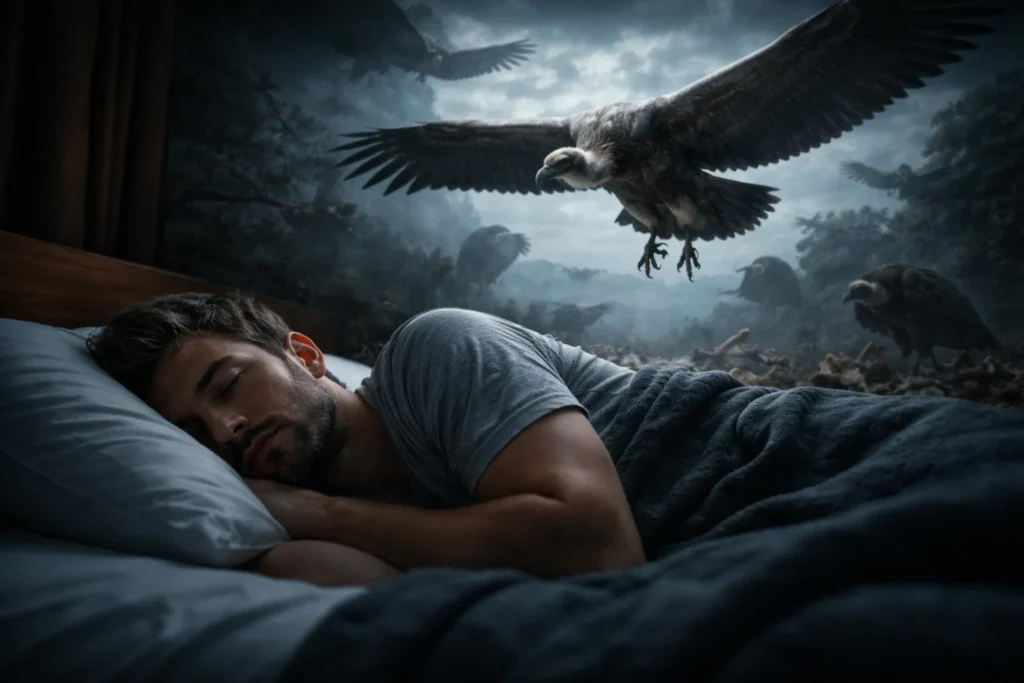
This is one of the most common and emotionally charged vulture dream scenarios. Vultures circling overhead often symbolize anxiety, anticipation, and the fear that something difficult is approaching. You may feel that a problem is not fully visible yet but is already present in the atmosphere. The dream may also reflect the emotional experience of being under pressure, observed, or surrounded by stress that has not yet landed but feels near.
Dream of a Vulture Watching You
A vulture staring at you can symbolize self-judgment, the sense of being vulnerable, or the feeling that someone is waiting for you to weaken. This may reflect real-life mistrust, but it can also point to your own inner critic. The dream may be asking whether you are living under too much emotional scrutiny.
Dream of Being Chased or Attacked by a Vulture
An attacking vulture often represents fear becoming active rather than distant. Something you hoped to avoid may now demand attention. This could relate to grief, conflict, burnout, financial strain, or emotional truths that feel impossible to postpone. The aggression in the dream does not necessarily mean external danger. It may symbolize the intensity of your inner response to loss or pressure.
Dream of Many Vultures
Seeing many vultures may suggest that a situation feels overwhelming, depleted, or socially threatening. You may feel surrounded by negativity, emotionally drained environments, or people who sense weakness and move closer when they feel they can gain from it. The dream can also symbolize the accumulation of fears around one major ending or crisis.
Dream of a Dead Vulture
A dead vulture can have surprisingly positive symbolism. It may represent the end of a fear cycle, the loss of power of something that once intimidated you, or the closing of a period dominated by emotional dread. In other cases, it can symbolize the exhaustion of vigilance itself. You may no longer have the energy to remain in survival mode.
Dream of a Vulture Landing Near You
A vulture landing nearby often symbolizes the arrival of uncomfortable truth. Something that once felt distant or abstract may now feel immediate. The dream may ask you to stop living only in anticipation and begin addressing the real issue in front of you.
Dream of a Vulture in the Sky
A vulture high in the sky often emphasizes watchfulness, perspective, and emotional distance. The dream may suggest that you are observing a hard truth from afar, not yet ready to engage it directly. It can also point to themes of fate, perspective, and higher-level awareness, which naturally connect with Dream About Sky, where emotional vastness, outlook, and meaning often become central.
Dream of Flying With Vultures
Flying with vultures can be unsettling, but it may symbolize rising above fear through realism. Rather than being hunted by harsh truth, you may be learning to see from its perspective. This scenario can suggest emotional maturity, perspective, and the ability to face life’s darker realities without denial. It also links well with the wider symbolism of Dream About Flying, especially when the dream is less about freedom and more about perspective gained through distance.
Dream of Vultures Around a Dead Animal
This scenario often points directly to emotional completion. Something in your life may already be over, and the dream is showing the aftermath rather than the loss itself. The image can be painful, but it is often clarifying. It may symbolize the need to stop reviving what has already ended.
How This Dream Connects to Your Real Life
Love and Relationships
In relationships, dreaming about vultures often reflects emotional deterioration, mistrust, or the fear that a bond is losing vitality. This does not automatically mean a breakup is coming. It may simply show that affection, honesty, or hope has weakened and now needs serious attention. The dream can also symbolize a relationship environment where one or both people feel emotionally picked apart, judged, or drained.
If you are healing from a breakup, the vulture may represent the aftermath: the thoughts that circle, the grief that returns, the fear of what remains after emotional collapse. If you are in a current relationship, the dream may be asking whether something important has been ignored for too long. Sometimes the vulture appears not to announce the end, but to warn that emotional neglect has consequences.
The symbol can also reflect unhealthy outside influences. A relationship may feel exposed to criticism, gossip, or opportunistic behavior from other people. In that case, the dream is less about the partner and more about the emotional environment surrounding the bond.
Career and Money
In career and money matters, vultures often symbolize pressure around depletion, competition, or the fear of losing security. You may feel that people around you are watching for weakness, waiting for mistakes, or ready to benefit from instability. This is especially likely in high-pressure workplaces, uncertain financial periods, or situations where trust feels thin.
The dream can also point to something more internal: the feeling that your current work has become emotionally dead. You may still be functioning, but the vitality is gone. In that case, the vulture symbolizes the recognition that a chapter is nearing completion, even if you have not yet acted on it.
Personal Growth
On the level of personal growth, dreaming about vultures can be deeply transformative. Growth is not always about adding more. Sometimes it is about removing what no longer has life. The vulture can symbolize your growing willingness to face difficult truths without turning away. That is a mature form of development, even when it feels uncomfortable.
This dream may appear when you are letting go of an outdated identity, facing a long-denied reality, or moving beyond illusions that once protected you. The process may not feel inspiring at first, but it often becomes liberating later. In that sense, the vulture stands not only for endings, but for psychological honesty.
The symbol may also share emotional terrain with Dream About Ravens, where intelligence, omens, shadow themes, and deep transformation often come forward in a more mysterious or intuitive form. Vultures tend to be blunter. They deal less with mystery and more with exposure.
Health and Emotional State
From a health and emotional perspective, vulture dreams often arise during periods of exhaustion, grief, chronic stress, or the sense that your system has been running on emptiness. The symbol may reflect depletion more than danger. You may be feeling emotionally spent, mentally over-alert, or unable to escape thoughts about what is failing, fading, or becoming unsustainable.
If the dream feels bleak, it may be worth asking where your life has become too draining or too focused on surviving rather than living. If the vulture appears calm and distant, the dream may be showing that you are already starting to see your condition more clearly. Clarity is not always pleasant, but it is often the beginning of change.
This can also connect with other bird symbols such as Dream About Hawks and Dream About Owls, though the vulture’s emotional message is usually less about strategy or wisdom alone and more about the need to confront what is depleted, hidden, or finished.
Is Dreaming About Vultures a Positive or Warning Sign?
Dreaming about vultures can be a warning sign when the dream reflects emotional depletion, fear of collapse, toxic environments, predatory social dynamics, or the refusal to face a necessary ending. A threatening or aggressive vulture may show that something in your life has become too unhealthy, too draining, or too difficult to keep denying.
At the same time, the dream can be positive in a deeper sense when it symbolizes release, truth, discernment, and the clearing of what no longer has life. A calm vulture may indicate that you are becoming more realistic, more spiritually mature, or more willing to let go of what is already over. That kind of dream is not cheerful, but it can be deeply constructive.
The key is balance. A vulture dream should not be treated as a fixed prediction of death, disaster, or doom. More often, it reflects your present emotional and psychological landscape. It asks whether fear is circling because something genuinely needs attention, whether exhaustion has reached a dangerous point, or whether an ending is ready to be acknowledged instead of resisted.
Sometimes the dream is simply descriptive. It may reflect a season of grief, transition, realism, or emotional exposure. In those moments, the vulture is less a threat than a messenger of hard truth.
Case Studies
A Woman Staying Too Long in a Drained Relationship
A woman dreamed of vultures circling above an empty field while she stood still below. She felt anxious but not surprised. In waking life, she had been sensing that her long-term relationship had lost its emotional vitality, but she kept hoping things would return to how they once were. The dream reflected the painful clarity that the relationship was no longer living in the same way, even if its outer structure remained.
A Man Under Pressure at Work
A man dreamed that a vulture watched him from the roof of his office building. He had recently made a costly mistake at work and felt that coworkers were judging him more than they admitted. The dream symbolized both his fear of failure and his feeling that others were waiting for weakness. It was less about actual attack than about a climate of pressure and scrutiny.
A Grieving Daughter Beginning to Accept Loss
A woman grieving her father dreamed of a single calm vulture standing beside a dry tree. The image was solemn but not terrifying. In waking life, she had just begun to move from shock into a more conscious form of mourning. The dream seemed to symbolize not death itself, but the difficult acceptance of its reality and the emotional clearing that grief eventually requires.
A Burned-Out Caregiver
A caregiver dreamed of many vultures gathering around a place she could not see clearly. She woke exhausted. In waking life, she had been supporting too many people without rest and felt emotionally hollow. The dream reflected depletion and the sense that too much of her energy had already been consumed. It became a turning point in recognizing her own limits.
A Man Letting Go of an Old Identity
A man dreamed of flying alongside vultures across a barren landscape and feeling strangely calm. He had recently left a career path that defined him for years but no longer felt meaningful. The dream was not pleasant, but it was clarifying. It suggested he was beginning to see his old life from a new height and accept that some chapters must end before something more honest can begin.
Dream Numbers
In some dream folklore and symbolic traditions, vultures are loosely associated with numbers such as 4, 8, and 13 because of their links with endings, cycles, transformation, and difficult truth. These associations vary by tradition and are best treated as symbolic rather than exact.
Lucky Lottery Meaning
Some folk beliefs connect vulture dreams with unusual luck because symbols of death and decay are sometimes thought to mark a turning point or reversal. Still, any lottery meaning attached to vultures should be viewed only as cultural folklore, not as certainty. The deeper value of the dream usually lies in what it reveals about fear, release, depletion, and emotional truth.
FAQ
What does it mean spiritually to dream about vultures?
Spiritually, dreaming about vultures often points to release, purification, realism, and the need to let something completed or depleted leave your life. It may symbolize hard but necessary transformation.
Why do I keep dreaming about vultures?
Recurring vulture dreams often happen when you are under emotional strain, dealing with fear of loss, sensing the decline of something important, or avoiding a truth that your deeper mind already recognizes.
Is dreaming about vultures a bad omen?
Not necessarily. Vulture dreams can feel heavy, but they are usually symbolic rather than predictive. They more often reflect endings, anxiety, emotional cleanup, or difficult honesty than literal misfortune.
What does it mean if vultures are circling in my dream?
Circling vultures often symbolize anticipation, pressure, or the feeling that something unresolved is drawing nearer. They may reflect fear of what is coming or awareness that a problem can no longer be ignored.
What does a calm vulture mean in a dream?
A calm vulture often symbolizes realism, patience, and acceptance of necessary endings. It may suggest that you are beginning to face a difficult truth with greater maturity and steadiness.
Conclusion
Dreaming about vultures usually speaks to the difficult but important side of transformation. This symbol often appears when life is asking you to face endings, clear emotional dead weight, recognize depletion, or stop turning away from a truth that has already arrived. The dream may feel heavy, but its purpose is often clarifying rather than cruel. At its core, the vulture reminds you that not every ending is only loss. Sometimes it is also release, honesty, and the first step toward a cleaner, more truthful beginning.