Dreaming about poverty can feel deeply uncomfortable because it touches one of the most basic human fears: not having enough. You may dream of being poor, losing your home, searching for food, wearing worn clothes, asking for help, seeing your family struggle, or feeling unable to pay for something important. Even if your waking life is stable, a poverty dream can leave a heavy emotional impression. In dreams, poverty does not always predict financial loss. More often, it reflects fear, insecurity, emotional scarcity, self-worth concerns, stress, or the feeling that some part of your life lacks support, comfort, or stability.
Quick Answer
Dream About Poverty meaning often reflects fear of lack, financial anxiety, emotional insecurity, low self-worth, stress about survival, or the feeling that you do not have enough support in waking life. This dream may appear when you are worried about money, work, family responsibilities, housing, debt, failure, or your ability to provide for yourself or others. Poverty in a dream can also symbolize emotional poverty, such as feeling unloved, unsupported, unseen, or spiritually drained. If the dream feels frightening, it may point to anxiety and a need for reassurance or practical planning. If it feels reflective, it may invite gratitude, humility, and a clearer understanding of what truly gives your life security and meaning.
Core Symbolism of Poverty in Dreams
Poverty in dreams is one of the most direct symbols of lack. It can represent not having enough money, food, shelter, help, confidence, love, time, energy, or emotional support. The dream may use material poverty to express a deeper inner feeling: “I do not have enough to feel safe.” This does not mean the dream is predicting actual poverty. It means your subconscious may be working through fear, vulnerability, or uncertainty around survival and stability.
Money is one of the most common layers behind poverty dreams. If you are dealing with bills, debt, unstable income, career pressure, or responsibility for family members, a dream about poverty may simply reflect real financial stress. The mind often turns practical worries into vivid dream scenes. This connects naturally with Dream About Money, where money in dreams often symbolizes security, value, power, opportunity, control, and self-worth.
However, poverty dreams can also appear even when finances are not the main issue. In that case, the dream may point to emotional scarcity. You may feel that affection, time, recognition, rest, or support is limited. You may be working hard but receiving little appreciation. You may feel unseen in a relationship, overlooked at work, or disconnected from the comfort you need. The dream uses poverty as a symbol for inner deprivation.
Poverty can also symbolize fear of failure. Many people connect financial stability with dignity, independence, and social respect. A dream of poverty may reveal the fear of losing status, being judged, becoming dependent, or disappointing others. This fear can be especially strong if you grew up in a family where money was a source of tension, shame, or survival anxiety.
The setting of the dream matters. Poverty in your own home may reflect fears about family security, domestic stability, or your private life. Poverty on the street may reflect exposure, vulnerability, or fear of being without protection. Poverty in childhood settings may point to early memories or inherited beliefs about scarcity. Poverty at work may reveal career insecurity or anxiety about not being valued.
The emotional tone is essential. If you feel panic, the dream may reflect anxiety. If you feel shame, it may connect to self-worth. If you feel sadness, it may show grief over loss or lack. If you feel determined, it may symbolize resilience and the desire to rebuild. If you feel calm despite poverty, the dream may reveal a deeper lesson about simplicity, humility, or inner strength.
Poverty dreams may also be about comparison. You may feel poor not because you truly lack everything, but because you compare yourself to others. Social media, family expectations, workplace competition, or cultural pressure can create the feeling that you are behind. In dreams, this emotional comparison may appear as poverty, worn clothing, empty rooms, or being unable to afford what others have.
From a psychological perspective, poverty can represent the scarcity mindset. This is the belief that there is never enough, even when some resources exist. A dream about poverty may show that your nervous system is operating from fear rather than trust. It may ask whether you are making choices from panic, shame, or a belief that security can disappear at any moment.
At the same time, poverty in a dream can carry a reflective meaning. It may invite you to examine what you truly need. It may strip away surface concerns and ask what makes you feel rich in a deeper sense: love, health, purpose, faith, family, safety, skill, wisdom, or peace. The dream may be uncomfortable, but it can lead to important self-reflection.
Spiritual Meaning of Dreaming About Poverty
Spiritually, dreaming about poverty may symbolize humility, dependence, simplicity, spiritual hunger, or the need to examine what you rely on for security. It may reveal fear of lack, but it may also invite reflection on what kind of wealth truly matters. A dream of poverty can ask whether your sense of safety is built only on possessions, approval, and money, or whether it also rests on inner values, gratitude, faith, and resilience.
If the dream feels sad or frightening, the spiritual meaning may involve a need for reassurance. You may feel cut off from support, guidance, or hope. The poverty in the dream may represent spiritual dryness rather than financial reality. You may be longing for comfort, meaning, or a sense that you are not alone in your struggles.
This connects naturally with Dream About Wealth, because dreams about poverty and wealth often mirror each other. Wealth in dreams may represent abundance, value, opportunity, and fulfillment, while poverty may represent lack, fear, humility, or the need to reconsider what abundance means. Sometimes a poverty dream appears not to frighten you, but to help you redefine richness beyond money alone.
If you are helping someone poor in the dream, the spiritual meaning may involve compassion. You may be called to notice the needs of others or to become more generous with time, attention, encouragement, or practical help. If someone helps you while you are poor in the dream, it may suggest that you need to receive support instead of carrying everything alone.
If you dream of poverty but still feel peaceful, the dream may symbolize simplicity and inner freedom. It may suggest that your worth does not depend only on possessions, income, or social status. This interpretation fits especially when the dream does not feel humiliating, but quiet and reflective.
If the dream involves begging, hunger, homelessness, or deep distress, the spiritual message may be more urgent emotionally. It may ask you to care for the parts of yourself that feel abandoned, unsupported, or deprived. These may be emotional needs, creative needs, spiritual needs, or relational needs.
Repeated dreams of poverty may suggest that you are being asked to examine a recurring fear of scarcity. You may need to look at your relationship with money, trust, receiving help, and your belief about whether life can support you. The dream does not demand blind optimism. It invites grounded faith, wise planning, and a more compassionate relationship with your own vulnerability.
A Related Bible Verse
A fitting Bible verse for a dream about poverty is Matthew 6:21: “For where your treasure is, there your heart will be also.” This verse connects with poverty dreams because they often reveal what the heart fears losing and what it depends on for security.
In a dream interpretation context, this verse can be understood as an invitation to examine your inner treasure. If poverty appears in a dream, it may not only be about money. It may ask what you value most, what you are afraid of losing, and where your sense of worth is rooted. The verse does not dismiss real financial hardship. Instead, it offers a reflective balance: material security matters, but the heart also needs deeper sources of meaning, love, and peace.
Psychological Interpretation
Psychologically, dreaming about poverty often reflects insecurity, stress, fear of failure, low self-worth, or anxiety about survival. The dream may appear when your mind is processing pressure around money, career, family, responsibility, or future stability. It may also appear when you feel emotionally under-resourced, even if your actual finances are not in danger.
One of the strongest psychological meanings is fear of losing control. Money and resources often give people a sense of control over life. When poverty appears in a dream, it may show the fear that control is slipping away. You may worry that one mistake, one bill, one job problem, or one unexpected event could destabilize everything.
This meaning connects closely with Dream About Losing Money, where financial loss in dreams often symbolizes fear of reduced security, lost opportunity, regret, or diminished confidence. Poverty dreams may carry the same fear but in a broader form. Instead of losing one thing, you may feel afraid of losing your entire foundation.
Poverty dreams can also reflect shame. Many societies attach identity and respect to financial success. If you dream of being poor and feel ashamed, the dream may reveal a fear of being judged, exposed, or seen as inadequate. You may be measuring your value through achievement, income, appearance, or comparison with others.
This dream can also appear during burnout. When you are exhausted, your mind may feel poor in energy, patience, creativity, or emotional strength. The dream may not be about money at all. It may be showing that your inner resources feel depleted. You may be giving more than you receive. You may be trying to support others while feeling empty yourself.
If you dream of poverty in childhood settings, the dream may connect to early scarcity experiences. Even if your current life is better, old fears can remain in the nervous system. You may still react strongly to uncertainty because your mind remembers what it felt like not to have enough. The dream may offer an opportunity to understand and soothe that old fear.
If you dream of hiding poverty from others, the dream may point to secrecy or fear of vulnerability. You may be trying to appear strong while privately struggling. You may feel pressure to maintain an image of success. The dream may be asking whether pretending is creating more stress than honesty would.
If you dream of escaping poverty, working hard, finding help, or rebuilding, the meaning may be more hopeful. It may reflect resilience, determination, and the belief that your situation can improve. The dream may show that although fear is present, so is strength.
The most important psychological question is not only “Am I afraid of being poor?” but also “Where do I feel lacking?” The lack may be financial, emotional, relational, spiritual, physical, or creative. Poverty in a dream often reveals the area of life where your inner world feels underfed.
Common Dream Scenarios About Poverty
Dream of Being Poor
Dreaming of being poor often reflects insecurity, fear of lack, or anxiety about whether you have enough resources to handle life. The poverty may be financial, but it may also symbolize emotional depletion. You may feel unsupported, undervalued, or worried about your future.
If you feel ashamed in the dream, the meaning may involve self-worth and fear of judgment. If you feel scared, it may reflect survival anxiety. If you feel calm and accepting, the dream may suggest humility, simplicity, or a deeper reflection on what truly matters.
This dream is especially common during stressful transitions such as job changes, financial uncertainty, family responsibility, or major life decisions. It does not mean poverty will happen. It means the fear of lack is active in your inner world.
Dream of Your Family Living in Poverty
Dreaming of your family living in poverty often reflects concern about responsibility, protection, and emotional security. You may worry about providing for loved ones, supporting parents, caring for children, or maintaining stability at home. The dream may be emotionally intense because family represents belonging and duty.
If you feel guilty in the dream, you may believe you should be doing more for others. If you feel helpless, it may show that responsibility feels too heavy. If your family works together despite poverty, the dream may suggest resilience and shared strength.
This dream can also reflect emotional poverty within the family, such as lack of warmth, communication, appreciation, or support. The material poverty may symbolize an emotional shortage.
Dream of Losing Your Job and Becoming Poor
Dreaming of losing your job and becoming poor usually points to career insecurity, fear of failure, or anxiety about identity. For many people, work is tied not only to income, but also to dignity, purpose, routine, and social status. Losing it in a dream may feel like losing stability.
This connects naturally with Dream About Job, where job dreams often reflect ambition, responsibility, pressure, performance, and fear of not being secure. In a poverty dream, the job loss may symbolize fear that one area of instability could affect your whole life.
If you are currently worried about work, the dream may be a direct expression of stress. If your job is stable, the dream may still reveal fear of not being useful, valued, or prepared for future changes.
Dream of an Empty Home Because of Poverty
Dreaming of an empty home because of poverty can symbolize emotional insecurity, fear of losing comfort, or feeling that your private life lacks warmth. A home in dreams often represents safety, identity, family, and the inner self. When poverty empties the home, the dream may suggest that something feels stripped away.
This connects with Dream About Home, where home often reflects emotional foundation, belonging, protection, and personal identity. A poor or empty home may indicate that your foundation feels weakened, even if the issue is emotional rather than financial.
If the home is cold, dark, or abandoned, the dream may reflect loneliness or lack of support. If you are cleaning or repairing the home, the dream may suggest that you are ready to rebuild stability from the inside out.
Dream of Begging for Money
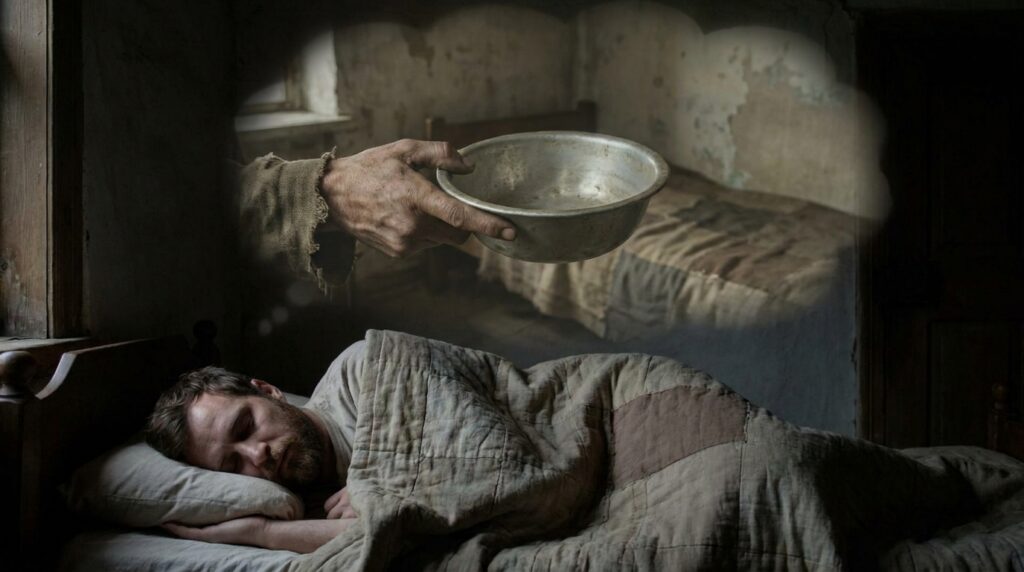
Dreaming of begging for money often reflects vulnerability, dependence, shame, or the need to ask for help. You may feel that you cannot manage everything alone, but asking for support may feel difficult. This dream can appear when pride, fear, or embarrassment prevents you from reaching out.
The dream may also reveal emotional begging. You may be asking for attention, love, approval, or reassurance from someone who does not easily give it. The money in the dream may symbolize value, care, or acknowledgment.
If someone helps you, the dream may suggest that receiving support is possible. If people ignore you, it may reflect fear of rejection or a belief that your needs do not matter.
Dream of Seeing Poor People
Dreaming of seeing poor people may reflect compassion, guilt, awareness of inequality, or concern about your own vulnerability. The dream may not be about you becoming poor. It may be asking how you respond to need, suffering, or disadvantage.
If you feel moved to help, the dream may point to generosity and empathy. If you feel afraid or uncomfortable, it may reveal anxiety about scarcity or fear that hardship could happen to anyone. If you ignore them in the dream, your subconscious may be asking whether you are avoiding emotional or social realities that need attention.
This dream may also represent parts of yourself that feel neglected. The poor person in the dream may symbolize an inner need that has not been cared for.
Dream of Working Hard but Still Being Poor
Dreaming of working hard but still being poor can reflect frustration, burnout, or the painful feeling that your effort is not producing enough reward. You may feel trapped in a cycle of responsibility where progress is slow or invisible. This dream can appear during periods of heavy workload, financial pressure, or emotional exhaustion.
This connects naturally with Dream About Work, where work dreams often reveal effort, duty, pressure, ambition, and the desire for recognition. In a poverty dream, working hard without improvement may symbolize fear that effort alone is not enough.
The dream may invite you to examine whether you need a better strategy, more support, clearer boundaries, or a healthier relationship with productivity. It does not mean your work is useless. It may mean you are tired of feeling unrewarded.
Dream of Escaping Poverty
Dreaming of escaping poverty can be a hopeful symbol of resilience, growth, problem-solving, and renewed confidence. You may be moving out of fear and into action. The dream may show that although scarcity has affected you, it does not define your future.
If you escape through help from others, the dream may highlight support and community. If you escape through your own effort, it may reflect determination and self-belief. If the escape is difficult but successful, it may suggest that improvement is possible through patience, planning, and persistence.
This dream can appear when you are beginning to rebuild after stress, debt, failure, emotional loss, or a period of low confidence. It may show that the mind is starting to imagine a way forward.
How This Dream Connects to Your Real Life
Love and Relationships
In love and relationships, poverty may symbolize emotional scarcity. You may feel that love, attention, affection, or reassurance is limited. A poverty dream may appear when a relationship feels cold, one-sided, distant, or unsupported. You may be asking for emotional nourishment but receiving very little.
If you dream that you and a partner are poor together, the dream may reflect shared stress or fear about future stability. It may also reveal whether the relationship feels strong under pressure. If you support each other in the dream, poverty may symbolize hardship that can be faced together. If one person abandons the other, it may reveal fear of being left during difficult times.
Family relationships may also appear in poverty dreams because money and care are often tied to family responsibility. You may feel pressure to provide, guilt about not doing enough, or fear that your loved ones are not secure. The dream may encourage honest communication and shared responsibility rather than silent worry.
Career and Money
Career and money are the most obvious real-life connections for poverty dreams. The dream may reflect worries about income, job security, debt, business performance, bills, or future planning. If you are currently under financial stress, the dream may be your mind’s way of processing that pressure during sleep.
A poverty dream may also appear when you feel undervalued at work. You may be earning money, but still feel poor in recognition, respect, opportunity, or growth. In that case, the dream may not only be about income. It may be about feeling that your effort is not being rewarded fairly.
If the dream makes you anxious, it may help to respond with practical grounding rather than panic. Review what is real, what is feared, and what can be planned. The dream is not a prophecy. It is a signal that security and stability are important themes in your emotional life.
Personal Growth
For personal growth, poverty in dreams may invite you to examine your relationship with worth. Do you feel valuable only when you have money, success, praise, or visible achievement? Do you feel ashamed when you need help? Do you believe rest must be earned through productivity? These questions can reveal the deeper meaning of the dream.
Poverty may also represent an inner area that needs nourishment. You may be rich in responsibility but poor in rest. Rich in ambition but poor in peace. Rich in activity but poor in connection. The dream may ask you to rebalance your life by caring for what has been neglected.
If the dream shows you rebuilding from poverty, it may reflect growth through humility and resilience. You may be learning that identity is not destroyed by hardship. You may be discovering strength in simplicity, patience, and practical action.
Health and Emotional State
In relation to health and emotional state, poverty dreams often connect to stress, fear, exhaustion, and insecurity. When the nervous system feels unsafe, the mind may create dreams of lack, loss, or survival. This is especially likely if you have been worrying about money, work, family, or the future.
This connects strongly with Dream About Stress, because stress dreams often turn emotional pressure into vivid scenes of crisis, loss, or instability. Poverty in a dream may show that your body and mind are carrying a strong fear of not having enough.
If you wake from the dream feeling heavy, it may be useful to ask what kind of support you need. Do you need rest? A plan? A conversation? Financial clarity? Emotional reassurance? Poverty dreams often become less frightening when the waking mind responds with grounded care.
Is Dreaming About Poverty a Positive or Warning Sign
Dreaming about poverty is usually not a literal prediction. It is more often a symbolic reflection of fear, scarcity, emotional lack, stress, or a need for greater security. It can be positive when it leads to humility, gratitude, better planning, compassion, and a clearer understanding of what truly matters.
The dream may act as a warning sign when it feels intense, repetitive, or connected to real-life avoidance. If you have been ignoring financial responsibilities, work problems, family pressure, or emotional needs, the dream may be telling you to pay attention. The warning is not “you will become poor.” It is “something in your life needs care before fear grows larger.”
This is where Dream About Fear becomes relevant, because fear in dreams often reveals what the mind experiences as threatening or unstable. Poverty dreams are often fear dreams at their core. They show what it feels like to imagine life without enough support.
A poverty dream can also be reflective rather than negative. It may ask you to simplify, return to gratitude, or stop measuring your worth only by material success. If you feel peaceful in the dream despite poverty, the message may be about inner richness, resilience, and the discovery that identity is deeper than possessions.
Sometimes the dream may be influenced by real-world exposure: news about economic hardship, conversations about money, seeing someone struggle, personal financial planning, or memories from childhood. These influences can shape the dream image, but the emotional meaning still matters.
The balanced meaning is this: poverty in dreams usually shows where you feel lacking, insecure, or unsupported. It becomes helpful when you use it as a signal to care for your emotional and practical foundations.
Case Studies
Emily Dreams of Losing Her Apartment
Emily dreamed that she could no longer afford her apartment and had to pack everything into a few bags. She woke up feeling ashamed and scared. In waking life, she had recently changed jobs and was worried about whether her new income would be stable.
For Emily, the dream reflected fear of losing security. The apartment symbolized independence and personal safety. The poverty in the dream did not predict homelessness, but it showed how strongly she linked income with emotional stability. The dream encouraged her to make a clear budget and seek reassurance through planning rather than panic.
Marcus Dreams of Working All Day and Still Having Nothing
Marcus dreamed he worked from morning until night but ended the day with empty pockets. In real life, he had been putting in extra hours at work but felt overlooked for promotion.
The dream reflected frustration and low recognition. Poverty symbolized not only money, but the feeling that his effort was not producing value. For Marcus, the dream invited him to examine whether he needed better boundaries, a conversation with his manager, or a new long-term career plan.
Priya Dreams of Her Family Eating Very Little
Priya dreamed that her family sat at a table with almost no food. Everyone was quiet. In waking life, she was supporting relatives financially and felt guilty whenever she spent money on herself.
The dream reflected responsibility and emotional scarcity. The lack of food represented her fear that there would never be enough for everyone. The silence showed unspoken pressure. Priya’s dream suggested that she needed healthier boundaries around giving and receiving.
Daniel Dreams of Being Poor but Peaceful
Daniel dreamed he lived in a small, simple room with very few possessions, but he felt calm. In waking life, he had been questioning whether his constant pursuit of higher income was making him unhappy.
For Daniel, the poverty dream had a reflective meaning rather than a frightening one. It symbolized simplicity and the possibility of peace without constant striving. The dream did not tell him to reject money, but it invited him to reconsider what kind of life felt truly rich.
Hannah Dreams of Helping a Poor Child
Hannah dreamed she saw a poor child sitting outside in the cold and gave the child food and a blanket. In waking life, she had been feeling emotionally neglected and trying to appear strong.
The poor child represented a vulnerable part of herself that needed care. By helping the child, Hannah was symbolically offering compassion to her own unmet needs. The dream encouraged her to stop dismissing her emotional hunger and seek warmth, support, and self-kindness.
Dream Numbers
In some folk traditions, poverty dreams may be lightly associated with numbers connected to lack, hardship, rebuilding, and survival. Numbers such as 4, 8, 13, 22, and 40 may symbolically relate to stability, effort, struggle, responsibility, and endurance. These numbers should be understood as cultural symbolism only, not as fixed meanings or guaranteed signs.
Lucky Lottery Meaning
In folk dream belief, dreaming about poverty may sometimes be associated with reversal, hidden opportunity, humility before change, or the hope of improvement after hardship. Some people may interpret poverty dreams as a reminder to be careful with money or to value what they have. However, this should only be viewed as cultural belief, not a promise of luck or a reliable prediction. The deeper meaning of a poverty dream is usually about fear, security, emotional lack, stress, and the need to strengthen your practical and inner foundations.
FAQ
What does it mean spiritually to dream about poverty?
Spiritually, dreaming about poverty may symbolize humility, dependence, simplicity, spiritual hunger, or the need to examine what you rely on for security. It may invite you to reflect on what true wealth means beyond money, while also acknowledging real fears about lack and survival.
Why do I keep dreaming about being poor?
Repeated dreams about being poor often suggest ongoing anxiety about security, money, work, self-worth, or emotional support. Your subconscious may be returning to a fear of not having enough. The dream may encourage practical planning, emotional reassurance, and deeper reflection on where you feel unsupported.
Is dreaming about poverty a bad omen?
Dreaming about poverty is not automatically a bad omen. It usually reflects fear, scarcity, stress, or feelings of lack rather than predicting actual poverty. It may act as a warning if you are ignoring financial responsibilities, work pressure, or emotional needs that require attention.
What does it mean to dream of your family being poor?
Dreaming of your family being poor may reflect concern about responsibility, protection, and emotional security. You may worry about providing for loved ones or maintaining stability at home. It can also symbolize emotional lack within the family, such as limited support, communication, or warmth.
Does dreaming about poverty mean I will lose money?
Dreaming about poverty does not necessarily mean you will lose money. It more often reflects anxiety about money, fear of instability, or a sense of emotional lack. If the dream feels intense, it may be helpful to review your finances calmly, but the dream should not be treated as a fixed prediction.
Conclusion
Dreaming about poverty often points to fear of lack, insecurity, stress, and the need for stronger emotional or practical foundations. It may reflect real financial concerns, but it can also symbolize emotional poverty, low self-worth, lack of support, or exhaustion from carrying too much responsibility. The dream is not automatically a prediction of hardship. It is more often a mirror of where you feel vulnerable.
The deeper message is to ask what kind of lack the dream is showing. Are you afraid of losing money? Do you feel unsupported? Are you working hard without feeling valued? Are you measuring your worth through success alone? A poverty dream can be uncomfortable, but it can also guide you toward clarity, gratitude, planning, compassion, and a more grounded sense of inner security. True stability is built not only through money, but also through self-respect, support, wisdom, and the ability to care for what matters most.