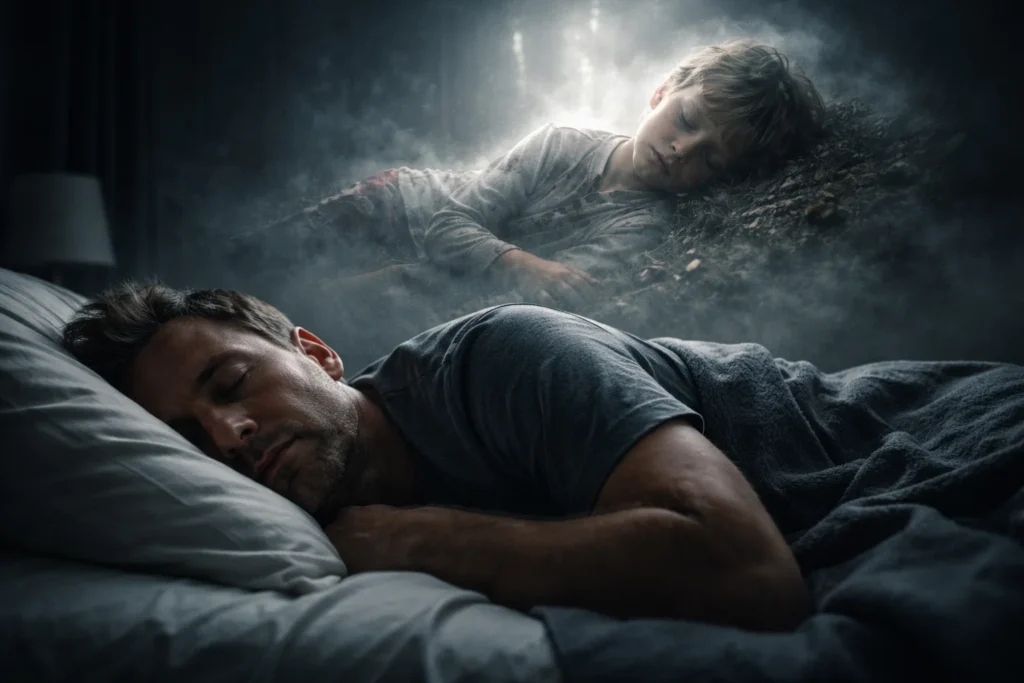
Dreaming about a dead child can be one of the most emotionally shocking dream experiences. Even if you don’t have children, the image can leave you with a deep ache, panic, guilt, or a hollow sense of grief that lingers after you wake up. If you do have a child—or if you’ve ever carried fertility hopes, pregnancy fears, or a protective bond with a younger family member—the dream can feel unbearable, like your mind showed you your worst nightmare.
As a dream psychologist, I want to name something clearly at the start: most dreams about a dead child are not literal predictions. They are symbolic messages about vulnerability, attachment, responsibility, change, grief, and the parts of you that feel “young” and in need of care. The dream uses the child symbol because nothing activates the human nervous system like the idea of innocence harmed or lost. This symbol goes straight to your protective instincts and your deepest fears, which is exactly why it’s such a powerful messenger.
In this guide, we’ll decode what a dead child symbolizes, what common scenarios tend to mean, how grief and anxiety shape these dreams, and what to do with the message in real life—so the dream becomes guidance rather than a source of ongoing distress.
Quick Summary
Dreams about a dead child commonly symbolize fear of loss, heightened protective instincts, unresolved grief, vulnerability, major life transitions, guilt or self-blame, and the “inner child” part of the self that feels neglected, wounded, or forced to grow up too fast. If the dream feels panicky, it often reflects anxiety, stress, or a season where you feel overwhelmed by responsibility. If the dream feels heartbreaking, it often reflects grief—either about a real loss or about a chapter, hope, or identity that ended. If you are trying to save the child, the dream often highlights a rescue pattern or a deep desire to protect what matters. If you are burying, mourning, or letting go, the dream often points to acceptance and closure work.
Why This Dream Happens
This dream is intense because the child symbol sits at the intersection of love, innocence, and the future. A child in dreams often represents what is precious and dependent: a relationship you deeply care about, a new beginning, a fragile hope, a tender part of you, or a responsibility that feels sacred.
When the child is dead, the dream is usually showing one of three psychological realities.
The first is fear-based activation. When your nervous system is stressed, it scans for worst-case scenarios. Your dreaming mind is essentially practicing threat response: “If the worst happened, could you cope?” This is more likely during high-stress seasons, sleep deprivation, postpartum periods, parenting burnout, or when you’ve been exposed to upsetting news.
The second is grief-based processing. The dream can be a container for grief that doesn’t have a clean place to go in waking life—grief about a real loss, grief about a miscarriage or infertility struggle, grief about a childhood you didn’t get, grief about a relationship ending, or grief about a version of your life that died quietly.
The third is transformation work. In dream language, death often symbolizes an ending and a rebirth. A dead child can symbolize the end of an old identity and the painful birth of a new one. This is common when you’re graduating, moving, leaving a relationship, becoming a parent, entering a demanding role, or realizing you can’t live the way you used to.
When your dream world repeatedly brings up loss and family symbolism, it can help to compare the broader pattern language in Dream About Dead Relatives.
The Child Symbol in Dream Psychology
A child in a dream can mean an actual child, but just as often it symbolizes one of these deeper themes.
Your inner child. This is the part of you that carries early emotional needs: the need for safety, attention, play, tenderness, and permission to feel.
A new beginning. A child can symbolize a new project, relationship, identity, or hope that is still fragile.
Dependency and responsibility. Children rely on adults. A child dream can reveal how you experience responsibility, pressure, and caretaking.
Innocence and purity. This can be your values, your sincerity, your tenderness, or the part of you that wants to trust.
The future. Children symbolize what comes next—legacy, continuation, life direction.
When the dream shows a dead child, it often means one of these things feels threatened, neglected, or changed. The dream may be asking you to protect what’s precious—or to mourn what you lost—so you can grow without carrying unprocessed pain.
The Emotional Tone Is the Compass
Two people can dream about a dead child and receive opposite messages depending on how it feels.
If you feel panic, the dream often reflects anxiety, overstimulation, or a sense of responsibility that has become too heavy.
If you feel guilt, the dream often reflects self-blame, perfectionism, or the belief that you must prevent every harm.
If you feel sadness and tenderness, the dream often reflects grief and the need to mourn something honestly.
If you feel numb or detached, your psyche may be protecting you from overwhelm. Numbness is often a defense, not a lack of love.
If you feel relief (rare but real), the dream might symbolize release from an impossible burden or the end of a prolonged fear cycle.
A helpful question is: did the dream feel like a warning, a mourning, or a mirror? Warning points to anxiety and boundaries. Mourning points to grief and closure. Mirror points to inner-child and identity work.
Common Dream Scenarios About a Dead Child
You discover a dead child
Finding a dead child in a dream often symbolizes shock and helplessness. Psychologically, it can represent a sudden realization: something you hoped would live is not thriving—your joy, your creativity, your trust, your sense of safety, or a plan you invested in.
Real-life step: identify what feels “no longer alive” in your life. Do you need to revive it, redesign it, or grieve it and let it go?
Your own child dies in the dream
If you have a child, this dream is often an anxiety dream rather than a prophecy. Parenting activates a constant protective scan, and dreams amplify that scan when you’re stressed, exhausted, or feeling unsupported.
If you don’t have a child, “my child” may symbolize a personal creation: a goal, a relationship, a business idea, or a part of you that feels dependent.
Real-life step: reduce fear-inputs and strengthen support. Anxiety dreams often soften quickly when the nervous system feels safer.
You are trying to save the child
Rescue dreams reveal your coping style: you take responsibility, you act, you try to prevent loss. This can be beautiful, but it can also signal a burdensome pattern—feeling responsible for everyone’s feelings, over-functioning, or believing love requires constant vigilance.
Real-life step: ask where you are over-rescuing in waking life. What would shared responsibility look like?
You are holding a dead child
This is one of the most tender and heartbreaking images. It often symbolizes grief that needs to be held rather than fixed. Sometimes it represents mourning a younger self: the child you were, the innocence you lost, the tenderness you had to bury to survive.
Real-life step: allow the feeling without turning it into punishment. Grief moves when it is allowed to exist.
The child dies and then comes back to life
This scenario often symbolizes renewal. It can mean hope returning after a dark season, a creative spark reawakening, or healing after grief. It can also symbolize the psyche rehearsing trust again—learning that not all endings are permanent.
Real-life step: support the “revival” with consistent care. New life is fragile; it needs protection and pacing.
You are burying a child or attending a funeral
Funeral imagery often symbolizes closure. It can indicate you are ready to accept an ending—an old identity, a relationship fantasy, a family storyline, or a version of life you hoped for.
Real-life step: ask what chapter you are being asked to release. Closure can be a conversation, a ritual, a boundary, or simply letting yourself feel the grief.
A stranger’s child dies
A stranger in dreams often symbolizes a part of the self you don’t fully claim. A dead stranger-child can represent neglected tenderness, disowned vulnerability, or a belief that “softness isn’t safe.” It may also reflect empathy overload if you’ve been exposed to distressing content.
Real-life step: reduce emotional overstimulation and rebuild safety through grounded routines.
The child looks sick, injured, or fading
This scenario often symbolizes something fragile in your life that needs attention before it collapses: your health, your energy, your relationship, your mental well-being, or your creativity. It can also reflect caregiver burnout.
Real-life step: focus on prevention rather than panic. What is one nourishing habit you can restore this week?
The dead child is you
Some people dream they see themselves as a dead child. This can be deeply symbolic of childhood trauma, emotional neglect, or a feeling that a part of you “died” early—your voice, your playfulness, your ability to trust.
Real-life step: treat this as inner-child work. The goal is not to relive pain but to restore protection, tenderness, and dignity to that younger self.
If your dream themes repeatedly connect to loss and maternal care, you may find additional context in Dream About Dead Mother.
What This Dream Often Reveals About Your Waking Life
A dead child dream often shows up in one of these real-life landscapes.
High responsibility seasons. You’re carrying too much, trying to do everything right, and your nervous system is signaling overload.
Fear of failure. The “child” can be your project or goal. The dream expresses fear that you’ll lose momentum, disappoint others, or waste potential.
Relationship instability. The child can symbolize the future of a bond. A dead child can express fear that the relationship won’t grow, won’t be safe, or won’t last.
Identity transition. The dream may appear when an old identity is ending. You might be grieving who you were—or what you thought life would be.
Unprocessed grief. Even if the grief is unrelated to children, your psyche may use the child symbol because it’s the most direct way to show innocence and loss.
Inner-child neglect. If you’ve been harsh with yourself, pushing through, denying needs, or living in survival mode, the dream can be a wake-up call: something tender inside you needs care.
The dream is rarely asking you to become superstitious. It’s asking you to become emotionally honest.
When This Dream Connects to Real Loss
If you have experienced miscarriage, stillbirth, infertility grief, child loss, or the illness of a child, dreams like this can be a natural part of grief. They may intensify around anniversaries, medical appointments, baby showers, family gatherings, or moments when your body remembers the story even if you’re not actively thinking about it.
In these cases, the dream may not be primarily symbolic. It may be memory and mourning. The most helpful response is gentle: normalize your reaction, reduce self-judgment, seek support, and allow grief to move in safe ways.
If you notice the dream triggers panic attacks, intrusive images, or a feeling of being unsafe, trauma-informed support can help. The goal is not to erase memory. The goal is to help your nervous system stop reliving the loss as if it’s happening now.
Spiritual and Cultural Perspectives
Many cultures interpret dreams of death through a spiritual lens: messages, warnings, transitions, or ancestral signals. Whether you hold those beliefs or not, there is a psychologically healthy way to engage them: treat the dream as meaningful without treating it as a guarantee.
In spiritual symbolism, a dead child can represent the death of innocence and the call to protect what is sacred. It can also represent purification—an ending that clears space for a truer life. In cultural terms, children often symbolize lineage, future, and family continuity, so a dead-child dream can intensify family pressure themes: fear of disappointment, fear of not meeting expectations, fear of being blamed.
A grounded spiritual response is often a simple ritual of care: lighting a candle, prayer, speaking tenderness toward the lost hope, or doing something life-affirming in your friend or family community. Ritual helps the psyche feel completion.
When your dream is strongly tied to lineage, authority, or family standards, you may also resonate with the approval-and-responsibility themes in Dream About Dead Father.
How to Work With a Dead Child Dream in Daily Life
This dream becomes less frightening when you treat it as a messenger rather than a threat. Here are practical steps that tend to reduce repetition and restore emotional steadiness.
Regulate before you interpret
If you woke up shaken, your first task is nervous-system safety, not meaning. Sit up, drink water, orient to the room, slow your exhale, and reduce immediate stimulation. A regulated nervous system can reflect; an activated one catastrophizes.
Identify what the child represents
Ask: in my life, what feels precious, dependent, or vulnerable right now? It might be a person, but it might be your health, your creativity, your relationship, your self-worth, your hope, or your future plan.
Translate the dream into one sentence
Try: “This dream is about ____.” Keep it simple and honest. “This dream is about fear of failing someone.” “This dream is about my exhausted nervous system.” “This dream is about grieving what I lost.” That one sentence is often more useful than ten theories.
Choose one repair action within 24 hours
Dreams repeat when your psyche doesn’t see movement. Choose one small step that matches the dream’s message.
If the dream was panic: reduce overload (sleep, boundaries, fewer inputs).
If the dream was guilt: do repair (apology, self-forgiveness, practical responsibility).
If the dream was grief: do mourning (letter-writing, ritual, safe conversation).
If the dream was inner-child: do care (rest, play, softness, therapy work).
Watch for the “over-responsibility” pattern
This dream often appears in people who carry an invisible contract: “If I relax, something bad will happen.” That belief produces chronic hypervigilance. Healing comes from building trust: you can care deeply without living in constant fear.
Protect your tenderness
If you immediately suppress feelings after the dream, you teach your psyche that tenderness is unsafe. If you allow some emotion—without drowning in it—you teach your psyche that tenderness can be held. That is how these dreams transform.
If you’re seeing repeated themes of insects, buzzing anxiety, or being overwhelmed by small threats, you may find it clarifying to compare nervous-system symbolism in Dream About Bees Chasing Me.
Case Studies
Case Study: The anxious parent during a burnout season
A parent dreamed their child died in an accident and woke panicked. In waking life, they were sleep-deprived, overstimulated, and carrying most of the mental load alone. The dream wasn’t prophecy; it was overload. After building a support plan, reducing doom-scrolling, and increasing rest, the dream frequency dropped.
Case Study: The “dead child” as a neglected creative self
A 29-year-old without children dreamed she held a dead child and sobbed. She had quietly abandoned a dream career path and told herself it didn’t matter. The child symbol represented her creativity and hope. Her healing action was taking one small step back toward expression; the dream shifted into a living child playing.
Case Study: A miscarriage grief wave resurfacing years later
Someone who had experienced miscarriage dreamed of a funeral for a baby they never met. The dream intensified around an anniversary and a friend’s pregnancy announcement. This was grief, not meaning to decode. They created a private ritual and shared their story with a safe person; the dream became less distressing.
Case Study: The inner-child trauma mirror
A person dreamed they saw themselves as a dead child in an old family home. In waking life, they were processing childhood emotional neglect and perfectionism. The dream symbolized the part of them that “went numb” to survive. Inner-child work and self-compassion reduced nightmares.
Case Study: The rescue pattern revealed
A 33-year-old dreamed they were desperately trying to save a child but couldn’t. In waking life, they were over-responsible in relationships, trying to fix everyone’s emotions. The dream highlighted the impossibility of rescue as a life strategy. They practiced boundaries and stopped over-functioning; anxiety decreased.
Case Study: The transition dream after a major life change
A 26-year-old dreamed a child died and then came back to life after they moved to a new city. They were grieving their old identity while building a new one. The dream represented the death of a chapter and the rebirth of confidence. Small routines and community support stabilized the transition.
FAQs
What does it mean to dream about a dead child?
It commonly symbolizes vulnerability, fear of loss, heightened responsibility, grief, major transitions, and inner-child themes. Most often it reflects emotional processing, not prediction.
Is a dream about a dead child a warning about the future?
Usually no. These dreams are more often anxiety and grief symbols than literal omens. If you’re stressed, sleep-deprived, or overwhelmed, the dream can intensify.
Why did I dream my own child died?
Parenting activates protective fear. When your nervous system is overloaded, dreams can dramatize worst-case scenarios. The dream is often a signal to reduce stress and increase support.
What if I don’t have children but I dream of a dead child?
The child may symbolize a vulnerable part of you, a new beginning, a creative project, or a fragile hope. The dream can be asking you to protect what’s precious in your inner life.
What does it mean if I’m trying to save the child in the dream?
This often reflects a rescue pattern, over-responsibility, or deep protective instincts. It can also reflect a real-life situation where you feel pressure to prevent loss.
What does it mean if the child comes back to life?
This often symbolizes renewal: hope returning, healing after grief, or a part of you reawakening. It can also represent your psyche learning to trust again.
Why do I keep having recurring dreams about a dead child?
Recurring dreams often mean the underlying theme is still active: ongoing anxiety, unprocessed grief, trauma echoes, or inner-child neglect. Track what repeats—setting, emotions, rescue attempts—to find the pattern.
What should I do after waking from a disturbing dead child dream?
Regulate first, then reflect. Hydrate, breathe, reduce stimulation, and name what feels vulnerable in your life. Choose one small action: rest, boundaries, repair, or support.
Can this dream relate to childhood trauma?
Yes. Sometimes the dead child represents a younger self who felt unsafe, unseen, or forced to mature too early. In that case, inner-child work and trauma-informed support can be helpful.
Does this dream have a positive meaning?
It can. Symbolic death often marks transformation—ending an old chapter so a healthier one can begin. The dream can motivate you to protect what truly matters and live more honestly.
Dream Number & Lucky Lottery Meaning
In symbolic numerology traditions, child-related dreams often connect to vulnerability, new beginnings, and protection themes. When the dream includes death, the number symbolism is usually used for reflection on endings and renewal rather than prediction. If you enjoy numbers as journaling anchors (not guarantees), common associations include 1 for a new chapter, 2 for attachment and connection, 6 for care and responsibility, and 9 for closure and transformation. Supporting numbers many readers use include 4 for safety and boundaries, 7 for inner wisdom, and 8 for stability under pressure.
Suggested picks for playful reflection (not financial advice): 01, 02, 04, 06, 07, 08, 09, 16, 26, 90. Use these as cultural fun or reflective prompts, never as guarantees. Please follow local laws and play responsibly.
Conclusion
A dream about dead child is usually your psyche speaking in the strongest possible symbol about vulnerability, responsibility, and love. It can reflect anxiety overload, unprocessed grief, fear of loss, or the neglected inner-child part of you that needs protection and tenderness. The most reliable compass is the emotional tone: panic points to nervous-system stress, sadness points to mourning, guilt points to repair, and numbness points to overwhelm. When you respond with one grounded step—rest, boundaries, support, or honest grief—these dreams often soften and become guidance rather than fear.
Dream Dictionary A–Z
If you want a dependable way to decode every detail in your dream—who the child was, where the scene happened, what emotions dominated, and what symbols appeared around the loss—use the master index as your map and explore Dream Dictionary A–Z.
Written and reviewed by the DreamHaha Research Team — a group dedicated to dream psychology and spiritual symbolism, helping readers uncover the true meaning behind every dream.