Sometimes a dream does not frighten you or confuse you so much as leave you with a quiet ache when you wake up. A dream about nostalgia often feels like that. It can carry old rooms, familiar faces, school days, family routines, lost places, or a version of yourself that no longer exists in the same way. These dreams tend to stir emotion because they do more than replay the past. They reflect what your inner world is missing, protecting, revisiting, or trying to understand. When nostalgia appears in sleep, it often invites you to look at memory, identity, comfort, change, and the emotional meaning of where you have been.
Quick Answer
Dream About Nostalgia meaning often relates to emotional reflection, a longing for safety, unfinished feelings about the past, or a desire to reconnect with an earlier part of yourself. This dream usually does not mean you literally need to go backward. More often, it suggests that your mind is revisiting old emotions, relationships, places, and personal memories in order to process change in the present. Depending on the tone of the dream, nostalgia can point to comfort, grief, regret, emotional healing, or a need to recover something valuable that has been lost in your current life.
Core Symbolism of Nostalgia in Dreams
Nostalgia in dreams is deeply tied to the symbolic idea of emotional return. In the subconscious, the past is rarely shown as simple history. It is often used as a living symbol. A childhood street may represent innocence. An old bedroom may reflect safety or emotional confinement. A familiar song may symbolize identity, longing, or the parts of yourself that still want to be heard.
From a psychological perspective, nostalgia is not just remembrance. It is remembrance charged with feeling. That feeling matters. Dreams use nostalgia when the mind is comparing the present self with the former self. They may arise when you are in transition, when something important has ended, or when your life feels emotionally dry and your inner world begins searching for warmth.
Carl Jung often wrote about symbols as carriers of psychic meaning rather than literal messages. In that sense, nostalgia can be understood as a bridge between the conscious personality and older emotional material that still influences the present. Freud might have framed some nostalgic dreams as wish fulfillment, especially when the dream returns to comfort, attachment, or unresolved desire. Modern psychology often sees nostalgia in a more balanced way. It can soothe distress, reinforce identity, and help people feel continuity during uncertain times.
Nostalgia also has a cultural layer. Nearly every culture carries stories about golden times, lost homes, family roots, youth, and belonging. That is why nostalgic dreams often feel universal. Even when the details are highly personal, the themes are widely human. A dream that reminds you of old photographs or forgotten routines may connect with the same emotional landscape explored in Dream About Memories, where the subconscious stores pieces of experience not only as facts but as emotional symbols.
At its core, nostalgia in dreams often symbolizes five things: emotional continuity, longing for security, grief over change, the search for identity, and the desire to reconnect with meaningful parts of life. Sometimes the dream is gentle and reassuring. Sometimes it hurts. Either way, it usually appears because the past still has something to say to the present.
Spiritual Meaning of Dreaming About Nostalgia
Spiritually, dreaming about nostalgia often reflects an inner call to remember what is essential. This does not always mean remembering events in a literal way. It can mean remembering your values, your softness, your original hopes, or the emotional truths you have neglected while trying to survive adult pressures.
Many people experience nostalgic dreams during seasons of transition, spiritual fatigue, or emotional disconnection. In that setting, the dream may act like a signal from the deeper self. It asks, what have you moved away from that once made you feel alive, grounded, or whole? The answer may involve creativity, love, trust, innocence, faith, or a slower pace of life.
Nostalgia can also symbolize the soul’s effort to integrate old and new identities. You may be outgrowing one version of yourself while not yet feeling secure in the next. A dream full of old places and familiar voices can appear during that in-between stage. The spiritual message is not necessarily to return physically to the past, but to reclaim the wisdom, sincerity, or emotional truth that belonged to that period.
When nostalgia appears repeatedly, it may be pointing toward emotional alignment. Perhaps your outer life is efficient but not meaningful. Perhaps you are functioning well while internally missing warmth, roots, or connection. In some cases, a nostalgic dream overlaps with the symbolism of Dream About Childhood, especially when the dream returns to early experiences that shaped your sense of safety, wonder, and vulnerability.
A balanced spiritual reading of this dream would say that nostalgia can be a gentle invitation to honor your history without becoming trapped in it. The dream reminds you that your past is part of your inner landscape, but not the whole of your future.
A Related Bible Verse
A verse that can fit this dream theme is Ecclesiastes 3:1: “To everything there is a season, and a time to every purpose under the heaven.”
This verse connects naturally with dreams about nostalgia because nostalgia often emerges when one season of life has passed and another has begun. The dream may reflect the emotional difficulty of accepting that time moves, people change, and certain chapters cannot be repeated in the same form.
Rather than pushing a rigid religious message, this verse can be read as a quiet reminder that every stage of life carries its own meaning. A nostalgic dream may not be asking you to resist change. It may be helping you honor what mattered in an earlier season so you can move forward with greater tenderness and perspective.
Psychological Interpretation
Psychologically, dreams about nostalgia often appear when the mind is trying to regulate emotion. Memory is not stored in a perfectly neutral way. The brain connects past experiences with mood, identity, attachment, and survival. When current life feels uncertain, lonely, stressful, or emotionally thin, the dreaming mind may reach backward toward earlier symbols of comfort and familiarity.
This kind of dream can be triggered by many situations. A breakup may bring back dreams of old school friends or family holidays. Career pressure may revive dreams of slower, simpler years. Moving to a new place can awaken dreams about old streets, bedrooms, or neighborhoods. Even a song, smell, season, or anniversary can stir the subconscious and create a nostalgic dream landscape.
Emotions inside the dream shape its meaning. If the dream feels warm and peaceful, it may represent emotional self-soothing. If it feels sad or unreachable, it may reflect grief, disconnection, or the pain of recognizing that something meaningful has changed. If the dream feels confusing, it may suggest that you are unsure which parts of the past you truly miss and which parts you are idealizing.
Nostalgic dreams can also involve defense mechanisms. At times, the mind uses the past to avoid a difficult present. This does not make the dream false. It means the dream may be revealing emotional need through symbolic retreat. For some people, nostalgia covers loneliness. For others, it covers fear of growing older, unresolved attachment, or discomfort with uncertainty.
The setting of the dream matters as much as the feeling. A dream of an old house may suggest psychological roots. A dream of a family meal may point to belonging. A dream about wanting to go back somewhere but being unable to may reflect inner conflict about change. When the atmosphere centers on comfort and belonging, the symbol may overlap with Dream About Home, especially if your present life feels emotionally unsettled.
In many cases, dreaming about nostalgia is the mind’s way of saying that your present emotional state cannot be understood without acknowledging what came before. The dream is not necessarily about the past itself. It is about what the past still means to you now.
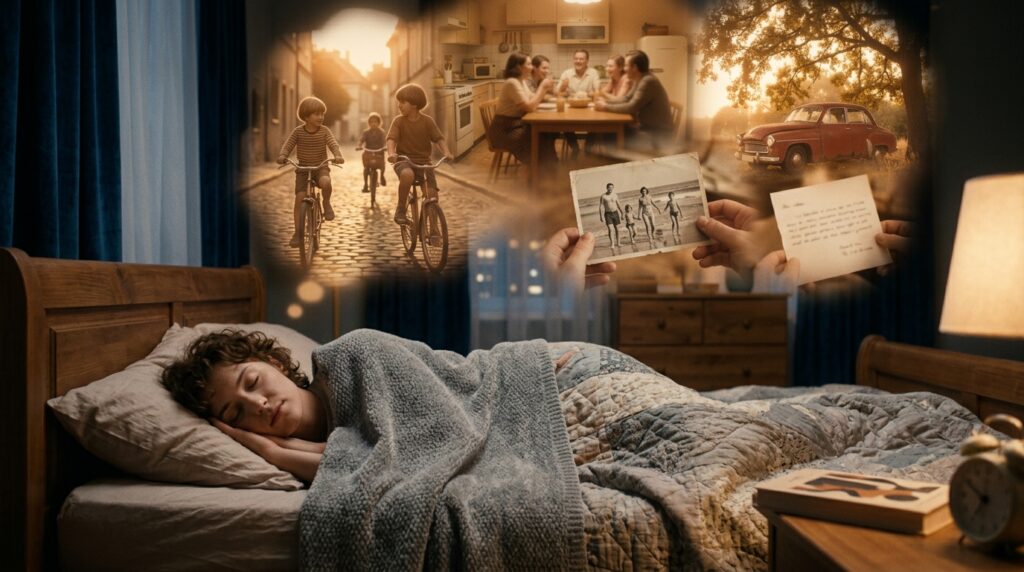
Common Dream Scenarios About Nostalgia
Dream of revisiting your childhood home
This is one of the most common nostalgic dream scenarios. A childhood home often symbolizes emotional foundations. If the home feels warm, the dream may suggest a desire for safety, acceptance, or emotional rest. If the home is damaged, empty, or unreachable, it may reflect painful changes, grief, or a fractured sense of belonging. The dream often appears when life feels unstable and the mind searches for an older sense of grounding.
Dream of seeing old friends or classmates
Dreaming of old friends can point to identity rather than to those people specifically. Friends from the past often represent how you once felt about yourself. You may miss your confidence, openness, innocence, or freedom more than the actual relationship. These dreams can happen during periods of social change, adult responsibility, or emotional isolation.
Dream of wanting to go back in time
This scenario usually suggests emotional comparison between past and present. It may reflect longing for simplicity, fewer responsibilities, or a phase of life that felt more emotionally meaningful. Sometimes it also reveals resistance to change. The dream does not always mean the past was objectively better. It may mean the present is asking too much of you emotionally.
Dream of listening to an old song or hearing a familiar voice
Sound can be a powerful symbol in dreams because it bypasses logic and goes straight to feeling. An old song or familiar voice may represent emotional memory, unfinished grief, or comfort that still lives inside you. This kind of dream can be especially strong after loss, separation, or a major life transition.
Dream of returning to a place you can no longer stay
When you arrive at an old place in a dream but cannot remain there, the dream often reflects the tension between memory and reality. Part of you may still be attached to an earlier chapter, but another part knows that life has moved on. This scenario often appears during emotional transitions connected to relocation, family distance, or identity change, and it may carry similar emotional tones to Dream About Homesickness.
Dream of feeling happy and sad at the same time
Nostalgic dreams often carry mixed emotion. You may smile in the dream while also feeling loss. This emotional blend is important. It suggests that your subconscious is not only remembering what was good, but also mourning what cannot return in the same form. Mixed feeling usually points toward emotional maturity and ongoing processing rather than a simple wish to escape.
How This Dream Connects to Your Real Life
Love and Relationships
In relationships, dreaming about nostalgia can reflect emotional comparison. You may be thinking about how love used to feel, how open you once were, or how a past connection shaped your expectations in the present. Sometimes the dream appears when current relationships feel emotionally distant or routine. It can also arise when a person misses tenderness, belonging, or the feeling of being deeply known.
Nostalgia in love does not always mean you should reconnect with someone from the past. Often it means you are searching for qualities that were present in an earlier emotional bond. In that sense, the dream may share meaning with Dream About Longing, especially when the dream leaves you with a tender ache rather than a clear message.
Career and Money
In work life, nostalgia can arise when success has begun to feel disconnected from meaning. You may be functioning well but missing simplicity, creativity, spontaneity, or a stronger sense of purpose. A nostalgic dream can appear during burnout, career transition, or financial pressure, especially when adult responsibilities make life feel heavy.
This dream may also reflect comparison between who you thought you would become and who you feel you are now. That comparison can produce sadness, but it can also create clarity. The dream may be prompting you to reconnect with values that were once obvious to you but have been buried under routine or survival.
Personal Growth
On a personal level, dreaming about nostalgia often appears during identity shifts. Perhaps you are maturing, healing, moving, becoming a parent, ending an important chapter, or questioning what matters most. The dream helps you integrate different versions of yourself. It reminds you that growth is not only about becoming someone new. It is also about carrying forward what was most honest and meaningful in who you have already been.
These dreams can be especially powerful when they reveal not just what you miss, but what you still need. The old self in the dream may symbolize playfulness, courage, trust, hope, or emotional openness that deserves a place in your present life.
Health and Emotional State
Emotionally, nostalgia often connects with stress, exhaustion, loneliness, or emotional overload. When the nervous system is tired, the mind may retreat into images of familiarity as a way of restoring inner safety. That does not mean the dream is unhealthy. It means your psyche may be looking for grounding.
If the dream leaves you feeling heavy or deeply reflective, it may also suggest unresolved grief or accumulated emotional fatigue. In some cases, the mood of the dream echoes the themes found in Dream About Regret, particularly when the past feels less like comfort and more like something you wish had gone differently.
Is Dreaming About Nostalgia a Positive or Warning Sign?
This dream can be positive when it helps you reconnect with what truly matters. It may remind you of emotional roots, forgotten values, family warmth, or pieces of identity that deserve renewal. In that form, nostalgia is healing. It gives you perspective and helps you recover tenderness in a rushed or disconnected season of life.
It can also function as a warning sign when the dream reveals emotional avoidance. If you are constantly dreaming about going back, hiding in the past, or rejecting the present, your subconscious may be showing that something in your current life needs attention. The problem may not be that you miss the past too much. It may be that the present feels too empty, too stressful, or too emotionally unsupported.
Sometimes the dream is neither especially positive nor especially alarming. It may simply reflect normal subconscious processing. Humans naturally use memory to create continuity, especially during change. A dream about nostalgia can be the mind’s ordinary way of sorting emotional history and making sense of transition.
The key question is not whether the dream is good or bad. The better question is what emotional truth it reveals. Does it point to gratitude, grief, loneliness, identity, or a need for reconnection? The answer usually matters more than the symbol alone.
Case Studies
A woman dreaming of her old kitchen after becoming a mother
A new mother repeatedly dreamed of the kitchen in her childhood home, where she remembered watching her mother cook. The dream appeared during a stressful season of exhaustion and self-doubt. The symbol was not simply about the past. It reflected her need for nurturing, emotional continuity, and reassurance as she entered a new life role.
A man dreaming of school hallways during a career crisis
A man in his thirties dreamed of walking through his old school and feeling both calm and embarrassed. In waking life, he was questioning whether his current career matched his values. The dream seemed to reflect a return to the period when his identity was still forming. It brought him back to questions of worth, direction, and authenticity.
A recent graduate dreaming of old family gatherings
After moving to a new city, a recent graduate kept dreaming about family dinners and holiday traditions. The dreams appeared during loneliness and culture shock. They did not predict anything. They symbolized her need for belonging, stability, and emotional familiarity while adapting to a very new environment.
A divorced person dreaming of music from teenage years
Someone going through divorce dreamed repeatedly of songs from adolescence. The dreams carried warmth but also tears. In context, the music seemed to symbolize a freer and more hopeful version of self that had been overshadowed by years of emotional strain. The dream encouraged reconnection with identity rather than escape into the past.
A middle aged adult dreaming of a grandparent’s house
A person in midlife dreamed of visiting a grandparent’s house and feeling calm until they realized the grandparent was gone. This dream reflected both comfort and grief. The house symbolized emotional inheritance, family memory, and the lasting impact of love. It also gently acknowledged that some forms of security now live more in memory than in daily life. In emotional tone, it moved close to Dream About Sadness, though its message was still tender rather than hopeless.
Dream Numbers
Some dream traditions loosely connect nostalgia with numbers related to memory, cycles, and emotional return, such as 6, 9, and 21. These associations are symbolic rather than factual. They are best understood as part of folklore and reflective interpretation, not as certainty.
Lucky Lottery Meaning
In some folk beliefs, dreams about the past are linked with luck because they are thought to carry emotional messages from memory or ancestors. Still, this should be treated only as cultural tradition. A nostalgic dream is far more useful as a source of self-understanding than as a sign for gambling or prediction.
FAQ
What does it mean spiritually to dream about nostalgia?
Spiritually, this dream often points to inner remembrance. It may suggest that you are being called back to values, emotions, or truths that once shaped you. The dream is usually more about reconnection than literal return.
Why do I keep dreaming about nostalgic places?
Repeated dreams about nostalgic places often happen during change, stress, or emotional loneliness. Your mind may be using familiar places as symbols of safety, identity, or belonging. The more emotionally charged the place is, the stronger its dream presence may become.
Is dreaming about nostalgia a bad omen?
No, it is usually not a bad omen. Most of the time, it reflects emotional processing, memory, longing, or the need for inner grounding. It should not be treated as a fixed prediction of the future.
Does dreaming about nostalgia mean I should go back to my old life?
Not necessarily. The dream may be showing what you miss emotionally rather than what you need to recreate literally. You may need more warmth, connection, creativity, or rest in your present life rather than a full return to the past.
Why do nostalgic dreams make me cry when I wake up?
These dreams often awaken feelings that have been stored quietly for a long time. Tears can come from grief, tenderness, relief, or emotional recognition. In some cases, the dream may also reflect a deep wish for reconnection with roots, belonging, or Dream About Family.
Conclusion
Dreaming about nostalgia often means your inner world is revisiting the past in order to understand the present more honestly. These dreams can bring comfort, sadness, longing, gratitude, or reflection because they touch the emotional threads that shape identity and belonging. They rarely mean you are meant to live backward. More often, they reveal what your heart still values, what your mind is still processing, and what your life may need now. When you wake from a nostalgic dream, the most helpful question is not simply what did I miss, but what part of myself is asking to be remembered?