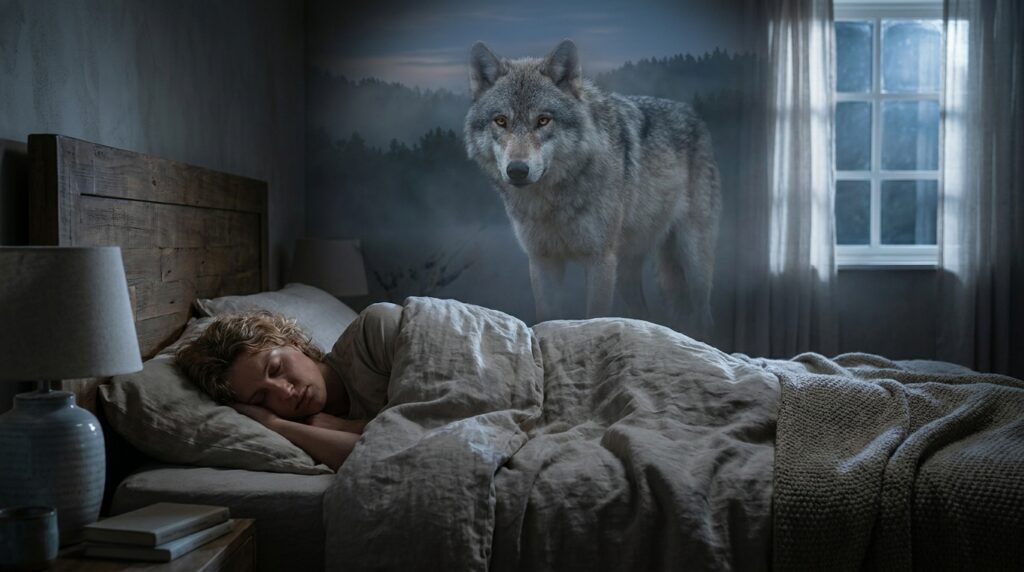
Dreaming about a wolf can feel powerful, unsettling, mysterious, or strangely protective, depending on how the wolf appears in the dream. A wolf is not a simple symbol. It can represent instinct, loyalty, danger, independence, hidden fear, emotional strength, or the part of you that knows how to survive when life becomes uncertain. Because wolves live between two worlds in the human imagination, both feared as wild predators and respected as intelligent pack animals, a wolf dream often asks you to look more closely at your instincts, your relationships, and the situations where you feel either threatened or deeply connected.
Quick Answer
Dream About Wolf meaning often points to instinct, survival, loyalty, hidden fear, protection, or a powerful force in your emotional life. A wolf in a dream may reflect your own inner strength, your need for independence, your awareness of danger, or your connection to a group, family, or community. If the wolf feels threatening, the dream may show anxiety, mistrust, pressure, or a person or situation that feels difficult to control. If the wolf feels calm or protective, it may symbolize guidance, courage, emotional wisdom, and the ability to trust your instincts. The meaning depends strongly on the wolf’s behavior, your feelings in the dream, and whether the wolf appears alone, in a pack, attacking, howling, watching, running beside you, or protecting you.
Core Symbolism of Wolf in Dreams
A wolf in dreams is one of the strongest symbols of instinct. Unlike many animals that appear in dreams as simple images of comfort, fear, or memory, the wolf carries a deeper emotional charge. It is wild, intelligent, social, alert, and difficult to tame. When a wolf enters a dream, it often brings attention to the parts of the self that are intuitive, watchful, protective, and emotionally alert.
At a basic symbolic level, the wolf may represent your natural instincts. This does not mean aggression alone. Instinct can also mean knowing when something is wrong, sensing emotional distance in a relationship, recognizing danger before it becomes obvious, or understanding what you need without being able to explain it logically. In this sense, the wolf may appear when your subconscious is asking you to trust your deeper awareness.
The wolf also represents the tension between independence and belonging. A wolf can hunt alone, but wolves are also deeply connected to their pack. This makes the symbol especially meaningful when you are thinking about family, friendship, loyalty, teamwork, or emotional distance. If you dream of a lone wolf, the dream may reflect self-reliance, isolation, or a desire to separate from others. If you dream of a wolf pack, it may suggest group pressure, family loyalty, protection, or the need to understand where you belong.
In many cultures, wolves have been viewed with both fear and respect. They are often associated with wilderness, night, danger, endurance, and primal wisdom. Because of this, dreaming of a wolf may connect to situations where you feel close to something raw and honest within yourself. It may be the part of you that does not pretend, does not ignore danger, and does not easily surrender.
From a Jungian perspective, the wolf can resemble an archetypal figure of the wild self or the shadow. The shadow does not simply mean something bad. It refers to the parts of the personality that are hidden, denied, feared, or not fully understood. A wolf dream may point to emotions you have pushed away, such as anger, desire, courage, suspicion, grief, or a strong need for freedom. The dream may not be telling you to act on every impulse. Instead, it may be inviting you to understand what those impulses are trying to communicate.
A wolf can also symbolize a perceived threat. If the dream wolf is chasing, attacking, growling, or watching you from the dark, it may represent a person, conflict, responsibility, or fear that feels predatory. This does not mean the dream predicts harm. More often, it reflects how your nervous system is processing pressure. You may feel watched, judged, competed against, or pushed into a situation where you must defend your boundaries.
Because wolves are strongly connected to wilderness, they may also appear when your life feels too controlled, too routine, or too far removed from your real emotional needs. The wolf may represent the wild part of you that wants honesty, movement, freedom, and a return to something natural. If your waking life has become overly restricted, a wolf dream may reflect a desire to reconnect with your own strength and authenticity.
In this way, a wolf dream can be both a warning and an invitation. It may warn you to pay attention to danger, manipulation, conflict, or emotional pressure. But it may also invite you to reclaim courage, loyalty, instinct, and the ability to survive difficult circumstances. For a broader animal symbolism connection, some readers also compare wolf dreams with Dream About Wolves, especially when the dream involves more than one wolf or a strong pack dynamic.
Spiritual Meaning of Dreaming About Wolf
Spiritually, dreaming about a wolf often points to instinctive wisdom, protection, inner guidance, and awareness of unseen emotional energy. The wolf is commonly understood as a symbol of wild intuition. It does not move carelessly. It listens, watches, senses, and responds. In a dream, this can suggest that your spirit or inner self is asking you to become more attentive to what you already feel but may not yet be ready to admit.
A wolf may appear spiritually when you are entering a phase that requires courage. This courage may not be loud or dramatic. It may be the quiet strength to set boundaries, leave an unhealthy environment, protect your peace, or stop ignoring signs that something in your life needs attention. The wolf does not always symbolize danger outside you. Sometimes it symbolizes the strength inside you that is finally becoming visible.
If the wolf in your dream is calm, walking beside you, or looking at you without hostility, it may represent a guide figure. This does not have to be understood literally. It may be your own intuition taking symbolic form. The dream may be encouraging you to listen more carefully to your inner voice, especially if you have recently been uncertain, pressured by others, or afraid to choose your own direction.
If the wolf appears at night, under the moon, in a forest, or near a mountain, the dream may carry a stronger spiritual feeling. These settings often suggest mystery, solitude, reflection, and emotional transformation. The wolf may represent your ability to move through unknown emotional territory without losing yourself. You may not have all the answers yet, but you may be developing the inner awareness needed to move forward.
A repeating wolf dream may suggest that an important instinctive message is being ignored. Perhaps you keep tolerating behavior that makes you uncomfortable. Perhaps you are avoiding a conflict that needs honest attention. Perhaps you are denying your own need for independence. In a spiritual sense, the wolf may return until you recognize the lesson: protect your energy, trust your perception, and do not abandon your inner truth to please others.
At the same time, it is important not to treat a wolf dream as a fixed omen. The wolf does not automatically mean betrayal, danger, or spiritual attack. Its meaning depends on the dream’s emotional tone. A peaceful wolf may symbolize wisdom. A wounded wolf may symbolize your own hurt instincts. A hungry wolf may show emotional need. A protective wolf may reflect guidance and strength. A threatening wolf may reveal fear, pressure, or unresolved tension.
Dreaming of a wolf may also connect with the larger symbolism of wildness. Wildness is not always chaos. It can mean authenticity, freedom, and the courage to live closer to your truth. If you have been hiding your feelings, suppressing your voice, or acting smaller than you are, the wolf may appear as a reminder that strength does not disappear simply because it has been quiet.
Because wolves are deeply associated with untamed nature, readers may also find symbolic overlap with Dream About Wild Animals, especially when the dream emphasizes wilderness, instinct, and the feeling of being near something powerful and unpredictable.
A Related Bible Verse
A verse that can thoughtfully connect with wolf symbolism is Matthew 10:16: “Behold, I send you forth as sheep in the midst of wolves: be ye therefore wise as serpents, and harmless as doves.”
This verse uses wolves as an image of danger, pressure, and the need for discernment. In the context of a dream, it does not mean that every wolf dream is a spiritual warning or that someone around you is automatically harmful. A balanced interpretation is that the image of the wolf may invite wisdom, alertness, and careful judgment. The dream may be asking you to stay kind without being naive, to remain gentle without ignoring risk, and to recognize when a situation requires stronger boundaries.
This verse can be especially relevant if the wolf in your dream felt threatening, watched you from a distance, circled you, or appeared in a place where you felt exposed. It may reflect a life situation where you need discernment. Perhaps you are dealing with competition, manipulation, social pressure, or a relationship where trust feels uncertain. The dream may not be telling you to fear everyone. It may be reminding you to observe carefully before giving your full trust.
If the wolf in your dream was protective or peaceful, the verse can still apply in a softer way. It may suggest that wisdom and innocence can exist together. You do not need to become harsh to protect yourself. You can remain compassionate while still paying attention to what your instincts are saying.
Psychological Interpretation
Psychologically, a wolf dream often reflects how your mind is processing fear, instinct, social pressure, independence, and survival. The wolf may represent an outside force that feels threatening, but it may also represent a powerful part of your own personality. Understanding the dream depends on the emotional atmosphere.
If you felt afraid in the dream, the wolf may symbolize anxiety, conflict, or a situation that feels unsafe. The fear may not always be about physical danger. It could be emotional danger, such as fear of rejection, betrayal, criticism, failure, or being overpowered by someone else’s expectations. Your dreaming mind may use the wolf because it is an ancient image of something alert, powerful, and hard to control.
If you felt calm around the wolf, the dream may show that you are becoming more comfortable with your own instincts. You may be learning to accept your assertiveness, independence, or emotional strength. In this case, the wolf is not an enemy. It is a symbol of self-trust. The dream may suggest that you can face difficult emotions without running from them.
If you felt confused, the wolf may represent mixed feelings about a person or situation. You may not know whether to trust someone. You may sense danger but lack proof. You may feel drawn to something that also feels risky. This kind of dream can appear when your conscious mind tries to stay rational, while your subconscious is already noticing emotional signals.
If you felt guilt in the dream, especially if you harmed the wolf or abandoned it, the dream may point to a conflict with your own instincts. You may have silenced your anger, ignored your needs, or rejected a part of yourself that wanted freedom. Killing or injuring a wolf in a dream can sometimes symbolize suppressing your natural power because you fear what it might mean.
If you felt relief after escaping a wolf, the dream may show that you are trying to distance yourself from pressure. This pressure may come from work, family, relationships, or inner fear. Escaping does not always mean weakness. It may mean your mind is practicing self-protection and searching for a way out of stress.
Freudian interpretations might focus more on repressed desire, fear, or instinctual drives. A wolf can represent emotions that feel too intense, forbidden, or difficult to control. Jungian interpretations may see the wolf as part of the shadow or as an archetypal guide connected to instinctive wisdom. Modern psychology would usually approach the dream through emotional processing: what stress, relationship tension, or survival concern is your brain working through while you sleep?
A wolf may also appear during periods when you feel socially vulnerable. Since wolves are pack animals, the dream can reflect your relationship to groups. Are you supported by your pack, or excluded from it? Are you loyal to people who protect you, or trapped in a group that pressures you? Are you acting as a lone wolf because you need independence, or because you are afraid to trust others?
This social layer is important. A dream wolf can symbolize both belonging and threat. A friendly pack may represent family, friendship, teamwork, or shared strength. A hostile pack may represent peer pressure, social anxiety, workplace competition, or fear of being judged. In this sense, the dream may help you notice whether your current relationships feel nourishing or unsafe.
If the wolf appears during a stressful life transition, it may symbolize survival mode. You may be trying to stay alert, protect yourself, and make careful decisions. The wolf becomes a picture of the part of you that refuses to give up. This can be emotionally intense, but it can also be empowering.
Common Dream Scenarios About Wolf
Dream of Being Chased by a Wolf
Being chased by a wolf is one of the most common and emotionally intense wolf dream scenarios. It often reflects avoidance. Something in your waking life may feel too powerful, too threatening, or too emotionally charged to face directly. The wolf may represent a conflict, a responsibility, a difficult person, a fear of failure, or an instinct you are trying to outrun.
The distance between you and the wolf matters. If the wolf is far behind, the pressure may feel manageable but persistent. If it is close, you may feel overwhelmed or cornered. If you escape, the dream may show your desire to regain control. If the wolf catches you, the dream may suggest that avoidance is no longer working and that an issue needs direct attention.
This dream may also appear when you are ignoring your own instincts. The wolf chasing you may not be an enemy outside you. It may be a part of yourself trying to get your attention. Perhaps you know something is wrong but keep dismissing it. Perhaps you want freedom but keep staying in a situation that drains you. The chase may symbolize the emotional cost of not listening to yourself.
Dream of a Wolf Attacking You
A wolf attack in a dream usually points to feeling threatened, criticized, exposed, or emotionally unsafe. The attack may represent a conflict that has become direct. You may feel that someone is pressuring you, competing with you, or crossing your boundaries. The dream may also reflect inner tension, especially if you have been carrying anger or fear without expressing it.
Where the wolf attacks can add meaning. If it bites your hand, the dream may connect to work, control, or your ability to act. If it bites your leg, it may suggest fear that something is stopping your progress. If it attacks your throat or face, it may relate to communication, identity, or feeling unable to speak freely.
However, a wolf attack dream should not be interpreted as a prediction. It is more useful to ask where you feel attacked in waking life. Is someone challenging your confidence? Are you dealing with a harsh environment? Are you criticizing yourself too intensely? The wolf may symbolize the emotional force of that pressure.
This type of dream can overlap with themes found in Dream About Predators, especially when the main feeling is being hunted, targeted, or forced into a defensive position.
Dream of a Friendly Wolf
A friendly wolf is often a positive sign of inner trust, guidance, loyalty, and emotional strength. If the wolf walks beside you, lets you touch it, follows you peacefully, or protects you, the dream may suggest that you are becoming more connected to your own instincts. Instead of fearing your power, you may be learning to use it wisely.
This dream may appear when you are growing more confident in your decisions. You may be learning when to say no, when to stay silent, when to move forward, and when to protect your emotional space. The friendly wolf can symbolize a healthy relationship with your own assertiveness.
A friendly wolf may also represent someone in your life who is loyal, protective, or quietly supportive. This person may not be overly gentle in appearance, but they may be dependable in difficult times. The dream could also reflect your desire for a companion who understands your deeper nature.
If the friendly wolf appears after a period of fear or loneliness, it may symbolize emotional integration. Something you once feared within yourself may now be becoming a source of strength.
Dream of a Wolf Pack
A wolf pack dream usually highlights belonging, loyalty, social pressure, teamwork, or group dynamics. Wolves survive through cooperation, hierarchy, communication, and shared responsibility. In a dream, a pack may represent your family, workplace, friend group, community, or any environment where group identity matters.
If the pack feels protective, the dream may suggest that you feel supported or that you are seeking stronger emotional connection. You may want people around you who understand your values and stand with you during difficult moments. A protective pack can also reflect your own capacity to defend those you love.
If the pack feels threatening, the dream may point to pressure from a group. You may feel judged, excluded, outnumbered, or forced to follow rules that do not match your true self. A hostile pack can symbolize workplace competition, family tension, social anxiety, or fear of being overwhelmed by other people’s expectations.
If you are part of the pack, the dream may be asking how you relate to loyalty. Do you belong because you feel safe, or because you are afraid to stand alone? Are you leading, following, hiding, or trying to escape? These details can reveal how you currently experience group life.
This scenario connects naturally with Dream About Pack Animals, especially when the dream focuses on loyalty, hierarchy, teamwork, and the emotional meaning of moving with others.
Dream of a Lone Wolf
A lone wolf in a dream often symbolizes independence, isolation, self-reliance, or emotional distance. It may appear when you are trying to handle life alone, either by choice or because you feel unsupported. The dream may reflect strength, but it may also reveal loneliness.
If the lone wolf seems strong and calm, it may represent confidence and personal freedom. You may be entering a phase where you need to trust yourself rather than depend too much on others. You may be learning to make decisions without seeking constant approval.
If the lone wolf seems wounded, hungry, or lost, the dream may suggest emotional exhaustion. You may be carrying too much alone. The dream may gently ask whether independence has become isolation. Being strong does not mean you never need support.
If you see yourself as the wolf, the dream may indicate that you are identifying with the qualities of resilience, alertness, and freedom. This can be empowering, especially if you have recently felt controlled, misunderstood, or underestimated.
Dream of Hearing a Wolf Howl
Hearing a wolf howl in a dream often symbolizes communication, longing, loneliness, warning, or a call from the deeper self. A howl travels through distance. It is not ordinary speech. It is emotional, instinctive, and meant to be heard. In a dream, it may represent something inside you calling for attention.
If the howl feels sad, the dream may reflect loneliness, grief, or longing for connection. You may miss someone, feel emotionally distant, or sense that part of you is not being understood. If the howl feels frightening, it may signal anxiety or awareness of danger. If it feels beautiful or haunting, it may symbolize spiritual sensitivity or a deep emotional awakening.
A wolf howl may also represent the need to express something you have kept inside. Perhaps you have been quiet for too long. Perhaps you want to be heard by someone who has not been listening. The dream may encourage honest communication, not in a harsh way, but in a way that honors what you truly feel.
Readers interested in this specific sound symbolism may also explore Dream About Howling, which connects the dream image to emotional expression, loneliness, and instinctive communication.
Dream of Killing a Wolf
Killing a wolf in a dream can have several meanings, depending on your feelings. If you kill the wolf in self-defense, the dream may symbolize overcoming fear, setting boundaries, or confronting a threat. You may be moving from helplessness into action. The dream could show that you are ready to protect yourself more firmly.
If you feel guilty after killing the wolf, the dream may suggest that you have suppressed part of your instinctive self. You may have silenced your anger, rejected your need for freedom, or forced yourself to appear calm when you were deeply upset. In this case, the wolf may not be an enemy. It may be a part of you that needed understanding rather than destruction.
If someone else kills the wolf, the dream may show outside influence over your instincts. Perhaps someone is discouraging your independence or making you doubt your perception. The dream may ask whether you are allowing others to weaken your confidence.
This scenario should be interpreted carefully. It is not about violence in a literal sense. It is usually about emotional power, fear, boundaries, and the way you handle intense instincts.
Dream of a White Wolf
A white wolf can symbolize purity of instinct, spiritual protection, quiet wisdom, or a powerful guide figure. The color white often adds themes of clarity, reflection, innocence, or higher awareness. A white wolf may appear when your intuition is trying to guide you through a confusing situation.
If the white wolf is calm, it may represent trust in your inner wisdom. You may be entering a phase of emotional clarity. If it protects you, the dream may suggest that you have more strength and support than you realize. If it watches silently, it may represent a truth you are not yet ready to fully face.
However, if the white wolf feels cold, distant, or frightening, the dream may suggest emotional detachment or fear hidden beneath a calm surface. The meaning is not only in the color but in the emotional atmosphere.
A white wolf dream can be especially meaningful when you are making an important decision and need to listen to your deeper instincts rather than outside noise.
Dream of a Black Wolf
A black wolf often represents shadow emotions, hidden fear, mystery, power, or the unknown. This does not mean the dream is bad. Black in dreams frequently points to what is unconscious, unseen, or not yet understood. A black wolf may symbolize a powerful emotion that you have not fully acknowledged.
If the black wolf is threatening, the dream may reflect fear of betrayal, danger, anger, or uncertainty. You may feel that something in your life is unclear but emotionally intense. If the black wolf is calm or protective, it may suggest hidden strength, deep intuition, or the ability to face difficult truths.
This dream may ask you to stop avoiding what feels uncomfortable. The black wolf often appears when the subconscious is presenting something serious but meaningful. It may be fear, but it may also be power. It may be danger, but it may also be wisdom that has been hidden in the dark.
Dream of a Wolf Protecting You
A wolf protecting you in a dream often symbolizes inner strength, loyalty, guidance, and emotional defense. This can be one of the most reassuring wolf dreams. It may suggest that your instincts are working in your favor, even if you have been doubting yourself.
The protecting wolf may represent a person in your life who is loyal and dependable. It may also represent your own capacity to protect your boundaries. If you have recently felt vulnerable, the dream may show that a stronger part of you is emerging.
This dream can also appear when you are learning to say no, leave unsafe situations, or trust your feelings about people. The wolf’s protection is not about becoming aggressive. It is about recognizing that you are allowed to defend your peace.
If the wolf protects you from another animal, a person, or a dark presence, the dream may symbolize your subconscious helping you face fear. It may be a reminder that you are not as powerless as you feel.
How This Dream Connects to Your Real Life
Love and Relationships
In love and relationships, a wolf dream may reflect loyalty, trust, desire, emotional distance, or fear of being hurt. Because wolves are both pack animals and predators, they can symbolize the two sides of intimacy: the need to belong and the fear of vulnerability.
If the wolf is protective, the dream may suggest that you are seeking safety in a relationship or recognizing someone’s loyalty. You may want a partner who stands beside you during difficult moments, not only someone who is gentle when life is easy. A protective wolf can also symbolize your own desire to defend someone you love.
If the wolf is threatening, the dream may reveal mistrust, jealousy, fear of betrayal, or emotional pressure. You may feel that someone is too controlling, too unpredictable, or difficult to read. The dream may not prove that the person is dangerous, but it may reflect how your emotional system is responding to the relationship.
If you dream of a lone wolf, you may be questioning whether you want closeness or independence. You may need space, or you may feel lonely even while surrounded by people. If you dream of a pack, the relationship meaning may involve family opinions, social expectations, or the way a couple fits into a wider community.
Career and Money
In career and money matters, a wolf dream may connect to competition, ambition, survival, workplace pressure, or the need to protect your position. A wolf can represent a competitive environment where you feel you must stay alert. It may also symbolize your own ambition and willingness to keep moving through difficult conditions.
If the wolf is chasing you, you may feel pursued by deadlines, responsibilities, debt, or fear of failure. If the wolf attacks, you may feel criticized or challenged at work. If you are part of a wolf pack, the dream may reflect teamwork, workplace hierarchy, or pressure to fit into a group culture.
A calm wolf can suggest strategic thinking. Wolves do not waste energy. They observe, wait, and act when the time is right. In career terms, this dream may encourage patience, careful planning, and trust in your ability to survive a competitive season.
If money stress is involved, the wolf may symbolize scarcity fear. You may feel that resources are limited or that you must fight to protect what you have. The dream may invite you to look at whether you are acting from real necessity or from anxiety.
Personal Growth
For personal growth, dreaming about a wolf often points to reclaiming instinctive strength. You may be learning to trust yourself more deeply. You may be discovering that your sensitivity, anger, independence, or desire for freedom has meaning.
The wolf may appear when you are becoming more honest about who you are. Perhaps you have spent years trying to appear agreeable, calm, or easy to manage. The wolf may symbolize the part of you that refuses to live only for approval. This does not mean becoming harsh. It means becoming more truthful.
If you fear the wolf, personal growth may involve facing parts of yourself that you have judged or avoided. If you befriend the wolf, growth may involve integration. You are learning that strength and kindness can exist together. You can be loyal without losing yourself. You can be independent without becoming emotionally closed.
A wolf dream may also appear during major transitions. Leaving a job, ending a relationship, moving to a new place, or changing your identity can activate survival instincts. The dream may show that you are adapting, even if the process feels intense.
Health and Emotional State
Emotionally, a wolf dream may reflect stress, hypervigilance, anxiety, exhaustion, or the nervous system’s need for safety. If you have been under pressure, the wolf may symbolize the part of your mind that is constantly scanning for problems.
A threatening wolf may appear when you feel unsafe, even emotionally. You may be dealing with conflict, uncertainty, or people who make you feel guarded. Your dream may be showing the body’s stress response in symbolic form.
A wounded wolf may reflect emotional injury. You may feel tired, misunderstood, or cut off from support. A hungry wolf may symbolize unmet needs. A howling wolf may point to loneliness or a need to express emotions that have been held in too long.
A calm or protective wolf may indicate emotional recovery. It may suggest that you are rebuilding trust in yourself and learning to listen to your body’s signals. In this sense, the wolf becomes a symbol of emotional self-protection.
Because wolf dreams often involve fear, danger, and survival instincts, they can also connect with Dream About Fear when the emotional tone is anxious, threatening, or overwhelming.
Is Dreaming About Wolf a Positive or Warning Sign?
Dreaming about a wolf can be positive, cautionary, or simply reflective, depending on the dream’s details. It is not automatically a bad omen. The wolf is too complex for a single fixed meaning.
A wolf dream may be positive when the wolf is calm, friendly, protective, or guiding. In these dreams, the wolf can symbolize courage, intuition, loyalty, emotional strength, and the ability to trust yourself. It may show that you are becoming more aware of your instincts and more willing to protect your boundaries.
A wolf dream may act as a warning sign when the wolf is aggressive, circling, chasing, attacking, or appearing in a dark and threatening setting. In that case, the dream may reflect danger signals from your subconscious. This danger may be emotional rather than literal. You may be sensing manipulation, conflict, competition, betrayal, or a situation where your boundaries are being tested.
However, the dream may also simply reflect stress. If you have watched wolf-related media, been thinking about danger, felt socially pressured, or gone through a tense period, your mind may use the wolf as an image of survival and alertness. Not every wolf dream carries a deep spiritual message. Some dreams process fear, memory, and emotion through strong symbols.
The most responsible interpretation is to ask what the wolf was doing and how you felt. A protective wolf may suggest strength. A lonely wolf may suggest independence or isolation. A chasing wolf may suggest avoidance. A howling wolf may suggest emotional expression. A pack may suggest loyalty or pressure. The dream is less about predicting the future and more about revealing what your inner world is processing now.
If the dream leaves you feeling unsettled, use it as an invitation to observe your waking life more carefully. Where do you feel unsafe? Where do you need stronger boundaries? Where have you ignored your instincts? Where might you need support instead of handling everything alone?
A wolf dream becomes useful when it helps you understand yourself more clearly. It does not need to scare you. It may be asking you to become more aware, more honest, and more grounded in your own strength. For readers exploring this side of the symbol, Dream About Survival can add another layer, especially when the dream involves escaping, defending yourself, or enduring a difficult situation.
Case Studies
The Employee Who Felt Hunted by Workplace Pressure
A woman dreamed that a large gray wolf was chasing her through a long hallway at her workplace. She kept trying to close doors behind her, but the wolf always found another way through. In waking life, she had been dealing with intense deadlines and a manager who constantly criticized her work.
The dream did not mean her manager was literally a wolf. Instead, the wolf represented the emotional feeling of being hunted by pressure. The hallway showed that the stress was connected to her professional environment. Closing doors suggested her attempts to create boundaries, but the wolf breaking through reflected how work concerns kept following her mentally, even outside office hours.
For her, the dream became a reminder that she needed clearer limits, better communication, and possibly support from others at work. The wolf symbolized pressure that had become too close and too persistent to ignore.
The Student Who Befriended a White Wolf
A college student dreamed of sitting beside a white wolf in a snowy forest. The wolf did not speak, but it stayed near her and seemed calm. She felt peaceful rather than afraid. In waking life, she was deciding whether to change her major, even though her family expected her to follow a different path.
The white wolf represented quiet inner guidance. The snowy forest suggested uncertainty, but also clarity and stillness. Because the wolf was peaceful, the dream pointed less to danger and more to self-trust. She was not being chased by instinct; she was being accompanied by it.
This case shows how wolf dreams can be deeply supportive. The dream encouraged her to listen carefully to her own direction while still making thoughtful choices in real life.
The Father Who Saw a Wolf Protecting His Children
A father dreamed that a wolf stood between his children and a dark road. The wolf growled at something unseen, but it never threatened the children. In waking life, he had been worried about family finances and whether he was doing enough to protect his household.
The wolf in this dream symbolized protective instinct. The dark road represented uncertainty ahead. The unseen threat reflected his anxiety about problems that had not fully arrived but still felt possible. The wolf was not the danger; it was his own protective energy taking form.
The dream helped him recognize that his fear came from love and responsibility. Instead of letting anxiety control him, he could turn that protective instinct into practical planning, honest communication, and steady support for his family.
The Woman Who Heard a Wolf Howling at Night
A woman dreamed of standing outside her childhood home while a wolf howled from a distant hill. She never saw the wolf clearly, but the sound made her cry. In waking life, she had recently moved away from her family and was struggling with loneliness.
The howl symbolized emotional longing. The childhood home pointed to memory, belonging, and the desire for comfort. The distance between her and the wolf reflected the distance between her current life and the emotional support she missed.
This dream was not a warning of danger. It was a message about loneliness and the need for connection. The wolf’s howl gave symbolic sound to feelings she had been trying to hide during the day.
The Entrepreneur Who Became a Lone Wolf
An entrepreneur dreamed that he transformed into a wolf and ran alone across open land. He felt strong at first, but eventually became tired and looked back for others. In waking life, he had been building a business almost entirely by himself and felt proud but exhausted.
The dream reflected both independence and isolation. Becoming the wolf showed that he identified with resilience, drive, and self-reliance. Running across open land represented freedom and ambition. But growing tired and looking back suggested that he could not rely on independence alone forever.
For him, the dream invited balance. He did not need to abandon his strength, but he did need support, collaboration, and rest. The wolf showed his power, while the loneliness showed the cost of carrying everything alone.
Dream Numbers
In some folk dream traditions, wolf dreams may be loosely associated with numbers such as 3, 7, 9, 14, 21, or 27. These numbers are not universal and should not be treated as certain signs. Symbolically, the number 3 may connect with instinct, action, and response; 7 may suggest mystery or spiritual reflection; 9 may point to completion or emotional maturity; and 21 or 27 may reflect movement through a challenging phase.
This section is best understood as cultural symbolism rather than a rule. The deeper meaning of the wolf dream comes from the dream’s emotions, setting, and behavior of the wolf.
Lucky Lottery Meaning
In some cultures, dreaming about a wolf may be connected with folk ideas about luck, risk, protection, or hidden danger. A calm wolf may be seen as a symbol of quiet strength, while a chasing or attacking wolf may be viewed as a sign to be cautious. These interpretations are part of folk belief, not guaranteed outcomes.
It is better to treat any lottery association lightly and responsibly. A dream should not be used as a promise of money or certainty. If the wolf dream feels important, its most useful message is likely about instinct, awareness, loyalty, and personal boundaries rather than gambling.
FAQ
What does it mean spiritually to dream about a wolf?
Spiritually, dreaming about a wolf often points to intuition, protection, instinctive wisdom, and the need for awareness. A calm or protective wolf may symbolize guidance and inner strength, while a threatening wolf may suggest that you need stronger boundaries or clearer discernment in waking life.
Is dreaming about a wolf a bad omen?
Dreaming about a wolf is not automatically a bad omen. It can reflect fear, danger, loyalty, survival, independence, or guidance. The meaning depends on whether the wolf was attacking, watching, protecting, howling, running, or calmly staying near you.
Why do I keep dreaming about wolves?
Repeating wolf dreams may appear when your subconscious is trying to draw attention to instinct, fear, loyalty, group pressure, or emotional survival. You may be ignoring a boundary issue, sensing tension in a relationship, or going through a life phase that requires courage and self-trust.
What does it mean if a wolf attacks me in a dream?
A wolf attacking you in a dream often reflects feeling threatened, pressured, criticized, or emotionally unsafe. It may represent an external conflict or an inner fear that has become difficult to avoid. The dream is usually about emotional pressure rather than a literal prediction.
What does it mean to dream of a wolf protecting me?
A wolf protecting you in a dream often symbolizes inner strength, loyalty, guidance, and self-protection. It may suggest that you are learning to trust your instincts, defend your boundaries, or recognize support from someone dependable in your waking life.
Conclusion
Dreaming about a wolf is a powerful experience because the wolf carries many layers of meaning at once. It can symbolize instinct, fear, loyalty, independence, protection, survival, or the wild wisdom within you. A threatening wolf may reveal pressure, anxiety, or a boundary that needs attention. A calm or protective wolf may show courage, guidance, and growing self-trust.
The most important part of interpreting a wolf dream is not the symbol alone, but your relationship to it. Were you afraid, calm, protected, chased, or called by its howl? Did the wolf appear alone or in a pack? Did it threaten you or walk beside you? These details reveal whether the dream is reflecting fear, strength, social pressure, emotional longing, or a deeper need to listen to your instincts.
A wolf dream does not need to be treated as a fixed prediction. It is better understood as a meaningful mirror of your inner life. It may invite you to become more alert, more honest, more courageous, and more respectful of the instincts that help you survive and grow.